Showing posts with label electronic resources. Show all posts

11 Mar 2021

The #ebooksos campaign in Ireland


Cathal McCauley is University Librarian at Maynooth University and Vice President of the Library Association of Ireland

Background

During the summer of 2020 Stuart Hamilton (Head of Libraries Development at the Local Government Management Agency (LGMA), the agency responsible for all public libraries in Ireland), Marian Higgins (County Librarian for Kildare and current president of the Library Association of Ireland) and I were discussing what we considered as the perfect storm of financial pressures, a dysfunctional market and skyrocketing customer demand in relation to ebook provision.


Irish libraries, in response to the COVID-19 pandemic, had significantly increased spending on ebooks.  On the 26th March, just 13 days into what could now be called lockdown 1, the Irish government announced an additional €200,000 investment in ebooks for public libraries and they injected a similar amount again in June.  Academic libraries have also ramped up spending on ebooks and welcomed the decision by many publishers to make a range of content available temporarily available at no additional cost.  Ebook usage soared by up to 300% and the increased content was broadly welcomed by students, faculty and members of the public.  However, we like many other library leaders and colleagues were worried about the sustainability of the approach and concerned about the fact that this increased dependence and spend on ebooks was really highlighting the longstanding problems with the current models of ebook provision that predated COVID-19.


Ebooksos Campaign

As we struggled with these issues Johanna Anderson’s ebooksos campaign was gathering momentum in the UK and Research Libraries UK issued a content statement in support of libraries.   Anderson’s campaign started when she was unable to obtain ebooks to support a new flagship course at her own institution.  The few titles that were available as ebooks cost multiples of the print equivalent via third party platforms.  To add salt to her wounds, the titles that were made available were sold directly to the school for an annual subscription – limiting access to a small group of students and removing the library from the relationship.  Frustrated by this experience she started the ebooksos campaign.


The UK ebooksos campaign’s primary objective was to call for an investigation into the academic ebook market.  By early March 2021 more than 3,725 people had signed the open letter including the Library Association of Ireland, CILIP, senior university staff, eminent academics, student unions and many librarians.  In parallel to this the campaign crowd sourced data to highlight the issues of concern.  This confirmed that many ebooks are many times more expensive than their print equivalents, many titles are unavailable as ebooks and vendors apply a raft of onerous terms and conditions to ebooks that are available.


The Campaign in Ireland

Building on the work of our UK colleagues I drafted a call for action on what I called the electronic content crisis facing libraries and library users and, working with Marian and Stuart, the call was signed by four key representative groups: the Library of Association of Ireland who represent librarians and libraries in Ireland; the Irish Universities Association Librarian’s Group; the Technological and Higher Education Association Librarians’ Group; and the Consortium of National and University Libraries.  This was an unprecedented cross-sectoral move which underlined the level of concern in libraries about these issues.  This cross-sectoral dimension is an interesting difference from the UK campaign which started out with an exclusively academic library focus.


The full text of the call is available online.  The key issues are around the unsustainability of electronic content and ebook pricing and the objectionable terms and conditions under which they are made available.  It is important to note that public libraries face even worse terms and conditions than academic libraries do with concepts such as ‘exploding licenses’.  In addition to highlighting these problematic issues the call also suggested areas for action including more support for Open Educational Resources, copyright reform and - echoing the campaign in the UK – a call for these issues to be investigated by government. 


We followed up the call, again following the ebooksos example, by gathering examples of the kinds of issues we were concerned about and our data collection confirmed that some ebooks are 20 times more expensive than the print equivalent and many are 3 – 10 times more expensive.  Interestingly, the data gathered suggests that the largest multipliers are applied by the large international publishers rather than the small local Irish publishers.


Gaining Momentum

The campaign has attracted a great deal of attention.  Webinars focusing on it have attracted over 500 delegates, librarians involved in the campaign have been asked to speak at many events, the BBC, Guardian, IFLA and many more organisations have written about it.  In the UK an increasing number of senior staff in relevant organisations and government departments are now interested in the campaign and the issues it is highlighting.  


Next steps

Due to the cross-sectoral nature of the Irish campaign we need to liaise with a range of government departments.  We have written to the Minister for Further and Higher Education, Research, Innovation and Science and the LGMA’s Library’s Committee has referred the request for an investigation to the Department of Rural and Community Development who will in turn refer it to the relevant department for such matters – possibly the Department of Business, Enterprise and Innovation.


During March and April we are ramping up our social media campaign and we will be using the graphics and the #ebooksos hashtag from the UK ebooksos campaign which will make the two campaigns more seamless which is welcome.  We will also continue to work with the UK campaign and colleagues in the EU on highlighting our concerns and developing our responses.  To conclude, I want to pay tribute to Johanna Anderson for her passion, energy vision and leadership of the campaign – she is a credit to Librarianship!

1 Jul 2016

Conference Report: The Drew University Transatlantic Connections Conference – January 15-18 2016: Part II

Guest post by Hanna Bush and Dermot O’Leary, School of Information & Communication Studies, University College Dublin

Building bridges to information:
A student perspective on the Transatlantic Connections Conference


We are Dermot O’Leary and Hanna Bush, two postgraduate students studying for our Master of Library and Information Studies at University College Dublin. In January, we were lucky enough – with the generous support of the Academic and Special Libraries Section – to attend the third annual Drew University Transatlantic Connections Conference in Bundoran with our lecturer, Jane Burns. As the first academic conference either of us had attended, this experience was particularly formative.

The Transatlantic Connections Conference covered a host of diverse topics ranging from medical humanities to literature and music, from multimedia technology to surf culture. All presentations related in some way to the conference’s overarching theme, “Building Bridges: Connecting a new Ireland and the Irish diaspora in the United States, past, present, and future.” The presenters were as varied as the topics – in one session on Irish literature, we saw several American postgraduate students present their research, sharing the stage with poet and Ph.D. Meg B. Tyler, and well-known thespian and Joyce scholar Michael Shanley.

As students from an Irish institution it was interesting to hear such wide-ranging perspectives on topics that hit close to home, particularly since our own backgrounds are so different (Dermot is Irish while Hanna hails from the United States). During the multimedia narratives session, at which our professor Jane Burns presented, several other presenters shared projects relating to the 1916 Rising and the Troubles in Northern Ireland. One of us was given a unique look at Irish history through someone else’s lens, while the other was transported through that lens back to his own experiences during the Troubles. In addition, during this session we had the opportunity to watch Jane present her work on the Mary Martin Diary website for the second time. Jane is a skilled, experienced conference presenter, and seeing how she prepared for the presentation, adapted the talk for a new audience and interacted with her fellow presenters gave us great insight into the world of research and academia.

The format of sessions at the conference – multiple presenters talking about topics loosely related through a common theme – provided various perspectives that we would not normally get in a regular university lecture. A prime example of this was the session on surf culture, a theme close to the heart of Bundoran, the self-professed surfing capital of Ireland. Presenters discussed the sensuality of the study of surfing, the role of the surf club within the community, and the representation of women in modern surf media. To the surfing novice, these three topics put forward a new way of looking at the sport and its culture.

The conference sessions were held concurrently in the hotel and in a movie theatre just down the road. Having a choice of which sessions to attend and which presenters to see meant we got to direct our learning. But we both felt that having so many options was a double-edged sword. On the one hand, we saw some amazing presentations on topics in which we were interested; on the other hand, we missed out on some we would have liked to attend.

While the presentations were certainly the main focus of the conference, other events – such as planned meals and keynote speeches – lent us many opportunities to meet and network with American and Irish scholars. Evenings were a spirited affair, featuring live music and poetry readings. Though many sessions at the conference were sparsely attended during the days, students, professionals and scholars came out in force for the evening fun.

For first-time conference attendees, the Transatlantic Connections Conference was a great place for us to start. The conference was small and manageable, with plenty of opportunities to connect and network with other students, presenters and scholars from Ireland and America. It also gave us valuable insight into how a conference, regardless of size, can introduce a wide range of topics and catalyse conversations across many disciplines. As future library professionals, we aspire to do just that – make connections across subject areas, people and places, building bridges to information in any way we can.

Please follow us on Twitter: @dermotaoleary @hannajbush

30 Jun 2016

Conference Report: The Drew University Transatlantic Connections Conference – January 15-18 2016, Part I

Guest post by Jane Burns, School of Information & Communication Studies, University College Dublin, one of the winners of the A&SL National and International Library Conference Bursary Scheme 2016

The Drew University Transatlantic Connections Conference –

 January 15-18 2016


Sometimes I forget the distance and difference there is between Ireland and the USA after living in here for just over a quarter of a century.  So I was keenly interested this time last summer when the call for papers for this conference went out. I was taken by the strapline of sharing information, ideas and connecting people and immediately thought this was solely a library information focussed conference. In fact it turned out to have a much a broader scope, with a range of presentations, participants and formats but all with a similar purpose to connect people to ideas and to enable them to share them in a meaningful way in order to make a range of connections.


I submitted a paper based on a research project I had undertaken with 4 other researchers whilst completing my Master’s Degree in Digital Humanities at Trinity College Dublin, entitled The Mary Martin Diary – A Mother’s Story of 1916 under the stream of Multimedia Narratives: Collaborative Research with Historical Material.  The Academic & Special Libraries Section had a call out for bursary funding and I decided to apply. This generous assistance not only allowed me to attend the conference but also provided funding for two of my MLIS students from the School of Information & Communication Studies, UCD, Hanna Bush and Dermot O’Leary to attend as well. Their reflections on attending this conference will be published in Libfocus tomorrow.

The conference was great. The range of speakers and conference participants was impressive. What I enjoyed the most was to see how others inside and outside of traditional library environments were creating and sharing content and research approaches and outputs.  I always think it is a good idea to see how others are processing, perceiving and personalising information – it certainly helps me refocus my understanding and perspectives as a LIS professional and as a Researcher.


The sponsors and organisers of this Transatlantic Conference was Drew University, which is a private third level institution located in Madison, New Jersey, USA. This was the second year this unique conference was organised through the Caspersen School of Graduate Studies at Drew University, in partnership with the Institute of Study Abroad Ireland, based in Bundoran, County Donegal. The Conference gathers together academics, experts and local guests to discuss the connections between Ireland, the US and the world, in an interdisciplinary context. This was not a library themed conference, but there were many librarians and information professionals such as archivists from all Ireland, the UK and the USA in attendance.

The Programme can be found here. The focus on cultural history and in particular music, the Irish language and education were very impressive.  There was a real emphasis on the relationships between Northern & Southern Ireland and the joint research and cultural understanding that has taken place, especially since the Peace process. 


The discussion panel about Hedge Schools and the Diaspora was very informative, particularly the perspectives by Liam Kennedy, who is the Director of the Clinton Institute at University College Dublin, and roles and opportunities for the diaspora not just in the USA but globally. 

For those of us involved in managing, developing and promoting archival material, the topic of the Ethics of Archiving and Commemoration: The Fluctuating Status of the Stolen Irish in the New World given by Michael McKenna from Queens University Belfast was thought provoking and insightful.

A different approach to the exploration and understanding to experiential learning from a surfing perspective was fascinating. Ethnographic research is a very topical subject in the understanding of how information users experience library spaces. There were many insightful approaches to the sport and philosophy of surfing that could be transferable to understanding how people behave, interact and engage with their environments.

Cathal Cavanagh’s presentation (Cathal is a PhD student from the University of Ulster) on his multimedia project Grace Gifford: The Woman behind the Song was the highlight of the conference for me. Not only did he beautifully capture the love story of Grace Gifford, an Irish artist active in the Republican movement, who married her fiancĂ© Joseph Plunkett in Kilmainham Gaol only a few hours before he was executed for his part in the 1916 Easter Rising, but Cathal demonstrated the use of and linking of primary source information into an online platform that could reach a range of users, from ordinary people, to researchers and historians. 

Concluding thoughts

Library & Information Professionals are involved a range of subject areas, delivery methods and a variety of research initiatives. While it is so important for us to attend exclusive library centric conferences it is important for us to realise that our research and our interests can also be promoted at broader conferences with a wider audience. It allows for those outside of our primary circles to understand the range of work we are involved in and it also provides for us different perspectives and approaches to user research and interest.  If we only talk amongst ourselves we are limiting the space we occupy and narrowing the lens by which others see us and our amazing skill sets. 

Many thanks to the A&SL, a truly progressive committee, for their support for me and my students to attend this event.

Please follow me on Twitter: @JMBurns99

23 Jun 2016

CONUL ANLTC Library Assistant Award 2016: Summer Time…Something Different!

*Highly commended entries 2016*

Summer Time…Something Different!

by Helen O’Connor, Maynooth University

Working in a very busy academic library brings many job opportunities. Each summer, Library Assistants are invited to work on different projects – we apply for the roles and attend an interview, that in itself is a new experience!  During the summer months of 2014 and 2015 I was delighted to get the opportunity to work in our Digital Electronic Collections (DEC) department.  This is a big change for me - as I mainly work in Library Information Services (LIS). I am part of a team of nine who work on desk services at the ‘coalface’ dealing with up to 45,000 queries in an academic year…luckily I work with some great colleagues to answer that volume of questions!  We answer a variety of questions including circulation enquiries, help finding material, assistance with sourcing material for assignments as well as those strange and wonderful queries you can get when working with the public!  (‘Could you please close the windows we are freezing?’......’Can you please ask the people who are talking on level 1 to be quiet?’.......’Do I really owe all those fines?’........)  

The experience in DEC was a great way to see and experience the work done in another department.    

Maynooth University ePrints and eTheses Archive

My first experience in DEC in 2014, involved working on a “Theses Digitisation” summer project. We drew up a list of nearly 300 of the most highly borrowed theses, I checked the list for the year and qualifications then I retrieved the theses from the shelves. These were then boxed and sent away to be digitised. Each thesis was copied and saved in PDF format which was sent back via Dropbox. Each thesis was then uploaded to eTheses - full-text electronic copies of theses produced by research postgraduates from the University. The bibliographic records were adjusted accordingly and all theses reshelved.

I really enjoyed working on this project.  It was something I could work at on my own and I could see how every stage of the project was progressing.  I found it a very worthwhile project as it gives our patrons immediate access to a selection of our theses and it gave me experience of working on our ePrints repository. It also gave me a much greater knowledge for the coming academic years when students or academic staff have queries about electronic theses. 


Copyright:  http://deevy.nuim.ie/  

In 2015 I had the opportunity to work on the Teresa Deevy Archive. 

Teresa Deevy was born in 1894, and was a deaf Irish dramatist, short story writer and also a writer for radio. Many of her papers have been digitised including scripts, published versions of Deevy writings, theatre programmes and other memorabilia from theatrical productions, details of broadcast productions, correspondence and newspapers clippings. 


This project involved editing some of the collections, including copyright newspaper articles, performances and broadcasts.  I did this using one of our library based repositories, Omeka, which is a free, open source content management system for online digital collections. I had never used Omeka before so this was an excellent learning experience for me.

A programme from the Abbey Theatre 
Image and content Copyright: NUI Maynooth 

I also catalogued a collection of letters including the transcription of these letters.  Interestingly, this gave me a small insight into the type of person Teresa Deevy was.  My work on the archive continued and I developed a spreadsheet with a list of actors and contributors and added links to Deevy archive, the Abbey Theatre archive and Wikipedia.  

I used links to Irish playography, a comprehensive database of new Irish plays produced professionally since 1904, while searching for actors of the Abbey Theatre.  I really enjoyed this particularly as I would have gone to a lot of theatre in the Abbey and I recognised a lot of the actors and this in turn evoked some really wonderful memories. 


I also worked on the Irish Newspaper Archive.This archive was very interesting as it was great to look back at the old newspapers at times. I found myself reading some of the old advertisements, that reminded me of times gone by!

Working on both of these projects enabled me to learn a lot about our collections and how we set up the archives and catalogue all the items.  Both summers involved very varied work and I always grab the opportunity to work with colleagues in other departments, but as always I love to return to working in LIS on desk services as a new term commences. 

20 Jun 2016

CONUL ANLTC Library Assistant Award 2016: An Extraordinary Life. Discovering the legacy of Professor Kevin Boyle on CalmView - our Archives Search System.

*Highly commended entries 2016*

An Extraordinary Life.

Discovering the legacy of Professor Kevin Boyle on CalmView - our Archives Search System.

by Bernice Walsh, NUI Galway

Courtesy of The Guardian

Recently the James Hardiman launched Calmview - (Cataloguing in Archives, Libraries and Museums) – our online catalogue for deposited collections at 


I click View Record. Scrolling through the description of the Archive, the full realisation of his legacy begins to sink in. This man has made a difference – on an international scale! It makes for exciting reading.  I am anything but calm, as I try to decide, which area of his life to explore first!

Would I begin with his role as Public Relations Officer with the Civil Rights Association in Belfast, and his membership of the group Peoples Democracy? Or would I explore his years as Chair of Law in NUI Galway, and the setting up of the Irish Centre for Human Rights? 

Perhaps I should read about his foundation and directorship of Article 19 – the Non 
Governmental Organization, concerned with the defence of freedom of expression? Or what about his chairmanship of the International Committee for the Protection of Salman Rushdie?

Could I leave aside his directorship of the Human Rights Department in University of Essex, during which time, he and his colleague, Francois Hampson, would be named UK lawyers of the year in 1998? 

Should I start with his observational reports, and research trips, for Amnesty International to Gambia, Somalia and South Africa?  

Or learn more about the year he spent as Special Advisor/Speech Writer to former President Mary Robinson, in her role as United Nations High Commissioner for Human Rights?  

The list goes on and on …………….. This is before I even consider, any of the pioneering legal cases he was involved, in such as:

  • Donnelly et al v United Kingdom – concerning complaints of ill treatment arising out of the emergency in Northern Ireland. 
  • Dudgeon vs the UK Case - central to the decriminalisation of homosexuality. 
  • Jersild v Denmark – involving freedom of opinion.  

In the end I begin with his years in NUI Galway, where he was the first full time member/professor of the Law Faculty.

I click Ref no A44, opening a list of what this Archive covers.


  • A box to the left of the Academia tab reveals a list of institutions, including University College Galway – as NUI Galway was known at the time.  
  • Clicking these boxes is an excellent way of browsing the Archive.  
  • University College Galway opens another list. 
  • The box to the left of the Correspondence tab displays a list of letters.  


I am drawn to these letters. Sentences are isolated. 


I discover how nervous and excited he is at coming to Galway, and setting up the Law Faculty (A44/5/5/1/1/5).

Another sub-heading concentrates on his efforts in establishing The Irish Centre for Human Rights (A44/5/5/4/1).


Further searching reveals his determination to get funding for our Law Collection (A44/5/5/6).

I am on temporary transfer to the Law Library. I am learning to appreciate the special history of the area that I presently work in. I become more familiar with the breadth of this Archive.

I type in Dudgeon in the Main Search Box. A wealth of information is displayed, such as Press Cuttings, Case Documents and Case Research.


Using Search Box

I type in lawyer of the year into the Search Box.


Among the results, my eye is drawn to an email, regarding his nomination for UK Lawyer of the Year 1988 (A44/5/9/1/6/23).


I read that Kevin and Francois Hampson received this award for their numerous against Turkey, on behalf of the Kurdish Human Rights Project. These prosecutions would become material, for both scholars and practitioners, in International Human Rights Law (Rodley, 2011).


Among his publications is Ten Years On in Northern Ireland (Boyle, Hadden, Hillyard) 349.416.Boy. We hold a copy of Stategic Visions for Human Rights 341.48.STR, a Festschrift published in his honour by colleagues on his retirement from Essex.


Sadly, Professor Kevin Boyle passed away on Christmas Day 2010 at the age of 67.

This blog is primarily an appreciation of the life of Kevin Boyle and the generosity of his wife Joan and sons Mark and Stephen, in sharing his legacy with future generations .It is also a salute to the power of digitisation, as after all – my journey started with just a Click!


References
Galway: James Hardiman Library Archives: Professor Kevin Boyle Papers A44’Accessed March/April 2016 http://www.calmhosting01.com/NUIG/CalmView/Record.aspx?src=Catalog&id=A44

Rodley,N.(2011)’Kevin Boyle Orbituary’, THE GUARDIAN, 2nd.January , http://www.theguardian.com/law/2011/jan/02/kevin-boyle-obituary.

The Hardiblog James Hardiman Library. http://hardimanlibrary.blogspot.ie/2015/01/a-voice-forhuman-rights-launching.html

13 Jun 2016

CONUL ANLTC Library Assistant Award 2016: Tradition and Technology and The Glucksman Library,UL

*First Prize, won by Seán Cafferkey, University of Limerick*

Tradition and Technology and The Glucksman Library, UL


"This nation has tossed its cap across the wall of space 
and we have no choice but to follow it." 

These are words from a speech in 1963 by United States President John F. Kennedy declaring NASA‟s commitment to putting a man on the moon and returning him safely to earth. President Kennedy was drawing on a story by the prolific Irish writer (and former librarian) Frank O‟Connor.


John F. Kennedy in his Senate Office 1959 
Image courtesy of JFK Presidential Library and Museum. 


Kennedy described how the young O‟Connor and his boyhood friends crossed the countryside until they came to an insurmountable wall. For some extra motivation to help them cross, they would toss their caps over the wall, leaving them with no choice but to follow.


Frank O'Connor 
Image courtesy of Munster Literacy Centre

By “tossing its cap across the wall” and investing in its space programme all those years ago the US spearheaded the global development and growth in technology which today sees most of the world living in the “Digital Age”. Nowhere is the Digital Age more prevalent than in modern academic libraries. The marriage of traditional library materials to technology has transformed library storage and retrieval systems in ways unimaginable 50 years ago.


“I have an unusual request”

Recently I received a phone call at the Information Desk, the caller started by saying: “I have an unusual request. I am looking for a poem, I think it is called „Christmas Time in the Penal Days‟ and I think it's by Daniel McAleese.” The caller went on to explain: “It's for someone with Alzheimer's and he tries to recite this poem which he scarcely remembers from his school days and he's frustrated because he can only recall bits of it. It would be great if we could find the poem for him so that he could recite it without having to recall it from memory.”  I took the caller's contact details and started to search. 

Firstly I googled the title but no joy. I then decided to search the Dictionary of Irish Biography for Daniel McAleese – BINGO! McAleese, Daniel (1833–1900), journalist, poet, newspaper proprietor, and politician. The dictionary stated that much of McAleese's work was published in the Dundalk Democrat and the Nation newspapers. So my next port of call was the Irish Newspaper Archive; starting with the Dundalk Democrat I carried out a keyword search for [christmas penal days daniel mcaleese] in the “Any of these words” search box between the date range 1860 – 1890.

To my delight I struck pay dirt with record no.5 from the results list. A poem entitled Midnight Mass In Penal Days appeared on page 6 of the Dundalk Democrat in the Saturday 27th February 1869 edition. The title didn't exactly match and the author wasn't specified but on reading the poem I felt that it might just be the right one.  


First three verses of Midnight Mass in The Penal Days
Dundalk Democrat 27th Feb. 1869, p.6


Using the excellent „Crop Selection as PDF‟ function from the database's toolbar, I was quickly and easily able to extract the poem from the “Newspaper” and I sent it on to the caller. The response was wonderful. It was the poem they were looking for and “you should have seen the look of delight when he started to read the poem, you're a star and thanks so much” said the grateful caller.


"...the combination of digitised artifacts, powerful search engines and online databases"


Feeling good that I had helped someone troubled by Alzheimer's to find some bit of comfort was satisfying but it struck me that it would have been almost impossible without the combination of digitised artifacts, powerful search engines and online databases all of which are largely taken for granted today. These technologies offer potential for expanding our searching capabilities while simultaneously providing fast and precise results. 


The BookBot


Who knows what the future holds as new technology emerges and is applied to library services. The Glucksman Library may be taking the lead. A new library extension is underway which will house the first automated book repository and retrieval system in Europe. The BookBot is coming to UL and heralds the ultimate marriage of technology and traditional Book material. Based on a system already operational in the Hunt Library at North Carolina State University, USA, the robotic BookBot can, according to the Hunt Library website “store up to two million items in a climate-controlled environment and deliver any of them within five minutes of a click in an online catalogue. Requiring one ninth of the space of conventional shelving, the BookBot helps transform a 21st century library from a storage facility into a rich environment of learning and collaborative spaces.” These are exciting times for us as we endeavour to take our library into the future and you could say that the Glucksman Library has “tossed its cap” into the BookBot and we can't wait to retrieve it!


For more information on the CONUL ANLTC Library Assistant Awards, please visit: http://www.libfocus.com/2016/06/conul-anltc-library-assistant-award-2016.html


CONUL ANLTC Library Assistant Award 2016

*Guest post by Kathryn Smith, ANLTC*

The 2016 ANLTC Library Assistant Award required entrants to submit a blog post on any library related topic.  Entrants could opt to blog about any aspect of their current work for example training activities they undertook; a development in their own library or an item in their library’s collection.  Prize winners were announced at the CONUL Conference on the 2nd June 2016. The prize winning and highly commended entries will all be published on the libfocus blog, starting today, 13th June 2016.

Award Winners 2016:

1st Prize: Tradition and Technology and The Glucksman Library, UL by Seán Cafferkey, University of Limerick

2nd Prize: A Captive Audience by Bernie Gardiner, Maynooth University

2nd Prize: The Kelmscott Chaucer by Helen McGinley, The Library of Trinity College, University of Dublin

3rd Prize: Facing the Open Access Challenge – The experience of a University Open Access Team by Megan Corrigan, Queen’s University Belfast

3rd Prize: Brian O’Higgins/Brian Ă“ hUigĂ­nn (1882-1963) by Olive Morrin, Maynooth University

Highly commended entries 2016


*****************************************

About ANLTC (CONUL Staff Training & Development)
The Academic and National Library Training Co-operative (ANLTC) runs an annual programme of events targeted at addressing identified training needs within CONUL member libraries.

About CONUL (Consortium of National and University Libraries)
The CONUL consortium aims to develop and improve the library and information services of the CONUL members through the exchange of experience and the organisation of cooperative activities. CONUL recently launched ‘Ireland’s Memory. Ireland’s Discovery’, the 2016-2019 strategy for the consortium.

17 Mar 2016

Technology as a facilitator - The symbiosis between technology and user education

Autumn last year I and a colleague published a chapter in an anthology, published by National Library of Sweden, called “Technology as a facilitator” in Swedish “Teknik som facilitator”. Since we have worked together for such a long time, over 20 years, the purpose was to combine our experiences from change in technology and its effect on user education (library instructions). It was an exciting journey back in time and an interesting reflection in the rearview mirror on the symbiosis between the two.

Abstract
In the last 20 years, much has happened that has come to affect university libraries educational approach in foundation. These intense decades have included the establishment of the Internet, the transition to digital forms of publication, Google as a search engine as well as the development of a range of powerful tools for information retrieval. It has had the effect that instruction based teaching of a few available sources has been replaced by a context-driven method of teaching, where reflection and critical evaluation have become more central than the demonstration of search techniques and individual databases. The change has also meant a shift of focus from the librarian as information gatekeepers to the student as a responsible information retriever also aware of their own lifelong learning.

For fulltext in Swedish - Teknik som facilitator (please use online tools for translation)


Ulf-Göran Nilsson (left) & Daniel Gunnarsson (right)


11 Mar 2016

Right of First Sale for eBooks?

Guest post by Rebecca Ciota

Since 2011, Amazon has been filing patents in the United States and Canada around setting up a marketplace for used ebooks.  In January 16, they filed a 46-page document with the Canadian Intellectual Property Office which outlines their plans in more detail.

In the United States the first-sale doctrine (also known as the right of first sale) limits the rights of the copyright and trademark owners, and protects the distribution chain, library lending, video rentals and secondary markets for copyrighted works (like used bookstores or used record stores) - by providing rights to the purchaser (and owner) of a physical copy of a work to distribute that physical copy as they see fit.  However, the first-sale doctrine does not hold for digital objects because there is no transfer of a physical copy from the copyright owner to the purchaser.

Thus, the resale of ebooks does not have legal protections in the United States.  So, Amazon's attempts at making a used ebook marketplace seems ambitious.  A used ebook marketplace would require new interpretations of the doctrine of first sale, to allow ebook purchasers to become owners and resell their copies.

Amazon seems to be willing to provide the copyright owner a percentage of the sale, which may earn them support (or at least less ire) from publishing companies.  Also, Amazon hopes to make ebooks more like print books by removing ebooks from the seller's inventory once the book has been sold, even though ebooks are copies of an original publisher-owned digital file.  One could in theory continuously copy and disseminate an ebook over and again, retaining their file.  Amazon's forceful removal of the copy from the seller's inventory might persuade copyright holders that some other individual or entity is not repeatedly profiting from the reproduction and sale of the ebook.

However Amazon manages (or doesn't) to set up its marketplace with the acquiescence of publisher and the support of the law, it will be interesting to watch how Amazon and its used ebook marketplace will challenge information policies.  And I'm hopeful that I can clear out my Kindle library, and get a few cents for new books.

​"eBooks can now be read on a large variety of devices" by Per Palmkvist Knudsen, CC BY-SA 3.0.

26 Mar 2015

Useful Web tools to support literacy - @Libfocus Special version

Guest post by Craig Kemp, an Educator from New Zealand. This post, in an earlier version, was published on his site

As a global educator I am connected with some of the finest librarians in the world. Librarians are some of the hardest working people I interact with. They work with hundreds of students and adults on a daily basis and are knowledgeable about all literature and its contents.

Librarians inspire me in the way I integrate technology in my classroom. My interactions with librarians from all over the world have given me these tools to support literacy in the classroom. These tools might be of particular use and interest to those of you working in Children's Libraries.

Into The Book is a FREE reading comprehension resource for K-4 students and teachers.

Reading Eggs is an exciting addition from the team at 3P learning (creators of Mathletics). It is a paid subscription but covers all forms of literacy with a focus on comprehension. An amazing tool for ALL classrooms, I can’t recommend it enough.

Angrybirds,com ia free online tool that allows children to learn through play. It is a cool way to inspire children to tell the story / inspire them to think what could happen next / tell stories from the point of view of the birds / pigs etc.

Wordle is a common and frequently used tool in any classroom. A great way to use this as a tool for the editing stage of writing is to copy and paste the story into Wordle to see how many times they use words. This could help them make changes / make it more exciting for their audience - be great as a focus on synonyms

Story Jumper is the perfect tool to create an e-book fro. It is FREE and you can upload your own art or use their images – unfortunately you can’t embed. It is best to screenshot them and add them to YouTube video / iMovie.   You can also use this as a resource during planning stage to see what props there are to help them write their story.

Screencast-O-Matic is a free online video screen recorder.

Chrome Awesome screenshot – great tool for capturing and recording and circling and typing over text easily.

Use YouTube for reading. Most books are online and free – e.g. the very hungry caterpillar

Tumble Books – online books for kids. Go through Hamilton libraries link so that it is free

We Tell Stories is a FREE online story creation tool

International Children’s Library is another FREE story book's online. It is awesome to use during reading session's.

Speakaboos is a site with several stories that are read to you from a variety of authors.

Rotorua East Lakes Learning Community  contains hundreds of literacy resources

Lit Works contains a variety of resources / links for literacy for a variety of levels.

If you have your own links / literacy tools please post them below with a short description.

Craig Kemp
www.mrkempnz.com
craig@mrkempnz.com
Twitter: @mrkempnz

8 Jul 2014

DBS Library Annual Seminar 13th June 2014

Guest post by Siobhan McGuinness - a knowledge assistant with A&L Goodbody and a research assistant with UCD.
This post was previously published on her own blog at A Library Bubble: Scribbles & Squiggles of a LIS pro

DBS Dublin Business School's library has always been very open and encouraging since I found their internship while doing my Masters in Information and Library Studies. The reassurance they provided was second to none and the advice and help given to me entering this profession was truly inspiring. I did not avail of their internship having secured employment, so I was thrilled to hear the announcement of their first seminar.

The agenda was very diverse and I was looking forward to hearing all the many wonderful projects DBS library had established, as there was six different presentations I am going to focus on three as I found these particularly exciting.

Firstly I shall outline Brian Hickey's presentation on "The Opportunities and Challenges of Hosting in the Cloud". This topic always interested me as there are many elements facing organisations that wish to make this move or individuals that are already availing of these many services.

Brian was very engaging and brought the topic into the library profession very easily, as I have been using the likes of Dropbox and Google Doc's in college and now as work tools I can understand the advantages of cloud computing, however when you begin to think of the many challenges that face us and threaten our data it becomes a very dark cloud.

Acknowledging these threats and challenges is the only way to move forward and understand the benefits that cloud computing can bring to an organisation or an individual. So what is the cloud? As I began to do my own little bit of research I came across a gem of a book called "A Brief Guide to Cloud Computing", by Christopher Barnatt, non techie and straightforward it answered the easy yet mindfully bashing question; where is this cloud?

As Brian had outlined in his example of amazon's web services (AWS) http://aws.amazon.com/what-is-cloud-computing/ so does Barnatt

"the cloud is made up loads of giant data centers AKA 'server farms' - run by the like of Goggle, Amazon, Microsoft, IBM, Apple and a host of other traditional and emerging computer giants" (Barnatt, 2010)

However the main issue Brian was aiming at it the many challenges that face large organisations that want to migrate to the cloud, here many took to twitter to begin a very interesting discussion. The need to know who has your data, what they can do with your data and the most important find out who they are, so many questions to be asked and so many times it seemed the answer is far from our reach which is very frightening in today's world of big data and how we freely give our data from our phones and computers through social media to these giant corporations.

Brian was very informative providing a checklist of things to do prior to moving to the Cloud, two points I would like to expand on are the governing laws and jurisdictions and forensics and criminal investigations, these are very nerving points to be discussing. On an individual level using the cloud for uploading documents that contain simple information maybe you have a cookery blog, the information contained in these files would not be detrimental to the owner if this information was open to abuse, however if this individual is using the cloud and storing information that is maybe, interviews used for a government study and these files were abused then the potential of breaching the participants consent and breaching a whole other forum of ethical issues leaves the individual's credibility in shreds.

The need to research Data Protection Issues is the first step if that means getting your hands dirty understanding legal jargon then so be it, it is at the end of the day your own professional credibility at stake. Next is the forensic and criminal investigations linked to the cloud, so if we were attacked an all our data abused how do we as an individual or organisation launch an investigation to tell the truth, still very much a new area and an increasingly interesting one, as there are so many different ways of a potential attack there are also many ways of investigations, as Brian nicely summed it up it is like a crime scene, who touched what, who walked where, what fell where, how did it break that way, who broke in, etc etc, which is very good after watching all those CSI episodes, but getting my head around the cloud aspect and the volume of potential suspects, it really does prove a huge feat.

Brian nicely added many links for further reading which I am very grateful for.

Moving onto the next presentation, is Dr Clare Thornley and "The role of Librarians in Measuring the impact of research". Dr. Thornley was very informative in the role a librarian can play in research, at the moment I am currently holding a position as a Research Assistant and find that the skills as an Information and Library Professional are perfectly matched. In an academic setting of course the need to play this role is altogether more important; however for any Librarian that is engaging in their CPD will also avail of these many inspiring and driven points.

The impact research has on society can be told in many different ways, for me it must deliver a deeper meaning to society, be it a better understanding of something that we tend to brush aside or a change that will impact each individual in this generation and many more to come, from cancer research to addiction research it all has to have a meaning and change to the pool of people it is aimed at.

Measuring this impact is the tricky part and it is where you as an individual will need to know if you are going to develop and continue your CPD, writing an article is fine and all, however when asked in an interview in five years' time, what impact did your research have on your profession? If you don't know well that is very embarrassing, you will need to know if it was added into other papers of similar topic or debated or challenged in ways that engaged you further.

This presentation opened up new questions for me as a new Information and Library Professional, as I do hope to engage in the LIS research to develop my professional profile. Your research can bring many rewards and by showcasing your papers at the many library conferences will add to how you measure the impact, there is nothing better than showcasing your research to a room of people and then listening to their thoughts opinions and debates for you to then analyse and ponder for further study.

Lastly Maria Rogers and Keith Brittle on "The Benefits of Cross Institutional Collaboration".

Collaboration within this context is seen in the academic sector of libraries with Dublin Business School joining with the National College of Ireland, however collaboration works in many sectors of librarianship.

Within the context of academia firstly the integration seen above is in the field of information Literacy, and how these two professionals can compare and contrast their outlines for information skills classes and how they can improve their guides that they provide to their students, as each college is similar, their libraries will have core aspects that ring through to both professionals. The benefits seen here is that instead in working in silos developing similar projects that they can now share their experiences and create better materials for their users. Collaboration is good when you have similar interests and goals, as one question was raised in the seminar how to collaborate with a library that is different from you in order to include new ideas, Maria answered it honestly saying it is easy to collaborate on something that you both are doing in your line of work so therefore the goals, interests, and achievements are already the foundations, when you are working with someone that is different it can become a teacher - learner space and goals and achievements can become too high or out of reach and ultimately may fail, not in all circumstances but it can be more difficult to maintain.

This area is a great interest of mine, as I am currently collaborating with the #uklibchat team on Twitter and it is an new way of working with LIS professionals. Having an insight into collaboration has really opened my eyes and how this can really help a new professional in the start of their career.

Again a huge thank you to DBS Library staff you were all so wonderful and nice and accommodating, and #librarypints turned into a very interesting evening!

11 Mar 2014

The future of blogs, the future of journals

Following a presentation I gave recently at an academic writing seminar in NUI Maynooth Library, I have been thinking about what the future of blogging as part of the scholarly communication process might look like, and in particular, how blogs and journals can co-exist, and even support each other.

More and more we are seeing journal publishers embrace blogs as a tool for promoting their journal titles. In this way, I think blogs not only work well from a marketing point of view, by helping to reinforce and differentiate journal brands, but they also provide an "added value" service for authors by showcasing their research to a new audience i.e. those who may not necessarily read the journal in question but may  be interested in its content from time to time (it may be outside their field for example, or they may not typically even read academic journals at all).

However, I think blogs can potentially play a much more significant role in scholarly communications than simply serving as a 'social advert' for the full-text. Since Melissa Gregg's discussion in 2006, we have seen blogging cement itself as a valuable part of the research workflow for many academics. I would go one step further than this. At present we see more and more research being produced, leading to longer journal issues and an increased burden on both editors and publishers. Outside of original research articles however, I think a lot of the supplementary content traditionally published in journals, such as conference reports, book reviews and even commentary or viewpoint-type pieces could easily migrate to blogs.

Before online publishing, it made sense to curate and package these items within journals, but with the emergence of new alternatives, I think some of these formats may even be more suited to the social space and context that blogging can offer. Firstly, the immediacy and speed of blog publishing allows reports and reviews to be published as soon as a conference is finished or a book is published. These pieces are typically not peer-reviewed anyway, and so apart from the loss of the skilled hand of an editor (which is certainly a loss), there is limited difference. Furthermore, opening up the possibility of post-publication review through blog comments and related channels may make a lot of sense for these types of contributions, as it allows others who have attended a conference or read a book to engage in the discussion (perhaps even the author or a conference presenter). Similarly, some viewpoint or perspective pieces may work most successfully when published within the zeitgeist they emerged from - a context that may be diluted or even lost with a lengthy publishing process. Many blogs are already publishing high quality, analytic pieces often comparable to those you might expect to find in the commentary section of a journal, and moreover, opening them up to an audience both scholarly and non-scholarly at once. Reducing the administrative and editorial load on journal publishers and editors would also be no bad thing, affording them more time to work on papers where they add most value, that is, through the co-ordination of peer-review and editing of original research articles. Allowing journals to specialise in what they do best seems like a win-win situation, and one that may even reduce the costs associated with publishing that are ultimately paid for by the end user.

The cross-over blog/journal format of Journal of Creative Library Practice may take the concept to an extreme, but it is an idea I find interesting. It fills an intriguing space that is 'not-quite-a-journal-not-quite-a-blog', and I think there is potentially room for similar ventures, side by side with the traditional journal as we know it. In a world where new journals are born digital and those in print are increasingly migrating online, it offers us opportunities to look at how academic writing (and not just research) is organised, communicated and shared.

18 Nov 2013

Germany’s green road: a 2012 census overview of German open access repositories

Back in 2012, Paul Vierkant and his team of three at the Information Management Department at the Berlin School of Library and Information Science conducted the most thorough snapshot survey of German open access repositories to date.

For practical purposes, Vierkant et al. developed their own definition as to what a digital open access repository denotes within the context of their census project. “The Census "[...] definition of Open Access Repository includes repositories that are institutional, cross-institutional or disciplinary providing (in the majority of cases) full-text open access scientific publications together with descriptive metadata through a GUI (with search/browse functionality). The repositories are registered with a functioning and harvestable base URL in at least one of the following registries: ROAR, OpenDOAR, OAI, DINI and BASE." (Vierkant, 2013).

Repositories that host digital collections, open access journal aggregators and research data were not included in this snapshot survey as they are difficult to compare due to their significant differences in character, scope and content. The survey took place on 14th February 2012.

Repository sizes and amounts of content
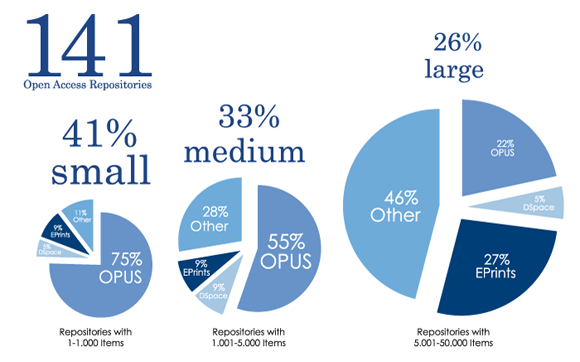
Within the context of the above definition, 141 active open access repositories are operational in Germany to date.

Size ranges of and software used for open access repositories in Germany (Source: Vierkant/D-Lib Magazine)

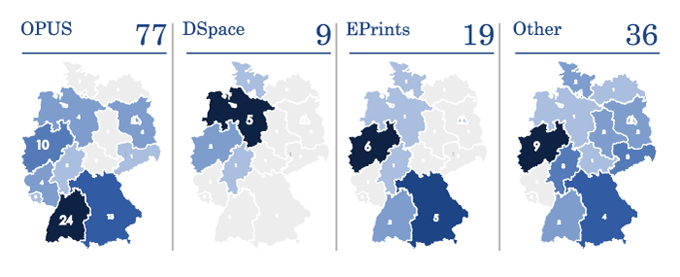
In total, over 704,121 items are accessible through open access. The majority (57) of individual repositories contain ≤ 1,000 items. Nordrhein-Westfalen (the most populated Bundesland) hosts 27 repositories, followed by Baden-WĂĽrttemberg (28) and Bayern (22).

The top five largest open access repositories are 1) elib Publikationen des DLR (46,136 items), 2) EconStor (45,268 items), 3) German Medical Science (41,753 items), PUP – Universität Bielefeld (32,695 items), 5) ePIC – AWI (29,480 items).

It is interesting to see that one third of Germany’s open access repositories avail of hosting services: the smaller the repository, the more likely it is that they are hosted off site.

Value-added services
German repositories offer the following basic services, but they are not collectively present in all instances. Bibliographic export is offered by 56%; usage statistics is offered by 24%; checksum provision is offered by 36%; RSS feed services is offered by 48%; Social bookmarking services are offered by 45%; Social bookmarking (such as Facebook, Twitter or AddThis button) is offered by 11%.

The reasons given why German repositories (don’t) offer value-added services are speculative in the report.

Repository software and metadata formats
Germany is considered to be “OPUS-country”: 77 out of 141 repositories use OPUS (open source).

National distribution of repository software in Germany (Source: Vierkant/D-Lib Magazine)

Only 9 repositories run DSpace, which is the biggest open source software platform for repository services. Simple Dublin Core is supported by 99% of all repository instances.

The full results of the survey can be accessed here.

As an aside, UKSG will be running a 45-minute webinar on 20th November: Managing Open Access in the Library (it offers a thorough introduction to open access and explains how open access advocacy and other related procedures can be integrated into libraries).