Showing posts with label literacy. Show all posts

18 Jun 2026

Literacy for the future: Review of the LIR Annual Seminar 2026

This guest post is by Cathal Madigan, Library Assistant at TU Dublin.

On Wednesday May 13th, 2026, I had the privilege to attend the LIR Annual Seminar 2026. Hosted in the ASIERA Offices in Dublin and recorded over MS Teams, the Seminar had a theme of “Supporting Emerging Literacies,” and asked the question of how libraries design and deliver new literacy programmes. The presentations had a shared idea of literacy, with each presenter showcasing how libraries could hope to use these programmes to bolster services and assist clients.

LIR Group logo of a swan with its wings shaped like an opening book
LIR Group logo, from LIR Group website

The Seminar opened with a keynote from Dr Andrew Cox, Senior Lecturer at the School of Information, Journalism and Communication, University of Sheffield. Focusing on the emerging use cases of AI and how librarians could integrate it, Dr Cox provided an examination of the potential costs and benefits of AI integration in libraries, exploring the importance of knowing how best to safely integrate it into library structures and be aware of how students are using it in their daily activities.

Ann Byrne, Digital Librarian for Hibernia College, spoke about “digital literacy for all” and reflected on the process of creating a course in digital literacy for Hibernia College, a process that began in 2023 in the aftermath of COVID-19 as staff realised that students had no real instructions for how to use digital literacy. This made it a good choice for an open course system as it is a universal need. The pilot programme launched in 2023 and was deemed a success as part of UNESCO's Global Media and Information Literacy Week and Be Media Smart campaign from Media Literacy Ireland. The success prompted a second phase in 2025, which added new lessons and incorporated feedback like a dedicated module on AI.

A office building on Dublin’s North Wall Quay reflected in the water on a bright, sunny day” purely decorative image
ASIERA Offices, North Wall Quay, Dublin 1, where the event was hosted, from archdaily.com
Ronan Madden, Learning & Teaching Team Lead at UCC Library, discussed the new Digital and Information Literacy Framework that UCC had begun developing. A new team, the Framework provides tailored classes on request with a focus on increasing awareness of the different forms of literacy across the university, such as information, digital, media and AI literacy. Ronan outlined how the Framework had been developed and used by students and faculty at UCC, how students assisted with peer review, and how it is intended as a living document that is always innovating and expanding.

Siobhán Dunne,Teaching, Research Support and User Experience, TCD, spoke about the concept of Sustainability Literacy (i.e. the knowledge of the relationship/conflicts between humanity and the environment), discussing the Sustainability Action Plan that Trinity had launched in February 2026 after a survey for students requested sustainability awareness. One of the major components of the plan was that Sustainability Literacy would provide a new opportunity to position the library as a trusted information resource for students and staff. As an example of this, Siobhán shared how part of the Action Plan involved creating a space where students could learn about AI and its impact on the climate, and share their concerns.

An informational graph with a cheese-wheel graphic on the left discussing a library’s Sustainability Action Plan for the year of 2026
A still from Siobhan Dunne’s presentation showing TCD’s Sustainability Action Plan for 2026

Patrick Keegan, Learning Specialist Librarian at RCSI, discussed a pilot workshop for postgraduate learners which included AI Literacy, or learning when would be an appropriate time to use AI. The concept of "cognitive offloading" was discussed (i.e. how the brain can only process so much information so steps must be taken to know ways to offload). Patrick emphasised how important it was to train graduates to be ready to avoid detrimental offloading when in the workplace, and that being able to retain cognitive prowess when working with patients is a key skill. The workshop he worked on provided three examples of issues healthcare students may face as AI usage becomes more commonplace; how to critically evaluate suggestions from AI, how it can disrupt learning journeys, and how to explain the choices one makes in their day-to-day operations. Patrick ended with the key takeaways from the workshop and suggested a “human in the loop” style of AI oversight where suggestions made by AI are always run by a skilled professional first before being implemented.

Dr Simone Fühles-Ubach, Library and Information Science at TH Köln, and Professor Elisabeth Kaliva, Computer Scientist and Educational Researcher at TH Köln, opened the final stage of the Seminar with a shared presentation on a research project they had been undertaking since 2020, based on the “Data Literacy” research project at TH Köln. They presented the progress and research findings of their project, focusing on the contribution and collaboration of academic libraries and the impact this had on students. The Data Literacy Initiative (DALI) at TH Köln has become a centralised shared working space for students and staff, creating an infrastructure to advise students on data literacy and usage of it while researching.

Ben Lee from Shared Intelligence, speaking about future literacy at the LIR Seminar 2026

The final speaker of the day was Ben Lee, director of think-tank consultant group Shared Intelligence. His event was named “Come Rain or Shine: futures literacy for libraries, and the role of libraries in building futures literacy among their users and communities.” Ben discussed how a report was made in 2023 to discuss the challenges facing public libraries in the United Kingdom and how to increase awareness and usage in local communities. The report suggested finding new ways to reverse declining attendance rates in libraries, and to beware the retirement cliff. Ben spoke of Futures Literacy, i.e. the concept of using the ideas of the future to inform the actions of the present. This led into a group exercise where Ben asked those in attendance to combine two uncertain future concepts on a graph to create different versions of the future, showing the different paths an uncertain future can generate, before the Seminar concluded.

The LIR Seminar proved to be a stimulating day. I was pleased to get to attend and found the experience very enlightening. The overall questions raised in the introduction of the Seminar of how libraries design and deliver new literacy programmes was appropriately answered and elaborated on. Each of the different representatives discussed how their own libraries oversaw new programmes to increase awareness of digital literacy among their clientele, providing a wide variety of alternate perspectives that showed how each of the guest speakers came to their conclusions. This allowed for improvements in their offered services and allowed for each facility to be more adept at handling queries asked by the modern library customer. 

2 Mar 2026

Call for papers: LIR Annual Seminar 2026, 13 May, Asiera offices, Dublin 1

The LIR Annual Seminar 2026 theme is Supporting Emerging Literacies: How do libraries design and deliver new literacy programmes? 

LIR invites submissions for lightning talks which address:

AI Literacy, including: critical AI literacy; AI in the research workflow; prompting as a literacy

Environmental / Sustainability Literacy, including: critical environmental literacy, climate misinformation and campus partnerships for impact.

Emerging Literacies and Cross‑Cutting Themes, including: futures literacy labs, data literacy, designing future‑ready services, programme design, ethics across literacies, misinformation & critical evaluation, equity & inclusion.

Papers that may not match the above but relate to the overall theme are equally welcome.

300 word abstract for a 10 minute lightning talk (including Q&A) can be submitted for consideration to:


Include with subject title: LIR Annual Seminar 2026. 

Please also include your name, title and affiliation.

The closing date for abstract submission is Midnight (GMT), Tuesday, March 31st. The seminar will take place in person at the Asiera offices, Dublin 1, on 13th May 2026.

7 Nov 2023

Unlocking Voices: DCU Library Creative Writing Competition and the Mountjoy Education Centre

This blog post by Grace O'Connor from Dublin City University was highly commended in the CONUL Training and Development Library Assistant Blog Awards 2023.

Since 1999, DCU Library has hosted an annual Creative Writing Competition for participants of adult reading and writing schemes in North Dublin. It aims to reward those who have returned to education to improve their reading and writing skills. Each year we receive entries from more than 12 literacy groups in North Dublin.

Library staff volunteer to participate in the judging and organisation of the competition, and an awards night for all writers and their friends and family is held each year. There is one overall winner announced by a guest judge, and 10 commendations given.

The competition has a real impact on winners, some of whom decided to pursue writing as a full-time career, or complete their Junior Certificate English exam.

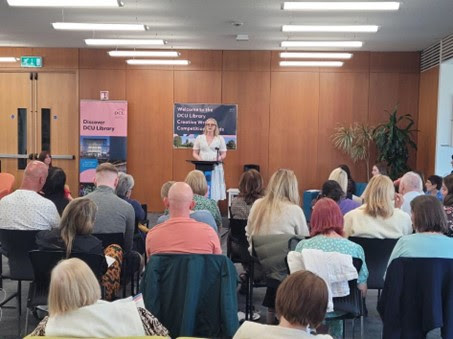
Guest Judge Sophie White addresses attendees at the 2023 DCU Library Creative Writing Competition Awards Night in O’ Reilly Library Pic: Eilís O’ Neill

Involving Mountjoy Education Centre

In 2023, we once again emailed all eligible writing groups seeking submissions for this year’s competition. For the first time in the competition’s 24 year history, tutors from Mountjoy Prison Service got in touch to submit entries from members of the City of Dublin ETB Mountjoy group.

The aim of the CDETB service [in Mountjoy] is to help prisoners cope with their sentences and prepare them for release, and particularly to offer them the opportunity to discover and develop new potential within themselves.

“Everyone has a story to tell, and it’s [on] that basis that I run the creative writing classes” says Margaret Hannigan, an English teacher in the Mountjoy education centre. Margaret has taught here for 24 years and is always looking for different competitions and writing festivals for her students to enter. It was through a new colleague, Christine Smith, that she heard about the DCU Library Creative Writing Competition.

Christine Smith has only worked with the Mountjoy Education Centre since October 2022, but prior to this had been a tutor Cabra Adult Education Service, where she tutored many previous entrants and winners of the competition. She was aware of the positive impact it had on her students and their confidence as writers, so she was keen to have her new students in Mountjoy participate.

Anonymous Judging for Fair Evaluation

Judges receive the stories anonymously, with all author and writing group details removed, so they can judge the entries on their own merits. However, entrants' names and details are recorded on entry forms, and any shortlisted writers are asked to attend the awards night to read their story. All stories along with the entrant’s full name are included in a booklet for attendees to take home.

Navigating GDPR and Confidentiality

In a phone discussion about the entries, Christine let us know that because of GDPR/confidentiality reasons, only the first names of the finalists should appear on the booklet, website and on social media. It wasn't difficult to accommodate that, but we had to be careful with aspects like the certificates all shortlisted entrants receive, which were photographed showing the surnames of the finalists. These were removed from the images before posting them on the website and on social media.

Mountjoy Education Centre tutor Clare O’ Connell accepting the Creative Writing Award from author Sophie White, on behalf of her student Dermot Pic: Kyran O’ Brien/DCU


We understood from the start that the finalists from Mountjoy Education Centre wouldn't be able to attend so Outreach librarian Eilís O’ Neill encouraged the tutors to invite their family and friends to register to attend, to represent them on the night. While Christine suggested playing pre-recorded readings, it was decided that live readings would create a more engaging experience for the audience. Thus, the CDETB Mountjoy tutors presented the finalists' entries on the awards night, and recordings of the writers reading their own pieces were made available on the library's website.

 Standout Entries and Performances

Julie, a library assistant who has been judging the competition since its inception, finds that the personal stories resonate deeply with her. She noted that the 2023 entries exhibited a raw quality, providing profound insights into the authors' experiences. Among the exceptional submissions, "Surprise" by Dermot emerged as the clear winner, captivating the judges with its compelling narrative. Library assistant and judge, Alana, praised this story for its ambition and execution. Alana also particularly enjoyed hearing the audio recordings of the authors from Mountjoy Education Centre reading their stories. She said of one (Hardcore by Eric) “...while I read this poem initially as a stand-alone piece of writing, I think this post- competition performance emphasises the art of language and how some stories sing once performed orally.”


The 10 runners up and winner of the Creative Writing Competition 2023. Runners-up from Mountjoy were represented on the night by their tutors. Pic: Kyran O’ Brien/DCU

Fostering Connections

The competition held special significance for Margaret, as one of her learners became a runner-up, receiving a certificate, book voucher and a DCU Library tote bag. Margaret expressed her delight at this achievement and eagerly looks forward to entering the competition again next year. Recognising the value of the creative writing classes at Mountjoy Education Centre, DCU Library seeks to foster a meaningful relationship with the institution. As a gesture of support and appreciation, the library has been invited to attend one of Margaret's creative writing classes in the near future.


Listen to the winning 2023 story via the Youtube link here: Surprise by Dermot


8 Jun 2021

An exploration of the effectiveness of the Accelerated Reading Programm

Blogpost by Sinead Kelleher, GradDip in Library and Information Studies, Graduating in the Summer of 2021

In an information rich society, it is evident that literacy skills and in particular, reading is an essential skill to have. The Department of Education in Ireland recognises this need and in 2019, provided a practice report to teachers, “Effective Interventions for Struggling Readers A Good Practice Guide for Teachers” (Department of Education and Skills, 2019), this report explored new forms of reading intervention methods. Different intervention methods using technology to improve reading skills (Valmont, 2003) are being used more often by teachers. One method the report suggested for struggling students to improve their reading was a web-based reading intervention program called Accelerated Reader (Department of Education and Skills, 2019). In 2019, two hundred schools in Ireland were using this Accelerated Reading programme, (Department of Education and Skills, 2019). This literary review will explore the literature surrounding the Accelerated Reading programme and in particular how Accelerated Reading effects a student’s reading in terms of quality, quantity and the effectiveness of the programme in improving reading standards. This review will also explore how the implementation of the Accelerated Reading Program in schools has an effect on the results of the Accelerated Reading programme. Within this paper the term Accelerated Reading/Reader will be abbreviated to AR for the sake of ease of reading.

How the Accelerated Reading Programme Works

The Accelerated Reading programme was developed by Renaissance Learning as a reading tool to assess, analyse and develop a student’s reading and is done in the following way. The student reading level is assessed through their STAR reading level test. The results are automatically fed back to the teacher, who then allocates a target level of points for the student to read. Students then read a book within their reader level bandwidth and do an AR comprehension test based on the book they have read. Books are levelled using the ATOS reading formula. Students earn points in the test based on how many questions they answered correctly with an aim to reach their points target assigned by their teacher (Cuddeback et al. 2002). Literature such as Cuddeback et al. (2002) suggests that AR could be used as a tool to measure a student’s reading by using this three-pronged approach of measuring the quantity of the number of books read by the students the quality of the reading tested through the AR comprehension test and the reading challenge by progressing through the reading level bandwidths.

Quantity of Reading

The literature that supports the Accelerated Reading programme indicates that the more you read, the better a reader you become and that students who are not such good readers will avoid reading, (Topping et al. 1999). In this sense the Articulated Reading programme gives the student the opportunity to read more (Topping et al. 1999; Krashen, 2003; Moyer et al., 2011). Research papers including Cuddeback et al. (2002) supports the premise that AR gives its user’s a gentle nudge into reading although it does concede that their research mainly focused on reluctant readers. Studies such as (Topping et al. 1999; Cuddeback et al. 2002) show that the AR system allows teachers to measure the number of the books students have read and in this way, teachers can use the AR system as a tool to monitor students reading levels and therefore identify students who are at risk readers.

Quality of Reading in terms of Comprehension and Challenge

As well as monitoring the reading levels of students the AR system is promoted as a tool to monitor the quality of the participants reading levels (Topping et al. 1999). The literature within this review found varying different results from different studies on this. The findings in (Foster et al., 2014; Shannon et al., 2015) supports the premise that the AR program is an effective tool to analyse the quality of the participants reading comprehension. Foster’s findings were based on an evaluation of an American school in the Caribbean. His results showed that if a student does not do any additional AR reading that their reading level will fall behind, in addition research in this paper showed that the Accelerated Reading program’s use of reading levels was a valuable tool in designing personal reading goals for students, which contributed to the quality of their reading achievements.

Other studies in the United Kingdom such as Gorard et al. (2015) evaluated the AR reading system involving a randomised control test of 349 participants in 4 schools, the participants did a 22-week programme of AR and reports indicated an increase in the level of reading comprehension, with a particular increase with children from disadvantaged communities.

Most educators and advocates of reading will agree that the quality of reading will improve by challenging a reader, it is not enough to read the same type of books at the same level, even students at a high reading level will benefit from reading at and above their level, this method is promoted through the AR program in testing and reading at appropriate reading bandwidths (Topping et al. 1999). This supports the scaffolding model of education, a model which is used in most school environments, and is used in primary schools in Ireland. In this sense the AR system is the scaffolding model which supports the students reading, the zone of proximity, which is when an educator or peer exacts the correct level of knowledge Zygotsky (1963), or in this case the reading level of the student in order to challenge the student by reading to the next level, not reading below or too far ahead in reading levels. The student will progress under the guidance of the teacher by following the feedback from the AR testing system. In this sense the literature in the review examines the Accelerated Reader as an evaluation tool to determine reading levels. Nunnery et al. (2006) reports the positive effects AR has on the reading achievements of at-risk students and children with learning disabilities. Literature such as Johnson et al. (2003) showed that there was an increase in reading achievement and vocabulary development in a group of students from a low socio-economic background.

Although literature such as Biggers (2001) argues that the AR programme only assessed a lower more literal level of comprehension ignoring a higher level of reading comprehension which would generally include a more critical or analytical comprehension of the book. Literature such as Cuddeback et al. (2002) argues that educators should not put the importance of higher comprehension over lower level comprehension. Literal comprehension can sometimes be undervalued. Cuddeback et al. (2002) suggests that higher order comprehension can be sometimes a result of a student’s background and in this sense the AR program reduces the bias in testing all students at a more literal level. Literature such as Cuddeback et al. (2002) supports the use of the Accelerated Reading Program with the added measures of other teaching directives that promote a lower and higher level of reading comprehension.

Accelerated Reading Program and Incentives

An integral part of the AR programme is its reward system to encourage reading. Cuddeback et al. (2002) points out that literature such as Cameron et al. (1994) shows that motivators when properly administered will have a positive effect and actually encourage intrinsic motivation. However, Biggers (2001) argues that the AR system favours the more competitive child and questions whether reading levels will drop when the rewards stops. Edmunds, et al. (2003) shows that when reading motivation decreases, reading decreases, however, although there wasn’t a decrease in motivation when students were given non- reading incentives to read, incentives alone have not had a positive impact on children’s reading motivation. Other motivators such as a teacher reading aloud and allowing students to talk about what they are reading can be used as powerful motivators in reading for students. Literature such as (Chenowith 2001) also discusses this challenge with the Accelerated Reader programme that although students who participate initially do read more books than the non-participants of the AR system, in her study the reading slowed down or even stopped when the program finished. Further studies such as Belland et al. (2013) suggests that a combined effort of computational scaffolding such as with AR with teacher support can benefit the student. Other literature sources such as Pavonetti et al. (2002) discusses how the AR system does not promote long-term reading using points and testing strategies. This variation in findings suggest a gap in the literature indicating that further research is needed into the longevity of the effects of the Accelerated Reading program on a student’s reading habits.

An obvious incentive to foster a student’s reading development is to provide material that they are interested in reading. Students surveyed in a study, (Thompson et al. 2008) described how within the AR reading lists there was a lack of supply of multicultural books or of books with a high readability level. Biggers (2001) suggests that the AR publisher does not take into account the reader’s interests when compiling reader’s list to correspond with the star test results. The students surveyed in Huang (2012) suggested that the biggest negative experience associated with the AR programme was the lack of the selection of reading material. As the school in question purchased the economy package from the publisher the reading selection was curtailed and therefore student choices were limited. Research such as Huang (2012) cited that the economy package restricted the reading material to authors from big publishing companies and newer or books from smaller less-known publishers/authors were not made available to them. Pavonetti et al. (2002) discussed also the economic limitations of the Accelerated Reading Program, in that it is an expensive package, the school just pays for the program and that the price does not include any books. Krashen (2013) suggests that instead of spending money on expensive reading software that the money would be better spent on providing more reading material and a reading environment.

Implementation of the Accelerated Reading System

Literature has shown that the incorrect implementation of the AR Programme can have detrimental effects on the results of the tool, Foster et al. (2014) has pointed out that students who read a lot and did well on the reading tests did better than those who didn’t get the correct guidance from their teacher, thus showing that teacher’s need to pay attention to best practice when using the AR system. Nunnery et al. (2006) also found that children with learning difficulties achievements had higher reading gains when the AR system was implemented well in comparison to a group where the AR system wasn’t implemented well. Waters (2016) also explores the importance of the correct implementation of the AR system and cites the lack of guidance from Renaissance learning in using the system for the teacher and suggests more input in training from them as a factor to resolve this. Moyer et al. (2011) showed in that with the teacher’s participation a more customised approach to the Accelerated Reader program increases the reading results for the students. Waters (2016) discusses the importance of involving parents within the AR system, suggesting that the school could have parent evenings in which the students could discuss the various reports from the books they read. This would become another motivator for the student, extending the incentive aspect of the Accelerated Reader program.

Literature such as Gorard et. al (2017) in looking at methods to support the correct implementation of AR found that many children in the UK were leaving primary school with low levels of literacy skills and although they were offered the support of the AR system within secondary schools, AR coupled with the new challenges of starting in secondary school proved to be too much an adjustment. These findings show that the AR system is more appropriately suited to primary school levels although more research in this area is needed.

Gorard et al. (2015) also focuses on the value of a good implementation of the AR system, for an AR system to operate effectively it’s important to have a well-stocked library, a wide collection of books of varying interest including fiction and non-fiction banded accordingly and easy access to computers with internet connection. Critics of AR such as Biggers (2001) have also noted that in school libraries where the books have been divided into AR reading books and regular reading sections students have been denied access to those reading sections.

Conclusion

In conclusion although the literature review shows that the Accelerated Reader programme has an effect on student’s who are in the at-risk reading group, it does also highlight limitations of the Accelerated Reading programme.

Most of the studies of the AR programmes are conducted with at risk readers, therefore studies on the effects of the Accelerated Reading programme on a more generalised normative student population would need to be done. Most of the literature’s findings are based on studies in American elementary and middle schools there is very little peer-reviewed literature based on studies in Irish schools. More research would be needed on this within the Irish school system to evaluate properly the programme within Ireland. Further research into a comparative studies of other reading intervention assessments such as the Lexile framework which has shown some positive results, Archer (2010), would be a useful study. Also, more studies on the long-term effects of the Accelerated Reader programme are needed to establish whether it is a tool with long term reading benefits. Finally, there is a limited number of peer-reviewed published papers available on this subject so further studies on the gaps in the literature on AR as shown in this literary review is essential to provide a more thorough evaluation of the effectiveness of the Accelerated Reading programme.

References

Archer, L.E. (2010). Lexile reading growth as a function of starting level in at-risk middle school students. Journal of Adolescent & Adult Literacy, 54 (4), 281-290.

Belland, B.R., Kim, C., & Hannafin, M.J. (2013). A framework for designing scaffolds that improve motivation and cognition. Educational Psychologist, 48 (4) 243-270.

Biggers, D. (2001). The argument against accelerated reader. Journal of Adolescent & Adult Literacy, 45(1), 72-75.

Cameron, J., & Pierce, W. (1994). Reinforcement, Reward, and Intrinsic Motivation: A Meta-Analysis. Review of Educational Research, 64(3), 363-423. Retrieved November 10, 2020, from http://www.jstor.org/stable/1170677.

Chenoweth, K. (2001). Keeping score. School Library Journal, 47, 48-52.

Cherry, K. (2020). The Zone of Proximal Development as Defined by Vgotsky. Very Well Mind. Retrieved from https://www.verywellmind.com/what-is-the-zone-of-proximal-development-2796034.

Cuddeback, M. J., & Ceprano, M. A. (2002). The use of accelerated reader with emergent readers. Reading Improvement, 39(2), 89.

Department of Education and Skills - National Educational Psychological Services, Ireland (2019). Effective Interventions for Struggling Readers A Good Practice Guide for Teachers. Dublin: Department of Education and skills.

Edmunds, K. M., & Tancock, S. M. (2003). Incentives: The effects on the reading motivation of fourth-grade students. Reading Research and Instruction, 42(2), 17-37.

Foster, D. K., & Foster, D. P. (2014). Estimating reading growth attributable to accelerated reader at one American school in the Caribbean. Reading Psychology, 35(6), 529-547. doi:10.1080/02702711.2013.789764.

Gorard, S. Siddiqui, N and Huat See, B (2015). Accelerated Reader, Evaluation Report and Executive Summary. Durham University, Education Endowment Foundation.

Gorard, S., Siddiqui, N., & Huat, S.B.  (2017). What works and what fails? Evidence from seven popular literacy ‘catch-up’ schemes for the transition to secondary school in England. Research Papers in Education, 32:5, 626-648, doi: 10.1080/02671522.2016.1225811.

Huang, S., PhD. (2012). A mixed method study of the effectiveness of the accelerated reader program on middle school students' reading achievement and motivation. Reading Horizons, 51(3), 229-246.

Johnson, R. A., & Howard, C. A. (2003). The effects of the accelerated reader program on the reading comprehension of pupils in grades three, four, and five. The Reading Matrix, 3(3).

Krashen, S., The Lack of Experimental Evidence Supporting the Use of Accelerated Reader. Journal of Children's Literature 29(2), 16-30.

Moyer, M., & Williams, M. (2011). Personal programming: Customizing accelerated reader helps delsea regional high school encourage student reading. Knowledge Quest, 39(4), 68-73.

Nunnery, J. A., Ross, S. M., & McDonald, A. (2006). A randomized experimental evaluation of the impact of accelerated Reader/Reading renaissance implementation on reading achievement in grades 3 to 6. Journal of Education for Students Placed at Risk, 11(1), 1-18. doi:10.1207/s15327671espr1101_1.

Pavonetti, L. M., Brimmer, K. M., & Cipielewski, J. F. (2002). Accelerated reader: What are the lasting effects on the reading habits of middle school students exposed to accelerated reader in elementary grades? Journal of Adolescent & Adult Literacy, 46(4), 300-311.

Shannon, L. C., Styers, M. K., Wilkerson, S. B., & Peery, E. (2015). Computer-assisted learning in elementary reading: A randomized control trial. Computers in the Schools, 32(1), 20-34. doi:10.1080/07380569.2014.969159

Thompson, G., Madhuri, M., & Taylor, D. (2008). How the accelerated reader program can become counterproductive for high school students. Journal of Adolescent & Adult Literacy, 51(7), 550-560. doi:10.1598/JAAL.51.7.3.

Topping, K. J., Terry, P.D. (1999). Computer-assisted assessment of practice at reading: A large scale survey using accelerated reader data. Reading & Writing Quarterly, 15(3), 213-231. doi:10.1080/105735699278198.

Valmont, W. (2003). Technology for Literacy Teaching and Learning. Houghton Mifflin.

Waters, T. K. (2016). Improving reading: A case study of the accelerated reader program. (2016) (Unpublished doctoral dissertation). Gardner-Webb University School of Education, North Carolina.

Posted on Tuesday, June 08, 2021 | Categories:

6 Apr 2017

Invisible librarians have contributed to the post-truth era: a debate

Below is a verbatim account of one side of a debate which proposed that 'This house believes that invisible librarians have contributed to the post-truth era'.

Ladies and Gentlemen, fellow debater, moderator and distinguished guests I am here to convince the house that invisible librarians have contributed to the post-truth era.

When it comes to invisible librarians, I can literally say ‘I wrote the book’ which is on sale tonight at a bargain price, come and talk to me later – sales pitch over!

I feel I need to clear up a few concepts here.  Invisible meaning ‘not seen’.  Post-truth era meaning circumstances in which objective facts are less influential in shaping public opinion than appeals to emotion and personal belief.  The president of Harvard University Drew Faust described it just last month as an era when “evidence, critical thinking, and analysis are pushed aside in favour of emotion and intuition as bases for action and judgment”.  Much talk of fake news has amplified the fear around a post-truth era. We are living in unprecedented times where there have been significant social and political upsets, in the USA a president was elected with no previous political experience or political position.  He is, in the words of Noam Chomsky “a showman”.  In the UK the people voted to leave the European Union.

Both upsets are linked to fake news, where the ultimate headline ‘We send the EU £350m-a-week let’s fund our NHS instead, vote leave’ was everywhere and was believed to be true.  Such headlines gave people hope and people vote for hope.  Some people and some politicians are opportunists and they have always lied and will continue to lie.  Post-truth, misinformation, disinformation and propaganda have fuelled many political campaigns, however the difference today is that the Digital Age we are living in has allowed the news and the story to be amplified.  Fake news is churned out as fast as it is retracted, but nobody reads the retractions.  One exception to this is a French newspaper, Le Canard Enchaine, whose editor refuses to make the paper digitally accessible.

The editor argued that when the Internet came along other newspapers made content available online and pushed out alternative facts only to retract them later.  They found that it was the only way to keep sales figures up, by selling fake news.  Le Canard continues to be only available in print. This is in a country which values freedom, equality and democracy.  A country which brought us the Declaration of the Rights of Man and Citizen of 1789, a fundamental document in the history of human and civil rights with a major impact on freedom and democracy.

Last year at a health conference I heard a professor of organisational behaviour and a leadership thinker (Gianpiero Petriglieri) state the following: “Whoever controls the story, controls the people”. If we take democracy to be an acceptable and equitable way that people have a say in how they are controlled, by casting their vote and by electing a government to represent them, then what we all need to ask is “who is controlling the story?"

The story is largely controlled by the press, the media, journalists.  Who controls them?  Big business and government.  According to Forbes 15 billionaires own American's news media companies.  According to the EU Commission, Ireland is exposed to a "high risk" over its concentration of media ownership.

Professions in academia and in the press are exercised about the post-truth era.  Why?  Because it is touches our values.  What has any of this got to do with librarians?  We share values with scholarship and the press – the value of intellectual honesty – in other words - truthfulness and we have a social responsibility to uphold our values. 

“We are living in a time of universal defeat when telling the truth is a revolutionary act” (G. Orwell).  Librarians have largely been invisible and apart from the fact that it is leading to the demise of the profession, it is also leading to the distortion of the truth.  The truth is something that cuts to the core of our profession. Veritas is our raison d’être. Librarians are defenders of intellectual freedom, of rational decision making and of democratic values.  We are defenders of the truth. If we remain invisible, and if we remain neutral, arguably so will the truth.

We are invisible in the following ways: by remaining neutral, through staffless libraries, by having low social media presence and by continuing to market the ‘library’ over the ‘librarian’.

WE NEED TO TALK ABOUT… NEUTRALITY. There is nothing neutral about librarianship, as Wendy Newman a Senior Fellow at the University of Toronto has said ‘Librarians are anchored in values’ and our values are democratic, not neutral. She says librarians are rooted in timeless values. I agree with David Lankes, Director of the School of Library and Information Science at University of South Carolina when he says "Good librarians aren't neutral: they are principled".  The underlying principles of both journalism and librarianship are to be truthful.  According to the IFLA Code of Ethics, we have a social responsibility to society and to individuals to assist people in finding information, factual information, peer-reviewed research.

WE NEED TO TALK ABOUT… SOCIAL MEDIA. Many Librarians in Ireland are invisible on social media. I can count on one hand how many health librarians are on Twitter. My esteemed colleague and immediate past president of the LAI is equally invisible on Twitter. I found a Philip Cohen intern but I don’t think that was you. There is no excuse left in the book for librarians to remain invisible on Twitter, believe me I have heard them all.

WE NEED TO TALK ABOUT… STAFFLESS LIBRARIES. Let’s be clear that a library without any visible staff is a reading room. Equally a digital library without any visible librarians is just a gateway. The link is not being made in the general public or among the majority of library users/non-users about what it is that librarians do and the library – be it physical or digital. Our skills are largely un-communicated, misunderstood and invisible. We need new service models where the visibility of staff and staff skills are clear for all to see and to understand. It is not just our skills but our values and we need a revolutionary act to start communicating what these are.

WE NEED TO TALK ABOUT... MARKETING. Why we continue to market the library over the librarian is beyond me.  Certainly in the case of public libraries I can see a rationale, but not for other types of libraries. Yes I’m talking about academic libraries, yes I’m talking about special libraries, yes I’m talking about health libraries. The shift in emphasis needs to move from ‘library’ to ‘librarian’ otherwise our profession and the values that we hold high will remain invisible. We need to guide people to the truth through education and empowerment. Information literacy is one of our core skills, we need to start telling people this is what we are about. The ALA defines IL as “The ability to recognize when information is needed and have the ability to locate, evaluate, and use effectively the needed information." This is where we add value, this is part of our social responsibility, this is most likely one of the reasons we became librarians in the first place. If people don’t know about what it is that we do, if they can’t see it, they won’t value it. And we want people to value the truth don’t we? And we want people to value librarians, don’t we? 

Michael Moore who brought us the film ‘Fahrenheit 9/11’ said ‘I didn’t realize librarians were, you know, such a dangerous group. They are subversive.  You think they’re just sitting there at the desk, all quiet and everything.  They’re like plotting the revolution, man”.

Our revolution is to hold our values high, to take part in revolutionary acts, in this time of deceit and to rebel against untruths and most important of all, to be visible. 

CLOSING ARGUMENT
We need to market our skills, talk about our value, become highly visible and defend the truth.  We must empower people with the skills to critically appraise information and give them the confidence not to believe everything that they read.

We have heard about grey areas, but the truth is not grey.  It can be ugly and it can be beautiful, but it is never grey.  The truth illuminates, the truth is worth defending and upholding.  As librarians we have a unique position in society to speak the truth, to uphold the truth, to defend the truth and ultimately to control the story.


18 Apr 2016

LILAC 2016

Guest post by Colin O'Keeffe

Ireland hosts the annual LILAC Conference every few years, 2016 is one of those years, and this year’s conference was held from 21st-23rd March at UCD’s O’Brien Centre for Science. Although hosting the conference in Ireland increases accessibility for Irish librarians it also diminishes the chance to secure funding to attend the full three days of events, a more likely scenario when travel to the UK is involved. That situation applied to me, I secured (a not unsubstantial) amount of funding to attend as a day delegate on Tuesday, 22nd March. This was to be my first LILAC, and as an Information Literacy Librarian, this conference was of particular interest to me. I booked in advance in order to avail of the marginally discounted early-bird rate but more importantly to secure a place in the parallel sessions that I wanted to attend. These sessions constitute the majority of LILAC’s programme of events and certain sessions are very popular, therefore it pays to study the full programme before booking to ensure a place.

From others’ descriptions I knew that the primary distinction between LILAC and the numerous other conferences that I have attended over the years would be the scale of the former. This year’s LILAC remained true to form, consisting of 93 separate events including three keynote addresses. Here are the sessions that I attended and my impression of them.

Keynote Address: Char Booth
The keynote address for day two was delivered by the current Library Associate Dean at California State University San Marcos, Char Booth. She has, to date written several books relating to library accessibility and reflective teaching, with the latter topic being the primary subject of her keynote, titled ‘Why Reflect? The Holistic Process of Stepping Back’. Char’s talk was engaging and well delivered, initially exploring the theory behind self-reflection, before describing initiatives that she has undertaken in order to assess and challenge both her own and subsequently her team’s teaching practices. The presentation then changed focus to examine the concept of ‘information privilege’, apparently many students are unaware that the access to information that they take for granted at university will cease on graduation. Additionally, students are unaware of the monetary cost of information. Char lauded the ever expanding open web and outlined how a group of her students edited a Wikipedia page for assessment purposes. Overall, Char’s enthusiasm, delivery, content and very polished slides made this particular keynote a very enjoyable experience. Slide are available here.

Parallel Session 1: Antony Groves
The first parallel session that I attended took the form of a workshop. It introduced and demonstrated Vine, a video sharing service that allows users record and share six second looped videos, created via a smartphone app. At the University of Sussex Library this has been utilised to show the physical location of the library, promote library training sessions and demonstrating of database filtering. Though easy to use, six seconds is a very limited amount of time to teach anything, though adequate time to advertise or highlight something to viewers. My group easily created and uploaded a Vine via smartphone; this service could easily be deployed on a library website, e-learning platform or display screen, though the looped nature of the video would require a full suite of Vines to ensure that content remains fresh to viewers. See Antony's vines here.

Parallel Session 2: Kimberly Mullins
The next session was a presentation on a new librarian/faculty partnership approach to integrate IL into academic courses; this is viewed as the most effective way to make IL relevant to students, which can sometimes prove challenging. Kimberly introduced IDEA (Interview, design, embed and assess) as a framework to integrate IL into academic courses. Librarian/faculty collaboration is considered the ‘Holy Grail’ in relation to IL delivery and IDEA ensures that IL outcomes and course outcomes are one in the same. IDEA is something I would definitely consider if I had faculty buy in. See Kimberly's presentation here.

Parallel Session 3: Fiona Mogg
I then attended a talk that outlined a project that saw Cardiff University Library, via school partnerships, provide critical thinking and digital literacy support to Welsh school students. The talk covered two initiatives undertaken by the library. The first was a MOOC, this was offered to level 3 students preparing for university in Wales, with the library providing a supporting role. The second initiative was a library/school partnership with a group of schools who are preparing students for the Welsh Baccalaureate. The library was tasked with providing support for both digital literacy and critical thinking. The projects seemed like very worthwhile initiatives that could be replicated in Ireland. Full presentation here.

Parallel Session 4: Philip Russell, Claire McGuinness, Jane Burns and Emer O'Brien
Next was a progress report on what librarians are doing, via the Task Force on Information Literacy (TFIL) to advance information and digital literacy in Ireland, especially in relation to lobbying government. The challenges that we face in Ireland in relation to promoting IL to government were outlined. The fact that references to libraries and information services were omitted from several recently released government digital literacy and ICT reports raised eyebrows. TIFL’s response and future plans were outlined. It seems that IL is still not on the radar of Irish government and will continue to play ‘poor cousin’ when compared to ICT and digital literacy/skills. The challenge continues. Access the full presentation via slidehare.

Parallel Session 5: Rachel Posaner and Emma Green
The final session described a distance learning project, undertaken via Moodle, to provide IL support to a large group of NHS students. In this initiative, four librarians utilised lots of tools to provide support to 1,500 students including online reading lists online forums for discussions and screen sharing technology. This one I felt was useful as the college where I work provides a library service to a group of Malaysian students, so online and distance support is the only feasible option for this cohort. We are about to re-launch our website using Libguides over the summer and already have online reading lists, so what the four librarians have been able to achieve in relation to IL support is feasible for this solo IL librarian. Full presentation available here.

Though I’ve attended many library conferences over the years, I’ve never been to one with the scale of LILAC. The amount of session choices, though fantastic, is somewhat of a double edged sword, you get to choose what you know you’ll enjoy, but you know you’ll miss out on a lot of good sessions. I attended 5 sessions, the maximum amount, out of 31 run on that day, but there were others that I would have really enjoyed also. Overall, I thoroughly enjoyed my day at the conference; to get others’ musings on the full three days I consulted Twitter, and there, via conference storyboards the consensus seems to be overwhelmingly positive for LILAC 2016.

15 Jan 2016

Moving to online-only information literacy teaching

I’m the subject librarian supporting the DCU Business School and recently completed the move to online-only IL instruction to teach the library basics to first year undergraduates in their first semester. The Business School takes in nearly 1,000 UG students per year and it’s always been a headache planning instruction for all their different programmes. I was embedded in one of the larger modules and delivered this in a blend of lecture, workshop and online assessment (which my predecessor wrote about here). This rushed-but-effective approach taught 300-400 students and I used to catch the rest of them with a dozen or so workshops for smaller groups but there were always gaps as programmes and modules changed year by year.


So last semester, in collaboration with the School’s Teaching and Learning Committee, we identified the one core module that all first years take, Introduction to Microeconomics (EF113), and the lecturer agreed integrate the training with his module.


Here’s now it works:
  • In the early weeks of semester 1, all students do an asynchronous tutorial hosted on the EF113 Moodle page (here’s a public version of it). It’s a combination of video, text, activities and quizzes I created mainly using Articulate Storyline. This takes them about two hours to complete and it covers IL basics like understanding reading lists, academic publications, citing and referencing etc.
  • Next the students complete a microeconomics exercise on finding and manipulating data from sources like the Central Statistics Office and Revenue Commissioners.
  • And finally they do a summative MCQ on both of the above which accounts for 5% of their marks for the module. The students had two weeks to complete all of this.


Overall I was really pleased with the outcome, when compared with the large blended class I had previously taught:

Online - 2015
Blended – 2013
Total students
774
194
Total completed assessment
743
187
% completed assessment
96%
96%
Avg. mark
86.6%
72%

The training was popular with students. Here are a few of the comments from the 183 feedback forms completed:
  • “Very helpful overall, easy to understand, and very thorough. Will undoubtedly be an asset to me as I begin my assignments.”
  • “I had been struggling with an assignment for Psychology in Organisations, but now I have a better understanding of what sources to use, when to use them and how to reference them.”
  • “Really good, even though it takes a while the high levels of interactive content throughout made it go by quicker than I would have expected.”


There were a few issues with the technology on Moodle but nothing serious. Whenever there were any issues from students with the content or the tech I was able to respond by email or face-to-face in the Library and resolve it quickly. Other benefits for the students were that they could control of pace of learning, it was (and remains) open to them whenever they need it and they got immediate feedback on their learning from the quizzes and activities.

While I'm satisfied that running automated, online-only training works for first year UGs, I won't be using this approach much for other cohorts like final year students and postgraduates. Teaching here is more specialised and done in smaller groups so it's manageable to deliver it face-to-face and these groups, especially the School's executive education students, value the hands-on workshops in a way I've never really experienced with the first years (it's very hard to get Irish teenagers straight from secondary school to open up!).


I'll be running this again next year and I have a few improvements in mind:

  • More interactivity in the tutorial.
  • Working with the lecturer to find ways to integrate the IL elements more seamlessly with the module.  
  • Improving the assessment. While I’m largely happy using MCQs as an assessment tool, I find it’s not as effective with the more subjective elements of the curriculum like evaluating sources, which the students fell down on. I have enrolled in an online module on assessment & feedback taught by DCU’s Teaching Enhancement Unit and I hope to make this my project. I’m thinking of something like including a peer-evaluated exercise on a short piece of reflective writing. We’ll see.

13 Aug 2015

Reflections on online privacy


https://libraryfreedomproject.org/

Guest post by Tom Maher who works with The Forgotten Zine Archive , likes long walks on the beach and enjoys Italian food....


Alison Macrina - of The Library Freedom Project - and Eoin O'Dell - Associate Professor of Law, TCD - led a discussion last Thursday evening in the RIA on the topic of digital privacy. The event, organised by A&SL attracted a large number of information professionals, from a variety of backgrounds, all eager to hear how this recent social concern would affect the services they provide. Although Macrina and O'Dell delivered great insight and sound recommendations, those professionals in attendance quickly understood the burden of change that lay before them. It would be up to them to maintain the dignity and rights of their patrons in the years to come, and to maintain the trust that allows the library/patron relationship to flourish.

The discussion began with a simple enough question: "Why privacy?"

Why should anyone, librarian or not, care about who has access to their data? Sure, if you have nothing to hide why be concerned? The answers developed along three lines:

- One, awareness of privacy-related issues gives people who are already giving implied consent to their personal data being collected the power to either give informed consent instead, or take steps to avoid that collection in the first place.

- Two, the ways in which personal data is currently being collected and used often violates our human right to privacy.

- Three, to allow recent disclosures of mass surveillance and non-transparancy in government to go ignored and under-discussed would be to allow the culture that spawned these practices to metastasize into further civil liberty violations.

Addressed to those that still needed convincing were further tales of such violations which, although thrilling to hear about, ultimately set my mind thinking about the CBS sci-fi crime drama 'Person of Interest'. The show tracks the weekly exploits of a former CIA agent and presumed-dead billionaire surveillance developer who have both taken it upon themselves to save lives using the godly power of well-indexed metadata. The show's duo also, rather auspiciously, operate out of an abandoned library in midtown Manhattan. What could be more fitting! Well worth a watch.

Returning to the talk, we were granted comparison views of the state of privacy in Ireland, the UK, Europe and the US. Unsurprisingly, Ireland is relatively ill-equipped and inexperienced in this area - though still at the mercy of larger spy agencies whose activities know no borders. Although mouthpieces may vary, a common feature of Western government policies is the commission of infringement in the name of tackling boogeymen - most notably, and vaguely, those classified as terrorists or extremists. O'Dell and Macrina also stressed the importance of not falling for the fear-mongering rhetoric - actively blocking, reviewing and/or repealing legislation imposed on this basis through mechanisms in the justice system instead. Although courts such as FISA have proven to be inept when it matters most, they do provide valuable structural legitimacy to acts of resistance.

Law reform takes time, however, so a number of ways were recommended in which libraries could effect change and protect the interests of their patrons outside the courts in the short term. The first is a piece of legal theatre known as a warrant canary - a method by which your library can communicate that they have not been served with a subpoena for patron information, and which can be removed in the event of such a serving taking place in order to alert patrons without violating a potential gag order. They usually take the form of a simple sign. If nothing else, it will spark questions!

https://underground.net/warrant-canary/


Among the more practical recommendations Macrina made are the following (all free):

CCleaner for securely and permanently deleting sensitive (or not so sensitive) local files from a computer. Although the delete key and Recycle Bin seem to do the business on anything you aim them at, files deleted in this manner can still be retrieved using specialist software.

DuckDuckGo is a search engine alternative to Google that doesn't offer personalised search results and notably emphasises searcher privacy in its policies.

Mozilla Firefox is a browser very similar to your Internet Explorers and Chromes of the world, with one major difference - it is open-source. This means that its code is available for all to inspect and review, and this keeps Mozilla honest and transparent about the way they handle your data.

KeePassX (https://www.keepassx.org/) or LastPass for secure password generation - a vital element of any security routine.

Tor Browser, a piece of software which bounces your communication from node to node around the globe in such a fashion as to make it almost impossible for a third party to track your true location or identity - perhaps more applicable to libraries is how the Library Freedom Project have themselves have begun a pilot programme of setting Tor exit relays up in libraries.

Using a Tor Browser, however, can be a red flag for authorities and can result in you becoming a target of greater surveillance. Although one ought to possess the bravery to wave this concern, it is not always the sensible choice. Consider VPN services such as those recommended in this article:

Loaded up with food for thought (and nightmares of a dystopian surveillance state, no doubt), the librarians in attendance eventually dispersed and stumbled off into the night. Whether the warnings of O'Dell and Macrina will take hold is anyone's guess, but at least now a few dozen more people are aware of what small changes they can make to protect themselves, their patrons and the privacy of all of their data.

Further reading:

Assange, J. (2014). When Google met WikiLeaks.

Foerstel, H. N. (1991). Surveillance in the stacks: The FBI's library awareness program. New York: Greenwood Press.

Library Freedom Project Resources. Including further recommendations, teaching guides and a few other tidbits.

OpenCourseWare|MIT - Computer Systems Security. A free online course covering the basics and beyond of cyber security. Available at: http://ocw.mit.edu/courses/electrical-engineering-and-computer-science/6-858-computer-systems-security-fall-2014/