Showing posts with label conferences. Show all posts

18 Jun 2026

Literacy for the future: Review of the LIR Annual Seminar 2026

This guest post is by Cathal Madigan, Library Assistant at TU Dublin.

On Wednesday May 13th, 2026, I had the privilege to attend the LIR Annual Seminar 2026. Hosted in the ASIERA Offices in Dublin and recorded over MS Teams, the Seminar had a theme of “Supporting Emerging Literacies,” and asked the question of how libraries design and deliver new literacy programmes. The presentations had a shared idea of literacy, with each presenter showcasing how libraries could hope to use these programmes to bolster services and assist clients.

LIR Group logo of a swan with its wings shaped like an opening book
LIR Group logo, from LIR Group website

The Seminar opened with a keynote from Dr Andrew Cox, Senior Lecturer at the School of Information, Journalism and Communication, University of Sheffield. Focusing on the emerging use cases of AI and how librarians could integrate it, Dr Cox provided an examination of the potential costs and benefits of AI integration in libraries, exploring the importance of knowing how best to safely integrate it into library structures and be aware of how students are using it in their daily activities.

Ann Byrne, Digital Librarian for Hibernia College, spoke about “digital literacy for all” and reflected on the process of creating a course in digital literacy for Hibernia College, a process that began in 2023 in the aftermath of COVID-19 as staff realised that students had no real instructions for how to use digital literacy. This made it a good choice for an open course system as it is a universal need. The pilot programme launched in 2023 and was deemed a success as part of UNESCO's Global Media and Information Literacy Week and Be Media Smart campaign from Media Literacy Ireland. The success prompted a second phase in 2025, which added new lessons and incorporated feedback like a dedicated module on AI.

A office building on Dublin’s North Wall Quay reflected in the water on a bright, sunny day” purely decorative image
ASIERA Offices, North Wall Quay, Dublin 1, where the event was hosted, from archdaily.com
Ronan Madden, Learning & Teaching Team Lead at UCC Library, discussed the new Digital and Information Literacy Framework that UCC had begun developing. A new team, the Framework provides tailored classes on request with a focus on increasing awareness of the different forms of literacy across the university, such as information, digital, media and AI literacy. Ronan outlined how the Framework had been developed and used by students and faculty at UCC, how students assisted with peer review, and how it is intended as a living document that is always innovating and expanding.

Siobhán Dunne,Teaching, Research Support and User Experience, TCD, spoke about the concept of Sustainability Literacy (i.e. the knowledge of the relationship/conflicts between humanity and the environment), discussing the Sustainability Action Plan that Trinity had launched in February 2026 after a survey for students requested sustainability awareness. One of the major components of the plan was that Sustainability Literacy would provide a new opportunity to position the library as a trusted information resource for students and staff. As an example of this, Siobhán shared how part of the Action Plan involved creating a space where students could learn about AI and its impact on the climate, and share their concerns.

An informational graph with a cheese-wheel graphic on the left discussing a library’s Sustainability Action Plan for the year of 2026
A still from Siobhan Dunne’s presentation showing TCD’s Sustainability Action Plan for 2026

Patrick Keegan, Learning Specialist Librarian at RCSI, discussed a pilot workshop for postgraduate learners which included AI Literacy, or learning when would be an appropriate time to use AI. The concept of "cognitive offloading" was discussed (i.e. how the brain can only process so much information so steps must be taken to know ways to offload). Patrick emphasised how important it was to train graduates to be ready to avoid detrimental offloading when in the workplace, and that being able to retain cognitive prowess when working with patients is a key skill. The workshop he worked on provided three examples of issues healthcare students may face as AI usage becomes more commonplace; how to critically evaluate suggestions from AI, how it can disrupt learning journeys, and how to explain the choices one makes in their day-to-day operations. Patrick ended with the key takeaways from the workshop and suggested a “human in the loop” style of AI oversight where suggestions made by AI are always run by a skilled professional first before being implemented.

Dr Simone Fühles-Ubach, Library and Information Science at TH Köln, and Professor Elisabeth Kaliva, Computer Scientist and Educational Researcher at TH Köln, opened the final stage of the Seminar with a shared presentation on a research project they had been undertaking since 2020, based on the “Data Literacy” research project at TH Köln. They presented the progress and research findings of their project, focusing on the contribution and collaboration of academic libraries and the impact this had on students. The Data Literacy Initiative (DALI) at TH Köln has become a centralised shared working space for students and staff, creating an infrastructure to advise students on data literacy and usage of it while researching.

Ben Lee from Shared Intelligence, speaking about future literacy at the LIR Seminar 2026

The final speaker of the day was Ben Lee, director of think-tank consultant group Shared Intelligence. His event was named “Come Rain or Shine: futures literacy for libraries, and the role of libraries in building futures literacy among their users and communities.” Ben discussed how a report was made in 2023 to discuss the challenges facing public libraries in the United Kingdom and how to increase awareness and usage in local communities. The report suggested finding new ways to reverse declining attendance rates in libraries, and to beware the retirement cliff. Ben spoke of Futures Literacy, i.e. the concept of using the ideas of the future to inform the actions of the present. This led into a group exercise where Ben asked those in attendance to combine two uncertain future concepts on a graph to create different versions of the future, showing the different paths an uncertain future can generate, before the Seminar concluded.

The LIR Seminar proved to be a stimulating day. I was pleased to get to attend and found the experience very enlightening. The overall questions raised in the introduction of the Seminar of how libraries design and deliver new literacy programmes was appropriately answered and elaborated on. Each of the different representatives discussed how their own libraries oversaw new programmes to increase awareness of digital literacy among their clientele, providing a wide variety of alternate perspectives that showed how each of the guest speakers came to their conclusions. This allowed for improvements in their offered services and allowed for each facility to be more adept at handling queries asked by the modern library customer. 

27 May 2026

What does Librarianship mean to A&SL Conference attendees? A summary of thoughts

Guest post Stephanie Chen, Learning and Teaching Librarian, Academic Services, UCC Library

For the A&SL 2026 conference, I facilitated a session titled: “What does Librarianship mean to you? Putting your values into practice.” This was neither a presentation nor a case study and could easily have been a dud so I do want to extend a massive thank you to the conference organisers for being open to including this in the programme and to all the attendees for participating. 

My aim for this session was to give attendees an opportunity to reflect on themes from previous sessions and, importantly, to give them a space to reflect on their own values and personal understanding of librarianship through participation in online polls, Padlet, and individual reflections.  

This blog post brings together the responses shared from attendees during the session. I have also included the questions and activities used, along with some context, for those who were unable to attend. If you would like to work through the questions and activities yourself, please know there are no right or wrong answers. 

Professional Values 

I began the session by introducing values. Values can exist at multiple levels: societal, values of the community and users libraries serve, our own personal values, and professional values. For the purposes of the exercises, I asked attendees to try and focus specifically on their professional values. Examples of professional values include Gorman’s enduring values (stewardship, service, intellectual freedom, rationalism, literacy and learning, equity of access to recorded knowledge and information, privacy, democracy) and Lankes’ new librarianship (service, learning, openness, intellectual freedom and safety, intellectual honesty). 

To help attendees get into a reflective mindset and identify a professional value, I asked them to complete the following exercise: 

Think of a time when you felt proud of your work or a sense of achievement in work. What was the situation, what did you do? What was the underlying value.

Attendees were asked to share this underlying value in an online poll. 

Here is a word cloud of what was submitted: 

 Broadly speaking, responses could be categorised into the following themes: 
  • Service
  • Connection and collaboration
  • EDI (Equity, Diversity, and inclusion)
  • Access and openness 
  • Learning and development 

The next exercise explored how strongly attendees related to professional codes of ethics from various library associations. While some associations do have explicit statements of professional values, most do not and instead have professional codes relating to ethics or conduct. An analysis of 60 code of ethics sourced from the IFLA website revealed the following broad values:

  • user service & quality
  • objectivity & impartiality
  • privacy & confidentiality
  • intellectual freedom & anti-censorship
  • professional integrity & ethics
  • access to information
  • social responsibility
  • cultural & heritage preservation
  • equity & non-discrimination
  • professional development


Values from Library Associations


The majority of attendees did relate to these values, although for a number of attendees, there does appear to be a disconnect. 

To try and explore this further, I asked attendees to engage in a sorting exercise in Padlet. From the list of values from library associations, attendees could sort these into four columns: non-negotiable values, important but flexible, aspirational values, and not important to me at all. 

Access to information and user service appeared most often as a non-negotiable value while professional development was typically viewed as being important but flexible. 

Some values, like social responsibility and cultural and heritage preservation, appeared in multiple columns. This demonstrates values do not always align between individuals and other values will take priority. 

While code of ethics can help articulate shared expectations, they can also fail to address any tensions in values, especially when our own values do not align with what these codes might say. When such conflicts arise, there is rarely an easy solution. However, I would suggest understanding our own values and reflecting on where we place importance and priority can act as a useful guide. 

Values into practice 

To give attendees something practical to take away from the session, I asked attendees to consciously foreground one value they wanted to put into practice. With this one value in mind, I asked them to consider the following: 

  • One tiny action I can take next week 
  • One medium-scale change I can influence this year (project, service, policy)
  • One big/aspirational change I’d love to see 

Attendees were invited to share their actions on a Padlet if they were comfortable doing so. Some of the smaller actions that emerged included checking in with fellow colleagues, prioritising staff wellbeing, and approaching work with more intentional positivity. Medium-term actions focused on increasing open access, improving practices, advocacy for librarianship, and professional development. Finally, some aspirational changes from attendees centred around achieving 100% open access, starting new initiatives, and the development of new library spaces or even a new library building (a hope many of us can probably relate to!)  

Defining librarianship

To conclude the session, I asked attendees to reflect on a final question: What does it mean to be a librarian today?

I asked attendees to complete the sentence: Librarianship is…

While many responses were positive, framing librarianship as essential and even “badass”, it’s important to also acknowledge the complexity involved in the profession, as highlighted by some attendees: “Being a Jack of all trades,” “hard work,” and “tiring.” Overall, responses showed librarianship as being a collaborative, people-focused profession centred on sharing knowledge and helping others.

To finish, I’d like to highlight some definitions that personally resonated with me, but I would encourage everyone to view all the responses: 

“Advocating and enabling for social justice and lifelong learning for everyone through collections, spaces, and research”

“Fostering a love of learning new things, while also learning new things yourself”

“A great career – be a contributor not an extractor” 


Acknowledgements

Thank you to the A&SL committee for giving me the opportunity to facilitate this session and thank you to my fellow UCC Library colleagues Ronan Madden, Learning & Teaching Team Lead, and Martin O’Connor, Communications Coordinator, for supporting me in developing the session. 


2 Mar 2026

Call for papers: LIR Annual Seminar 2026, 13 May, Asiera offices, Dublin 1

The LIR Annual Seminar 2026 theme is Supporting Emerging Literacies: How do libraries design and deliver new literacy programmes? 

LIR invites submissions for lightning talks which address:

AI Literacy, including: critical AI literacy; AI in the research workflow; prompting as a literacy

Environmental / Sustainability Literacy, including: critical environmental literacy, climate misinformation and campus partnerships for impact.

Emerging Literacies and Cross‑Cutting Themes, including: futures literacy labs, data literacy, designing future‑ready services, programme design, ethics across literacies, misinformation & critical evaluation, equity & inclusion.

Papers that may not match the above but relate to the overall theme are equally welcome.

300 word abstract for a 10 minute lightning talk (including Q&A) can be submitted for consideration to:


Include with subject title: LIR Annual Seminar 2026. 

Please also include your name, title and affiliation.

The closing date for abstract submission is Midnight (GMT), Tuesday, March 31st. The seminar will take place in person at the Asiera offices, Dublin 1, on 13th May 2026.

25 Jun 2025

Blog on the Conul conference 2025: Shaping tomorrow, Reflections and new directions.


This review of the CONUL Conference 2025 is by John O'Donnell, who is a Library Assistant at the Glucksman Library, UL.


Thanks to the kind sponsorship of Bibliotheca, I had the opportunity to attend the CONUL Conference as a library assistant who qualified from an LAI accredited coarse in the last 5 years. The Conference took place in the Tullamore Court Hotel on the 28th and 29th of May. This was the first CONUL conference which I would have had the opportunity to attend so I was curious but also excited to find what the conference had in store for me.

The conference opened with the head librarians of the University of Limerick, Technological University Dublin, University of Galway and University College Dublin.  They discussed the opportunities and the threats faced by academic libraries within the current climate of which we work in.

The first of the keynote speakers was Richard Ovenden, who currently holds the title of Bodley’s Librarian & the Helen Hamlyn Director of the University Libraries, Richard comes from a special collections background. The keynote title was Collecting and preserving new imperatives and challenges. Collecting and preserving knowledge is important due to these uncertain times libraries are currently operating in. Throughout the keynote speech from Richard, he continued to stress the importance of collecting and preserving information.

After the first keynote speech, the breakout session which I attended was the lighting talk. In the lighting talk each talk revolved around Auditing digital collections for long term preservation, AI curious to AI conversant, Aligning Open repository Network, AI Literacy at UCD Library and Finally Trends in Open Access Publishing. I found these lightning talks helpful and informative as I currently work in the customer engagement side of the Glucksman Library I want to branch out and begin looking at different aspects of the work performed in academic libraries, such as AI, OA publishing, preserving collections and final the use of Open Repository networks to strengthen practices. These talks were very interesting and helped me further understand other aspects of the academic library which will overall help me in my understanding of what goes on in the day-to-day work within an academic library. After the lightning talk, that concluded the talks for the day. I then took the opportunity to go over and view some of the posters which had been done by members of other libraries around the country.

After all the events, I was given the opportunity to meet my Bursary Mentor, Elaine Harrington from UCC. We discussed the first day of the conference and what I had thought of the whole experience, from the keynote speaker to the lightning talks which I had also attended That concluded my first day at the CONUL conference.

On day two we had our talk from the second Keynote speaker Anne Jarvis, who is the current University Librarian in Princton University in the United States. Anne spoke about her professional experiences and focused on three primary three themes that she believes to be crucial to library leadership.  The three themes which she believes to be the most important are Partnership, Innovation, and Sustainability of Services.

After Anne’s talk, we then had the first break out session. I went to the feedback session of the Record Data Management (RDM) costing model. This session was presented by Armin Straube and Marcus Leaning from UL. The attendees were to view the process of good record data management standards and see if they could find any potential unforeseen costs within the data management plan. This was an informative session which helped me better understand the process required when creating a record data management plan. After that workshop I then attended a Parallel paper talk session from Jenny O Neill, Michaela Hollywood and Oksana Dereza. The three individual papers touched on the topic of Open Research, Reimagining the Library and Transforming text into discovery.

Being able to attend the Conul conference was an excellent experience for me as I only began my full time carrier in libraries in early 2024 so the conference was an amazing experience for me to attend so that I could, number 1, meet people within the field which I work in, and also to gain a better understanding of the work done, not only in the Glucksman library where I work but also other university Libraires around the country. To top it all off, I was fortunate enough to win the annual conference quiz- a highlight of the event.

14 Dec 2023

The Lower Decks: A Symposium on Janeway and Open Access Publishing

This post includes the abstracts and streamed recordings of most talks delivered at the inaugural Janeway Symposium, which took place at Birkbeck, University of London on 7th and 8th September 2023.

The itinerary consisted of five panels: (1) Janeway/Open Library of Humanities Report (links one & two), (2) Innovative Uses of Janeway, (3) Content and Creativity, (4) Editorial Innovation and, (5) Open Access, Communities and Activism.

Ronan Cox, Jim Rogers and I had the opportunity to speak about the School of Communications Undergraduate Journal (panel 5: Open Access, Communities and Activism), published by DCU Library in partnership with the School of Communications.

Learn more about Janeway here.


29 Sept 2022

The coming together of librarians post Covid - WLIC 2022


Guest post by Aisling Smith. Aisling recently graduated with an MLIS in UCD and is currently working at TU Dublin Tallaght Campus 

When New Zealand found they were unable to hold the 87th World Library and Information Congress (WLIC) in 2020 due to their venue, the New Zealand International Convention Centre in Auckland, being destroyed by fire, Ireland seized its’ opportunity and stepped in to save the day by offering to hold it in the Convention centre in Dublin. As a result of the pandemic, it was delayed until July 2022 and the subsequent return to in-person meetings and networking after an absence of two years, probably made 2022 the best Congress ever and cemented Ireland's place in world librarianship.

Being a volunteer team lead ensured I was kept busy during the Congress, but I endeavored to attend the session entitled “News Literacy: Fighting Mis/Disinformation at your library” in full.  Fake news and misinformation really came to the forefront with the rise of Trumpism and continued to be a major issue during the pandemic with increased dependency on digital resources for communication, information, and learning. Liffey Hall 2 was packed for the session and the presentations and Q&A session was most enlightening. We appear to be in a post-truth society, where beliefs are influenced by emotions and opinions rather than reason. Freedom of information gives freedom to create and disseminate fake news but fake news is a threat when aimed at those who are in a vulnerable situation or unable to think objectively.

We were advised that Nigeria might even have more problems than most due to the proliferation online of dangerous remedies even before Covid-19 such as salt for Ebola and that fake news can spread panic, tension, and fear in populations. In our post-truth era, young people are predominately dependent on social media and other online sources for information so especially vulnerable to fake news and misinformation. Fulton and McGuinness (Ireland) related how they developed a course for training librarians in media literacy to enable them promote media literacy in the community. Rajic from Serbia reminded us that librarians had to be conscious of the sensitivities of users when promoting media literacy, to anticipate anger and upset when serving “as the patrons’ shield” against fake news. Nguyen Thi Kim (Vietnam) reported on research that indicated that the dissemination of fake news or misinformation was reliant on poor digital and media literacy and this view was postulated by all presenters. The ensuing Q&A session included a discussion on tools to teach critical thinking. I learned that the CRAAP test is now deemed only fit for general literacy as opposed to media literacy and might even have a negative impact on students and leave them worse off. The SIFT method introduced by Michael Caulfield was proposed as being most effective especially regarding digital literacy. The importance of agile project management in libraries was highlighted as librarians have had to adapt and use strategies from other professions ever more frequently in recent years especially since Covid.

The importance of informal interactions at such an event cannot be overlooked. IFLA’s mission ( 2019-2024) is to “inspire, enable, engage, connect” and the Congress gave participants a chance to reconnect with others and share experiences and ideas. The poster sessions were an excellent way of promoting one's work and ideas, and one would be hard put to find so many librarians interesting and passionate people in such a small space.  Covid-19 highlighted the importance of libraries to governments and the general public. IFLA's WLIC 2022 gave librarians from all around the world the opportunity to reconnect by discussing important issues, networking and dancing to YMCA at the disco in the Lexicon public library in Dun Laoghaire. Volunteering at WLIC 2022 presented the opportunity to experience the friendliest conference one could attend. To belong to the tribe of librarians means one is consistently in the company of empathetic, altruistic, opportunistic, and optimistic colleagues, this is what made WLIC 2022 such a success and explains why the future is bright for libraries!

15 Aug 2022

Integrating into the library community of Ireland: my journey to IFLA WLIC 2022

Image courtesy of Nadina Yedid

Guest post by Nadina Yedid. Nadina works as Assistant Librarian at the Heritage Centre of the Royal College of Physicians of Ireland. She has a Master's Degree in Libraries and Digital Information Services from the Universidad Carlos III de Madrid (Spain) and a bachelor's degree in Library Science from the Universidad de Buenos Aires (Argentina). She is the editor of the SLA-Europe newsletter and is part of the LAI-CDG and LAI-ASL groups.


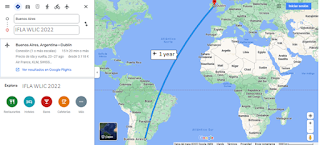
Last month, like many other librarians, I had the most amazing one week professional journey as a volunteer at the IFLA WLIC 2022. But my journey had begun much before that. On the 21st of June 2021, I took a flight from Buenos Aires (Argentina) to Dublin, looking for a better future for me and my family. I knew nothing about Irish libraries, but I had been working in libraries for 13 years and I was certain I wanted to continue my professional development in this vibrant city. My case might be a bit extreme, but if you are looking to start a career in the Irish libraries you might as well stay and read some of my tips to integrate into the library community of Ireland.

Getting started

Library worlds tend to be small worlds. I found out that that statement was true both for Buenos Aires and for Dublin. I changed from being in a place where I knew everybody and everybody knew me, to not knowing anyone at all. I had so many questions to ask but, where could I start? Who could I contact? I decided to start with the people I had close to me, and believe it or not, it worked! Not long after arriving in Dublin, a former colleague of mine wrote me an email saying she knew an Argentinian librarian who was working in The Hague, had worked for several years at IFLA and had a lot of international connections. The email also said she had already contacted her, and she was waiting for my call. And here comes my first tip: TIP 1 - Tell it to everyone. If you are looking for a change in your career or you want to start a career in libraries, just tell to everybody (if you can). You never know whom the help might come from. Embrace any help you can get, even if it looks like a long shot. After all, it’s worth trying, don’t you think?

The Argentinian librarian living in The Hague didn’t know much about Irish libraries, but she handed me the tip of a cord to pull. She said her first advice for me would be to join an association. She of course didn’t know any Irish associations, but she knew a member of the European charter of the SLA (Special Libraries Association), a librarian from the British Library, whom she could put me in contact with. At the time I didn’t fully understand the implications of joining an international association, but I do now, and I would like to replicate her advice. So, this is my second tip for you: TIP 2 - Join an international association. Joining an association will allow you not only to avail of the benefits for the members, like attending webinars and other kinds of events but also to obtain a different perspective of the library field. If you can, explore the possibilities of joining a committee. The options to work within an association are vast, and they are always a very good way of acquiring experience and skills much requested for open vacancies. Plus, it will look great on your CV! 


The wheels in motion

The librarian from the British Library was, of course, delighted to have another person on board and she offered me to join one of their committees. She said she even knew some librarians here in Dublin she could introduce me to. And that was when all the magic began.

She took the time to write a personal email to each of these librarians, telling them my story and asking if they could help me in any way. Not long after, I got answers from all of them. With some of them I met for coffee, with others I had a video call, and with others I exchanged emails. But all of them offered me a great deal of help.

I want to be clear about this: I got help from four different Irish librarians, who didn’t know me at all, who at the time were introduced to me by a British librarian, who didn’t know me either, and who I had met thanks to the contact of an Argentinian librarian living abroad who, again, didn’t know me from before. All this chain of beautiful people, they helped me just because. They didn’t need to do it nor had any reason to do it, but the will of doing something nice for someone else. And with this comes my third tip: TIP 3 - Don’t be afraid to reach out. The librarians’ community is probably one of the most cooperative and solidary communities you might find. If you have a teacher, a colleague or an acquaintance to whom you would like to ask something, don’t be scared to do it. I’m sure they will be happy to help you in any way they can.


First steps

Chatting with these librarians meant a pivot point for me. They gave me tips on what kind of positions I should aim for, what kind of libraries, how to put together my CV, and they stressed two pieces of advice I followed, and now I would like to share with you too. So these are my fourth and fifth tips. 

TIP 4 - Get a Twitter account. There is a huge library twitter community, and a lot of what’s happening in the library world is reflected there. Vacancies in libraries, webinars, workshops, in-person events, and what other libraries/librarians are doing, most of those things get published on Twitter. If you don’t know who to follow, start with the easiest one: follow @LAIonline. The LAI (Library Association of Ireland) posts much interesting news for the library world. They also retweet interesting posts from other libraries/librarians. So once you are following them, you can start following the other people they are retweeting, and so on and so forth. The Twitter algorithm will take care of the rest. It will show you other users to follow based on your interests until you get your own personal connections in the library world. It’s not hard, give it a try!

TIP 5 - Join the LAI, and if you can join one of their many committees, so much the better! You don’t need to be already working in a library to join the LAI. Joining is very easy and it’s not expensive at all! They have around 16 groups you can join according to your interests and you can join as many as you want (or your time allows you). This is an excellent way to get involved with the library community. It will give you the opportunity of networking with other librarians, and to participate in the planning of many professional-related activities. At the time I joined the LAI-CDG group I wasn’t working in a library and I was sceptic about how I could help the group in any way. But I found out there are lots of different ways in which one can help, and for sure you will find your way to be helpful to the group. Taking part in a group will not take much of your time and you can have a lot of fun too! 


IFLA WLIC 2022

In February 2022 I saw in a LAI newsletter (and again, on Twitter) that a call for volunteers for the IFLA WLIC 2022 was taking place. By that time I was already working in a library but I thought that it could be the best opportunity for me to attend and collaborate with a conference I had never even dreamed about going to. The last time an IFLA conference took place in Latin America was in 2004, and I hadn’t even finished my undergraduate studies back then! But now, a conference was taking place in the city where I was living, and I didn’t want to lose my chance to be a part of it. I talked to my manager who immediately agreed to it, and on Sunday 24th of July, I joined a group of approximately 200 volunteers from around the world. That’s when I got a true sense of what IFLA WLIC was.

The congress is as thrilling as it is exhausting. The days start very early in the morning and end very late in the evening. Volunteering implies that you have to do some “work” during the conference, but you also get some free time to enjoy the sessions. There are plenty of different tasks you might be given, like collaborating with the social media coverage, taking care of the VIP delegates, help out with the registration or badge control, among many others. In my case, my assignments involved assisting in one of the rooms where the sessions were taking place, so even when “on duty” I was able to attend some talks! The duties of a Room Assistant are quite simple: check that there are clean glasses and bottles of water for the speakers before every session; play a loop-presentation on the screens in between sessions; keep the room tidy; and eventually help the speakers to start their presentation (if they need it). Not a lot to ask, right?

During my time as a Room Assistant I got to listen to very interesting talks. I learned, for instance, about programs to identify Open Access journals; I became aware of innovative ideas taking place in health and academic libraries; I got to know IREL, the Irish e-Resources Consortium, and the fascinating work they are doing; and I listen about publishing in Irish academic libraries, among many other interesting topics. Needless to say, I also got the best out of my free time at the conference, learning about digital skills, conservation, marketing for libraries, and so much more.

But for me, the most invaluable asset I got out of the IFLA WLIC was the personal connection with other librarians. The Irish caucus, the cultural evening, the breaks, the lunches, all of them opportunities to get to know new people, and to finally meet face to face with those colleagues I had been interacting with over Zoom, Twitter or email. Putting a face to that Twitter account that always has interesting information, knowing how tall a person you had only seen sitting on the other side of a camera actually is, or how the voice of someone you’d only “talked” over email sounds. Humans are social animals, and all of our institutions and organisations are constructed on the grounds of the people who are part of it. The same happens with all the activities we do, for pleasure or work (or for both, if you are lucky enough). It all comes down to the people walking the path with us.

And with this comes my sixth and seven tips. TIP 6 - Get involved. If you see an opportunity to volunteer at any event, or if you can take part in it in any way, don’t lose your chance! Get involved, participate, join the community. Many events are taking place now, some of them in person and some of them online, but all of them equally worthy. Many of these events are for free, but for many others there are ways to join even if you can’t afford the admission fee, like applying for a bursary or, as I did, volunteering to help.

I’ve left my seventh tip almost for the very end of this post, but I think all the tips I’ve given you so far are in a way related to it. And if I had to choose only one tip to give you, it would be this one: TIP 7- Network. For any person that wants to make a start in any professional field, this would be my first advice. Knowing people already working in the industry probably won’t get you a position, but it will help you understand how the industry works. They can give you advice, they can help you understand what a position involves, and they can even shout out when they see a vacancy that might be good for you. I’m sure you already know many people you can talk to, but the biggest the circle, the better.

Moving forward

Last but not least, I wouldn’t like to finish this post without mentioning two extra tips for the time you are already enjoying your beloved library position. Here they are: 

TIP 8 - Be grateful. Getting your longed-for position is probably a combination of different factors. You were probably born in a home where you were supported to study, you had choices, you put lots of effort and perhaps, there was a bit of luck involved as well. Be grateful for that. And above all, if along the way you met people who helped you reach the place you wanted to be, thank them. You might not be able to repay them, but let them know that their actions had a positive impact on your life. So if you allow me, I would like to follow my own advice, and take this opportunity to thank the four Irish librarians who first introduced me to the Library world in Ireland: Marie O’Neill, Fiona Lacey, Ann O’Sullivan and Lara Musto; to Martin O’Connor and Helen Fallon for their support and inspiration to write this blog post; and very especially to the person who believed in me and offer me my first Assistant Librarian position in Ireland, Harriet Wheelock. To all of you, THANK YOU!

TIP 9 - Keep the chain. If someone helped you along the way, as I’m sure someone has, keep the chain of kindness. Help someone else to achieve their goals, as you have achieved yours. And again, as I like to follow my own advice, I’m writing this blog post hoping that someone might find it useful to start their own journey to integrate into the library community of Ireland. And if I can, from my humble place, help you in any way, please do not hesitate to contact me. Look me up on Twitter @nadinayedid, or send me an email to nadyed@gmail.com.

Thank you for reading!

14 Jun 2022

Keeping Calm in the Face of Technological Calamity

Guest post by David Carlos Rinehart. David is a Library Assistant at Maynooth University Library’s Special Collections and Archives Department where he has worked on expanding the Library Treasures blog to include the audio and audio-visual mediums of Podcasts and YouTube videos. He is currently in the dissertation stage of completing an MSc in Library and Information Studies from Robert Gordon University which he is on track to finish by April 2023. You can find him  @DCRinehart on Twitter 

In conversation with Martin O’Connor’s Libfocus post Dodgy cursors, wonky links and alarming fire alarms...

Ok, the plenary is done, I gotta get up to the sixth floor and make sure everything is running smoothly for my presentation.


Trapped between people getting out of their seats and meandering to the doors of the Shannon Suite at the Strand Hotel in Limerick for CONUL 2022, I (im)patiently wait. Once I get out of my row of chairs, I push through the crowd as elegantly as I can (basically not sticking my hands out and knocking them out of the way with the power of my nerves which are vibrating as I’m first up for the parallel paper I’m presenting).

Elevators… Elevators… There they are. Perfect. Oh good, Marie, my friend, is standing at the front. I’m just going to go and stand by her, I do go first so I need to be at the front.

Ok the button is pushed, good deal. Now we wait.

Behind the glass pane I see the elevator weights rocket up and soon the first of the two elevators arrives. Unfortunately, it’s the elevator for who’s line I am not in. Well, we will just have to wait until the door shuts and we press the button and the other elevator will soon come.

The elevator door shuts.

Then

It opens

Shuts

Opens

SHUTS

OPENS

SHUTS OPENS SHUTS OPENS SHUTS OPENS!!!!

What is going on!? I have to get up there! The other elevator won’t come if this one doesn’t go up!

As those in the elevator try varying arrangements of their bodies inside the elevator, and the door keeps opening to mark their failed attempts, I look for a hotel employee.

There she is!

“Hi, can I please use the stairs, the elevators don’t seem to be working,” I say, trying to keep the edge out of my voice.

“Sorry, we don’t have stairs.”

Don’t have stairs? DON’T HAVE STAIRS!? Seriously!? That is totally and absolutely impossible!! “Oh, ok, I’ll just wait then. Thank you.”

“Here’s another elevator,” someone calls out.

Since I am presenting first, I am ushered over to it.

We stand in the elevator and press six. The light flicks on, and then flicks off. No movement.

Ok, this is a cosmic joke, right?

Wrong. Or, well, right actually. It does appear to be the case.

I press six again.

On

Off

Again

On

Off

Again

ON OFF ON OFF ON OFF ON OFF GAHHHHHHHHH

Ok, what is the highest floor we can go!?

5

On

OFF

4

On

OFF

3

2

1

A key card is required to access any floors above the lobby and we don’t check in for another 5 hours. Perfect.

0

On

Still on

Up we go.

Now I am in the lobby. I press the button to go up on the elevators that will actually take me up.

We see the elevator lowering through the glass pane.

And….

it just keeps on going down.

It’s gone down to the floor I had just been on. And guess what? When it comes to the lobby floor, IT IS FULL!

At this point my manners and shyness have completely drained and I ask someone to please just let me on because I have to present!

Of course they let me on. I really should have asked from the start. But it’s just the way I am, a bit too shy for all that.

Ok, up we go.

Sixth floor.

Success!!


I run down the hall to the Harris Suite and the chair of the session asks, “David?”

“Yes! It’s me! I’m so sorry!”

“No worries, we will get started now.”

I am introduced very kindly and I step up to the mic. My presentation is already open and it’s go time.

Wow very professional! I don’t even have to open it. Awesome!

“Hello, I’m David, thank you for attending…” blah blah blah

Next slide.

“I am going to show you a video clip…” so on and so forth.

Nothing. The embedded video does not work.

Well, ok, here we go again
.

“Sorry everyone, seems like I am having some technical difficulties. Just one second, sorry about that.”

What could it be.

(Troubleshooting mode initiated)

Maybe the internet isn’t on.

I exit out of the presentation and sure enough, not connected.

Ok quickly connect (which is not quick at all, in fact, excruciatingly slow).

Ok. Connected. Perfect. Let’s go.

“As I was saying…” blah blah blah

Video starts playing with no sound.

Bloody hell already!!!

“Sorry about that everyone, it seems we don’t have sound.”

GAHHHHHHHHHHHHHHHHHHH

The IT guy is right next to me and I ask him, “Do we have speakers in here?”

“No.”

“I really need speakers because one of the clips I have is a podcast and, well, I need speakers for that.”

“Alright, I’m going to go get them, you keep doing your presentation and I’ll be back before you are done.”

Thank goodness for a calm IT guy with solutions!

“You got it!”

And I run through the entire presentation and right at the last slide, the tech guy comes in with the speakers, hooks me up and I play the clips.

Not only that, but I end up winning an award for keeping it cool with great technical challenges, or as I like to call it, a technical calamity!

Yes, I can keep my cool externally, from years of experience performing in a band, but I hope that this little story shows you what is going on inside which is total freak out mode, but also quick troubleshooting and solutions mode, which all comes together for a successful presentation despite the various challenges that present themselves.


Photo credit: Alexandra Caccamo

10 Feb 2020

Announcing - CONUL Conference Bursaries


Guest post by the CONUL Conference Team

We are delighted to announce that there will be two bursaries to attend CONUL Conference 2020: a LIS Student bursary, sponsored by Cambridge University Press; and a recent LIS Graduate bursary, sponsored by Annual Reviews. The conference, with the theme ‘Imagining The Future and How We Get There’ provides an exciting opportunity for those beginning LIS careers to attend an internationally regarded conference, with ample provision to attend sessions, network with delegates, and learn about key issues facing research libraries.

Two bursaries in total are available, one for each eligible category of applicant:

  1. LIS students currently studying a LAI accredited course
  2. LIS graduates who have graduated from a LAI accredited course within the last 5 years
LAI Accredited courses can be found here and here.

CONUL 2020 bursaries will cover:
  • Full CONUL 2020 registration - entrance to conference sessions and sponsor exhibitions, lunch and refreshments, drinks reception and conference dinner on Wednesday 27 May
  • One night’s accommodation on Wednesday 27 May, with breakfast the following morning
  • Public Transport costs from within Ireland to and from Limerick
  • Appointment of a mentor
To apply please email Michaela Hollywood (Michaela.hollywood@dcu.ie) with a letter of expression of interest (maximum 500 words) that includes:
  • An outline of why you would like to attend CONUL 2020
  • Your anticipated learning outcomes, and why you would benefit from attending
  • Confirmation of your agreement to submit a report of the event to the Libfocus library blog within 4 weeks of attending the event, which may be published on both the Libfocus and CONUL websites (mandatory)
Successful applicants will be notified via email by Monday 27 March 2020

In addition to attending conference sessions successful applicants will be required to:
  • Submit a report on the conference within 4 weeks of the event for potential publication on the Libfocus library blog and CONUL website
  • Be present at the conference venue in Limerick for the full conference programme

*Closing date for applications is 17:00 on Wednesday 24 February 2020*

29 Nov 2019

IFLA World Library and Information Congress (WLIC) 2020 – An Exciting Opportunity to become a Volunteer


 Next August something incredible, amazing and unique will be taking place in Dublin. From August 15-21st 2020 The International Federation of Library Associations and Institutions (IFLA) and the Library Association of Ireland will be hosting the  IFLA World Library and Information Congress (WLIC) 2020.

The IFLA World Library and Information Congress is the international flagship professional and trade event for the library and information services sector. It brings together over 4,000 participants from more than 140 countries. It sets the international agenda for the profession and offers opportunities for networking and professional development to all delegates. It is an opportunity for the host country to showcase the status of libraries and information science in their country and region as well as to have their professionals experience international librarianship and international relations in a unique way. The congress also offers an international trade exhibition of approximately 1,000 square metres with over 80 exhibitors. The combined buying power of all delegates can be estimated at more than €1 billion. This event is being hosted by the Library Association of Ireland.

Are you ready to become an international IFLA volunteer?

In order to be a success IFLA needs a team of international volunteers. Volunteers play an integral role in supporting WLIC 2020 and we look forward to welcoming you as part of our Volunteers in WLIC 2020. Volunteers are key in creating a positive and welcoming atmosphere to delegates while assisting the hosts to deliver a professionally run Congress.
A series of upskilling programs and training sessions will be offered to Volunteers and an information kit will be provided regarding specific duties and benefits
Who are we looking for?
We are looking for volunteers who have the time, dedication and enthusiasm to assist us to deliver a successful international event. If you are professional, committed, hardworking, reliable and culturally sensitive, then you are exactly what we are looking for.

What’s in for you?

The  IFLA World Library and Information Congress (WLIC) coming to Ireland is a once in a lifetime opportunity- the conference travels to different countries every year- so this is a once in lifetime opportunity.
Volunteers receive free registration for the conference (valued at €800) and they will be given time to combine volunteering with attending talks and events. They will get to meet volunteers and librarians from all over the world. Volunteers need to secure their own accommodation.

Application forms and more detailed information is available here  CLOSING DATE IS DEC 20TH 2019!


Message from Jane Burns, Institute Librarian, Athlone IT.  LAI Executive Council Member

I am the National Co-ordinator for the Volunteer Program.  In order to make this conference a success we are recruiting a team of up to 350 volunteers. These opportunities are ideally suited to students, retired information professionals and individuals who have an interest in this field.
The IFLA conference travels to different countries every year- so for many this will be a once in lifetime opportunity - volunteer and don't miss out!


Jane can be contacted via email janeaburns@gmail.com/ or through her Twitter account @JMBurns99