Showing posts with label special collections. Show all posts

29 Sept 2025

Shells, Shorthand, and Skipping Classes: Documenting Prize Bookplates in the John Manning Collection of Children’s Books

Libfocus is delighted to present the winning post for the CONUL Training and Development Library Assistant Blog Awards 2025. The winning author is Claire Dunne who is a Library Assistant in UCD Library.

Growing up, I could never understand why my mother made me sign my books. “Just sign it” she’d say, pushing a pen into my hand, “and don’t forget the date!” Now as an adult, and especially one who works with old books, I see the value in this and how it can give a book its own story beyond the words on its pages. In the cultural heritage profession this is known as “provenance”; the story of an item, how it came to be here and who might have owned it in the past. 

In UCD Special Collections we look after many books with important provenance. Books signed by James Joyce? We got ‘em. 400-year-old tomes delicately annotated by priestly scholars? We got ‘em. Modern works of art with the signature of the artist? We’ve got those too. But sometimes it isn’t the prestigious origins or famous names that catch your attention. Rather it is the casual note of the ordinary person now forgotten to time, or the scribbles of a child, made 100 years ago but somehow still familiar. It was this sense of the ordinary person, and the desire to highlight their importance, that inspired the latest work on the John Manning collection of children’s books in UCD Special Collections.

three colourful books
Figure 1: Three colourful books from the John Manning Collection (45.0.14), (45.J.1c), (45.U.12), UCD Special Collections. 
John Manning was an avid collector of 19th and early 20th century children’s books and in the 1970s he generously donated his collection to UCD Special Collections. These shelves are now some of the most colourful in the storeroom. They tell stories of adventures and wonder, and open a window to childhood in the Victorian era. For this reason, they are important sources of social history during this period.

Two rows of colourful books on shelves
Figure 2: Books in the John Manning Collection on the storeroom shelves, UCD Special Collections.
Many of these books were gifted to children as prize books. This was the custom of awarding books, often for academic merit, with a dedicated bookplate commemorating the achievement. The presence of these bookplates, however, was not previously recorded on the UCD Library catalogue, which is the main way that our visitors find out about our collections. This wasn’t too surprising because despite the current recognition of the importance of provenance, traditionally this wasn’t something that was included on a library catalogue. Keeping our catalogue up to date with retrospective edits and additions is an important part of our job in Special Collections.

And so, we set about documenting these enigmatic bookplates so that they can be discovered and researched.

An inscribed page on the inside cover of a book
Figure 3: Book awarded to Mary Alice Boyd, 1883, (45.R.11), UCD Special Collections.
Step one: find the bookplates. Just like one of the treasure hunters in Edith Nesbit’s The Story of the Treasure Seekers, we opened each and every one of the books in the Collection. Opening the cover and finding a prize bookplate was like unearthing a little piece of history that had been forgotten until now.

Four pages showing illustrations and a mix of text and handwriting
Figure 4: Four prize bookplates. Top left: (45.H.1). Top right: (45.J.1c). Bottom left: (45.L.15). Bottom right: (45.C.17), UCD Special Collections. 
The next step was updating the records on the library catalogue. Cataloguing Special Collections books is a technical skill that requires the use of standardised language and formats. We decided to use three specific fields on the record, one to identify the book as being part of the Collection, another to detail any provenance information, and a final one that notes it as a prize book. By describing the books this way it allows users to easily find and cross reference them. Here’s what it looks like on the online catalogue:

Catalogue record, an illustrated page and a book
Figure 5: Partial catalogue entry and images of (45.L.10), UCD Special Collections. 
It quickly became clear that we had more prize bookplates than we anticipated and some from much further afield than we thought too. We also discovered that some books had been missed when initially catalogued many years ago. About 50 books that were uncatalogued have now been recorded and this 'hidden' collection uncovered.

Two pages with a mix of typed text and handwriting
Figure 6: Prize bookplate in French (45.C.20), and prize bookplate from Edinburgh (45.H.17), UCD Special Collections.
The bookplates come in all shapes and sizes, from very simple to elaborate and colourful.

Three bookplates with a mix of typed text and handwriting
Figure 7: Three prize bookplates in different styles. Top: (45.D.25). Bottom left: (45.H.18). Bottom right: (45.J.14), UCD Special Collections. 
Many prize books were awarded for excellence in religious studies, others for practical skills like art, and shorthand. One charming example was awarded for collecting shells.

A book plate page
Figure 8: Prize bookplate awarded to John Stevenson for collecting shells, (45.G.3), UCD Special Collections
But it seems not all books were presented for merit, as the inscription below suggests!

Handwritten text reading 'Harold Simpson was awarded this prize for being in late every morning in the year'
Figure 9: Prize book inscription reading, "Harold Simpson was awarded this prize for being in late every morning in the year." (45.0.14), UCD Special Collections. 
Finally, old book flags that had become old and worn were replaced with new versions, and books that had become fragile were carefully wrapped with acid-free cotton ties.

Pages with numbers on them, two lines of colourful books
Figure 10: Top: Old book flags ready for the recycling bin. Below: New book flags on the shelves. UCD Special Collections.  
In total, 67 prize bookplates were identified, each with its own story to tell. Beyond their historical value, these bookplates hold a special sort of emotional resonance, perhaps because they once belonged to a child, or maybe because they capture a snapshot in not only our own social history, but the history of an individual. One of the most endearing discoveries was uncovered in The Worst House at Sherborough by Desmond Coke. The inscription, in Latin, reveals that this book was awarded to John Manning himself, at the age of 13. We hope that he would have enjoyed this project as much as we did.

Illustrated page showing a bookplate awarded to John Manning for scholastics
Figure 11: Prize bookplate awarded to John Manning for scholastics, 1S20. (45.F.28), UCD Special Collections.
Find out more:

Almack, Edward. Bookplates (London: Methuen & Co., 1904), SC/R 097 ALM.

Ex Libris: Bookplates in UCD Special Collections, UCD Cultural Heritage Blog

John Manning Collection of Children’s Books, UCD Special Collections

Warren, John Byrne Leicester Warren (Lord de Tabley), A Guide to the Study of Book- Plates (Ex-Libris) (Manchester: Sherratt and Hughes, 1900), SC/R 097 DET.


Search the catalogue for these books and more at UCD Library
here. Make an appointment to visit UCD Special Collections here. Have a prize bookplate of your own? Share it with us on Instagram.


14 Nov 2023

“Brewing up a storm” – Outreach to develop your professional profile

This blog post by Catherine Ahearne from Maynooth University was highly commended in the CONUL Training and Development Library Assistant Blog Awards 2023.

What professional growth means to me is, it is an active process and that involves more self reflection that I had realised. As someone who had lived by the phrase “self-praise is no praise,”  looking back at my career and truly examining it, is difficult. Aware of the library experience gap  in my C.V., my career path has not been a linear nor smooth one. I have worked in Law, Public,  Tax and Academic libraries, but have also done several years in an administrative role for one  the big 4 four accountancy firms. I worried that this would put me at a disadvantage when  compared with my library peers. But when I looked closely, I could see the transferable skills  that I bring to my library role. This also allowed for me to notice and focus on my weaker areas,  treating the process as a needs assessment if you will.  

I have spent the most recent part of my career looking at my professional development so that I  can progress and succeed in my position to the best of my ability. I have obtained the Associate  of the Library Association (ALAI), participated in conferences as a poster presenter even  speaker. But what I have had to acknowledge is that I qualified more than a decade ago and  through my various roles I have seen how much the profession has changed in that time. A  professional profile for librarians is now a crucial element of professional development. But  how do we create this? Networking is one way of building relationships with others in our field  allow us to share ideas and experiences. Outreach is a tool that not only benefits your  institution but also you on a professional level.  


Picture of the Russell Library taken by Catherine Ahearne  


The outreach experience that I am going to share is writing for RTÉ Brainstorm. An email was  sent to the Special Collections & Archive team based on our MU Library Treasures blog  exposure, that the editor of RTÉ Brainstorm Jim Carroll was available to talk to any of the team  who might interested in writing for RTE Brainstorm and can help define a story with them. 10- minute one-to-one feedback sessions were organised. The feedback sessions enabled staff to share an area of work with the editor. And receive suggestions on generating an angle for the story.  

Map taken from John Hall’s, Tour through Ireland: particularly the interior & least known parts (London,  1813)  


I went to the pitch a little unsure if I would be able to provide something that would be of  interest to Brainstorm. My pitch was about the opinion and attitudes of the Irish as expressed  through the travel guides of the 18th and 19th century. The Pitch was successful, and I was given  a word count and deadline. I began to write; I had some trusted colleagues review some of my  early drafts. Up to this point anything that I had written had been for a specific audience, “the  library world,” so before submission I asked the communications officer to review, and she  made some extremely helpful suggestions that would allow the blog to have an appeal to a  wider audience than just those interested in Special Collections. The 15th of March saw my blog  go live, “People drinking whiskey, porter and punch” Travellers to Ireland and their thoughts on  the Irish”.   


Illustration “An outside jaunting car in storm” by Daniel Maclise is from John Barrow, A Tour round  Ireland through the sea-coast counties in the autumn of 1835 (London, 1836). The title page is from the  same publication.  


This exercise in outreach not only highlighted my profile within my own institution, but also  gave me positive feedback, and an opportunity to engage with academics about the blogs  success. Another benefit of completing the blog was that it allowed me an opportunity to  promote my colleagues that also write for our own blog “The Maynooth Library Treasures” and  the celebrate the rich collections of the Russell Library. In recent weeks, the article has been  promoted again by MU Spotlight on research. My advice for anyone interested in developing  their professional profile is to take the opportunities you are offered; you need to be seen to be  heard. You can use these to gain experience, increase your confidence and as a form of  continuing professional development. 


17 May 2023

The Role of Librarians in Preserving Endangered Crafts

Post by Laura Ryan, Assistant Librarian, Special Collections & Archives, DCU Library.


A store room of 17th and 18th century leather bound books, DCU Library
All librarians, and in particular Special Collections librarians, have long played a role in preserving history. Through outreach programmes, genealogy, recording oral history, or simply in our long-term care for books – we play a role in ensuring the history of a place, a community or craft continues long after we have retired. We generally also love books – the smell, the feeling of paper, leather bindings and of course the contents. It puts us in a unique place. We have an appreciation and often an in-depth understanding of the craft of books, as well as access to them and their care. 


Red List of Endangered Crafts 2023 banner.
The UK charity Heritage Crafts has released its 2023 edition of the Red List of Endangered Crafts.
Funded by The Pilgrim Trust with additional sponsorship from The Royal Mint, Heritage Crafts undertake enormous research to rank traditional crafts in the UK by the likelihood they would survive into the next generation. There is no equivalent for the Republic of Ireland but the report includes data from Northern Ireland. Unsurprisingly, included on the list are many of the crafts which together created the physical books that line our Special Collections stores. 


There are four categories of risk within the report: Extinct, Critically Endangered, Endangered, and Currently Viable. Many criteria decide the ranking, from the number of those employed in the craft, to trainees, to serious amateur makers and leisure makers. The viability of making a living while practising a craft, market issues including supply, industrialisation of the process, and cost of machinery or tools, public awareness of the craft, as well as many more factors are represented in the report. 


Pertaining to book craft only, here are the following crafts now Extinct, Critically Endangered, or Endangered in the UK:


Extinct

Gold-beating 

The process of beating gold until it is thin gold leaf. For book craft, this is used to gold tool bindings or to illuminate manuscripts. Beaten gold is still available – though done now by machine and imported. 


Critically Endangered

Fore-edge Painting

The application of an image onto the fore-edge of a book. Usually applied while the pages are fanned out at an angle, the process means that if covered in gold, the image will completely disappear when the book is closed. For an example of this in an Irish collection, see “Now You See It, Now You Don’t”  from UCD’s Cultural Heritage blog.


Paper making (commercial handmade)

Thqe process of hand-forming paper, using a mould and deckle to gather and form the sheet of paper. Paper made this way is generally formed of cotton and linen flax. The report also notes that the manufacturing of the mould and deckle no longer takes place in the UK.


Parchment and Vellum Making

Parchment is made of sheep and goatskin, while vellum is made of calfskin. Both have made up our manuscripts and books for several centuries. The report notes that much of the public does not understand what vellum is in particular which is part of the decline. Vellum is more flexible than paper and survives far longer over time than modern conventional paper. Many of our books from the 1400s and 1500s made of these materials are in far greater condition than books from the 1980s. 


Endangered

Illumination 

Embellishment of a manuscript with gold leaf on a gesso base, as well as decoration with colouring. We may be most familiar with historiated initials: illuminated capitals which begin a book or section. The report notes that there is very little demand for this type of illumination these days.


Letterpress

Printing using hand-setting and a variety of presses. This is the form of printing developed by Johannes Gutenberg and was the primary form of printing of books from the 15th to 20th centuries. This craft is maintained currently by artisan or fine art printers.


An example of Spanish Moiré marbling, DCU Library.
Paper Marbling

A form of aqueous surface design, this is the process of floating inks on mixture of water and surfactant, creating designs within that floating ink and transferring it onto paper. This is traditionally applied to endpapers but became common on outer bindings when leather became more expensive. It can also be applied to fore-edges. To read more on marbled paper in Ireland, see “Marbled Paper: History of an Endangered Bookcraft”.


Tanning

The process of using vegetable tannins to convert raw hide into leather. This is used for the exterior bindings of books. Due to some processes within the creation of leather, it can degrade over centuries and crumble. It is often subject to an issue referred to as ‘red rot’. Conservation of this is difficult and binding with leather has become much rarer. 


What now for librarians?

Why does it matter to us as librarians? Quite simply, the books that we are charged with preserving and conserving require the sustained existence of the craft  so that conservators can source materials (now and into the future) that match the process and materials of the book being conserved. 


So what can we as Special Collections librarians do about this issue? We can’t fix the issue ourselves and many factors are far beyond our control or remit: economics, supply issues, traineeships, loss of skilled people to pass on the craft, etc. However, the report mentions several factors that librarians do have an impact on. 


Cataloguing 

Creating accurate 563 fields (binding notes) which use consistent and accessible terminology so that the crafts involved can be found through catalogue searches and tracked through collections. This means that we have to be knowledgeable about the crafts in order to adequately describe them. Research into understanding how things are made must be part of our role so that we can best understand how to preserve them. 


Outreach

Recently, someone mentioned to me that ‘materiality of the book’ had been overdone, because the research exists. This does not negate the sharing of that knowledge and research. The report mentions a lack of public awareness of the crafts. Librarians are both keepers of and speakers for these books. It is important that when we do outreach sessions, talks, seminars, blogs or tweets that we include descriptions of and information about the processes behind the books. We need to share our knowledge and understanding to generate interest in those processes. Few of those people will ever follow up on becoming a professional in the craft, but they may pursue it as a leisure maker and generate business for a craftsperson to run classes and make a livelihood. In doing so, we also further the memory and preserve the history of the craft. We, too, create historical records in our research output and outreach efforts. 


Acquisition

Very few of us, especially here in Ireland, have significant funding for purchasing. When we do purchase, due to the nature of our existing holdings, we often look to older collections on sale or available from donors. We spend much of our time delving into the past. It is time to look at the present, as a gateway to future collections. There are local craftspeople using all of the above techniques in Ireland. Specialist publishers, binders and fine art printers, from Stoney Road Press to The Salvage Press are current creators of specialist limited edition publications that keep alive these crafts in Ireland, but also publish works to match our interests in Irish literature and culture holdings. 


What librarians can do may affect only a small part of the ongoing legacy of book crafts, however  it is pertinent that we adequately understand the process of these crafts and their history, to contribute to their ongoing maintenance while supporting current local businesses and craftspeople where possible. 


Laura Ryan in an Assistant Librarian in Special Collections & Archives at Dublin City University. With a background in Art History, she has a particular interest in the book as an object, and the continuation of book craft practices.


9 Dec 2022

Ligatus Summer School 2022: Histories of Bookbinding

Guest post by Yvette Campbell, Collections and Content Librarian at Maynooth University Library. Yvette’s professional interests include the history of the book, codicology, descriptive bibliography, and digital preservation.
 
(Fig 1) - Week 1 Ligatus School 2022 participants at the Edward Worth Library. Photo courtesy of Elizabethann Boran

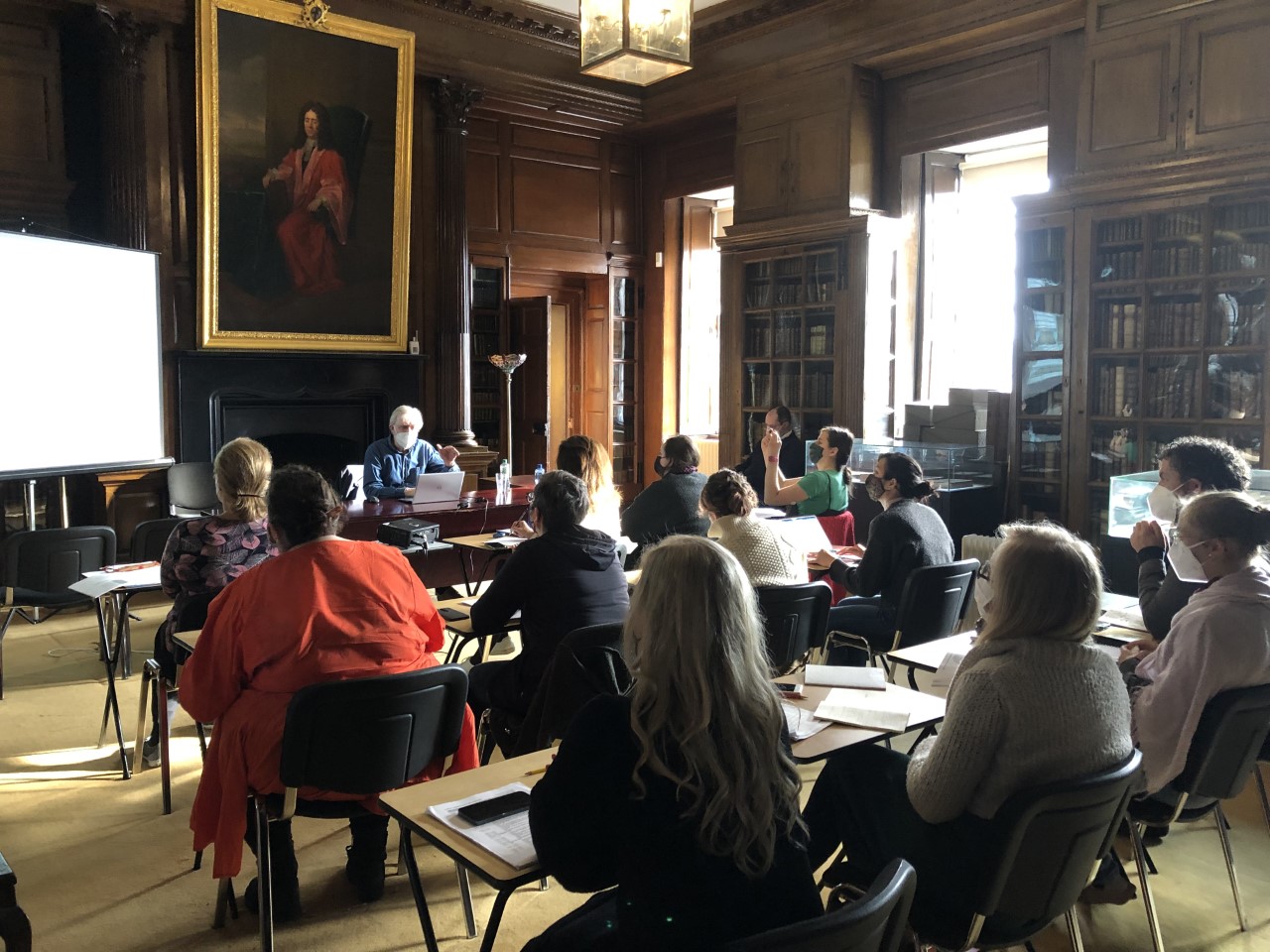
I was very fortunate to undertake a terrific professional development opportunity this year to attend the 2022 Ligatus Summer School for two consecutive weeks in September. The Summer School took place in Dublin and was hosted by the Edward Worth Library and included scheduled visits to both Marsh’s Library and the Chester Beatty.
 
The Ligatus Summer School is world-renowned amongst librarians, cataloguers, conservators, historians, and scholars who work with early books. It offers courses on bookbinding history and Linked Data - in particular, the development of historic bindings with a particular emphasis on description and recording of their various structures and materials.
 
Ligatus is organised in collaboration with many institutions including the University of the Arts, London and the Saint Catherine Foundation which supports conservation work at Saint Catherine’s Monastery in Sinai, Egypt. The Summer School takes place in a different city each year worldwide and 2022 was the first year it has been held in Ireland.
 
Call for applications
 
I noticed the call for applications to attend the school on social media and didn’t hesitate twice about applying. Anyone who works with unique and distinctive collections in Ireland will know what little opportunities are afforded to us in recent years to upskill in the areas of special collections curatorship. I also felt it was a great opportunity to visit some of the most important historical collections in other local institutions and to re-connect with colleagues in this area. I previously had knowledge of European bookbinding which for several years has been beneficial in my role as a rare materials cataloguer. In recent times, I have been drawn to the traditions of bookbinding that developed in the East (in particular, the Islamic manuscript tradition) and was very keen to expand my knowledge in this area. For me it was important to understand that bindings can be read as a text with a language of their own, and to describe them accurately is to learn their language.
 
The Application Process
 
The course fee (as of 2022) was €400 per week and candidates could choose to attend one or both weeks. Maynooth University Library kindly supported my application to attend both weeks. The application process was much the same as applying for a regular job. The school required an up-to-date CV and a supporting cover letter outlining who we are, our occupation and why we were interested in applying.

Successful candidates would be contacted in August, and I was delighted when I received the acceptance email. Shortly afterwards, I received the summer programme including a reading list for week 1 which focused on European Bookbinding 1450-1830. I was also provided with a list of software to download in advance of week 2 which was concerned with Identifying and Recording Bookbinding Structures of the Eastern Mediterranean.

Week 1 - European Bookbinding 1450 - 1830
 
(Fig 2) - Prof. Nicholas Pickwoad teaching European Bookbinding at the Edward Worth Library. Photo courtesy of Elizabethann Boran

Professor Nicholas Pickwoad‘s course on European Bookbinding, 1450-1830 was every bit as meticulous but rewarding as I had hoped it would be. It consisted of rich lectures every morning and hands-on sessions in the afternoons looking at specimens from the Edward Worth Library. Two afternoons included excursions to Marsh’s Library and the Chester Beatty for classes examining their collections in greater detail.

Participants came from a variety of diverse backgrounds, traveling from Estonia, France, England, Germany and Sweden. Eight students were book and paper conservators, while three were Irish librarians (including a digital librarian and two special collections librarians). It was fascinating to see the mix of backgrounds and I was heartened that there was representation within my own profession. Without the know-how to catalogue and describe binding structures as accurately as possible, we are losing great opportunities to provide researchers and scholars with enough material evidence to support important historical research including questions of who bound a book, where and for what purpose?

As a rare materials cataloguer, I have always tried to include at least a brief description of each book’s decorative binding. This course has now given me the knowledge and vocabulary to describe other important elements and how they were made. For example, recording the presence of uncut edges is vital for understanding the status of the book and to be cautious when recording the prices on title-pages to understand exactly what they mean - as without other supporting historical annotation, it can be meaningless - is it the price of the textblock, the print, or the binding?

(Fig 3) - Selection of bindings to examine from the Edward Worth Library 


(Fig 4) -Selection of European bindings from the Chester Beatty


We concentrated on the structural analysis of bindings particularly regional techniques and materials present rather than decorative finishing. We also examined how to date bindings in the medieval period, how to identify the raw materials used (with caution), how to check leather that has been tooled by hand through symmetry, sewing and stitching techniques, recessed supports, spine linings, edge treatments, board types and endleaves – all of which can tell us the where, why and hows of the history of the book as an object.

As books regularly travelled from the bindery to private collections across Europe during this time-period, they were often rebound to suit the taste of their wealthy owners. Patrons could choose their books to be bound in various uniform colours or stripped back to the plain old basics. Thus, Professor Pickwoad emphasised the importance of intact historic collections as one of the most important for studying original bindings - since they were often commissioned for one or perhaps two collectors and unlikely to have moved around. Some Irish examples in this context include the St. Canice’s Cathedral Library Collection on long term loan from the Church of Ireland held at Maynooth University, the Bolton Library at University Limerick and indeed the Edward Worth Library itself.

(Fig 5) - Example of customised fore-edge painting by Cesare Vocellio from the Pillone Library


Week 2 - Identifying and Recording Bookbinding Structures of the East Mediterranean
 
For week 2, the course was divided into two inter-related sessions delivered by Dr Georgios Boudalis and Dr Athanasios Velios, both conservators respectively working on the St. Catherine’s Monastery Project in Egypt. In the first session, Dr Boudalis focused on the major structural and decorative features of different bookbinding traditions that developed in the Eastern Mediterranean, including Coptic bindings, Arabic, Armenian, Georgian, Syriac and Ethiopic books– with a special focus on Byzantine and post-Byzantine bookbindings. We examined various precursors to the multi-gathering codices such as wooden, legal and wax tablets and papyrus rolls.

(Fig 6) - Week 2 Ligatus School 2022 participants at the Chester Beatty. Photo courtesy of Kristine-Rose Beers


While showcasing bookbindings from various museums and libraries (including St. Catherine’s Monastery), we were guided through the development of these closely related binding structures and their influences from the West. Dr. Boudalis emphasised that by examining representations of the codex in iconography, we can ascertain evidence of decorative and functional characteristics that may no longer survive and how they may have been utilised once upon a time. We concluded this session by visiting the Chester Beatty again to view and study examples of these various traditions with an impromptu visit to the Conservation lab hosted by Kristine Rose-Beers, Julia Poirier and Hoa Perriguey.
 
(Fig 7) – Coptic binding fragments from the CBL dating to 600 AD 


(Fig 8)  - Bone ties decorated with characteristic concentric circles used to keep leather ties in place

In the second session, Dr Athanasios Velios introduced participants to the semantic web, Linked Data and the CIDOC Conceptual Reference Model (CRM) for cultural heritage objects. We were also introduced to the consolidation potential currently being explored in a Linked Conservation Data Pilot.

The session consisted of a combination of presentations and hands-on group-oriented workshops. We explored the importance of standardised vocabularies for book descriptions and the significance of using Uniform Resource Identifier’s (URI) to assist systems in linking to a global thesaurus for maximum discovery impact. The afternoons were spent writing xml schema for various book components and mapping these to CIDOC-CRM using 3MEditor, a web application to view xml mapping files and publishing the Linked Data in ResearchSpace, an open-source platform that supports knowledge preservation.

At the end of the course, I received a certificate of completion for my continuing professional development (CPD) records.
 
Reflections on the course
 
I am looking forward to applying new knowledge of concise binding descriptions to my role in Maynooth University Library and perusing our holdings again as we enter an exciting and challenging new phase of the Russell Library Cataloguing Project to enrich records from the collections of St. Patrick’s College Maynooth with copy-specific features related to bindings. If contemplating how to describe bindings, I would highly recommend consulting the Language of Bindings thesaurus as a reference. The course has given me a deeper appreciation for the study of bindings as artefacts and how materiality impacts history. As Prof. Pickwoad declared during one tea break when I revealed that I need to go back and amend a few entries in our catalogue - “I want you to go away from this course feeling worried”… And I do, but in an optimistic way! 

19 May 2022

The Library Treasures Podcast

Guest post by Alexandra Caccamo and David Rinehart.


 In 2015, the Maynooth University Library’s Special Collections and Archives (SC&A) Department started the LibraryTreasures blog on WordPress. We have continued to publish a new blog every month detailing treasures found in our collections in both the Russell Library and the John Paul II Special Collections and Archives. It was with the shock of the pandemic and a quick pivot towards presenting our service virtually that we began to think about other ways to reach new and existing audiences.

Historically, SC&A departments tended to be thought of as exclusive spaces for distinguished researchers and academics. Further, in some cases, what makes these collections ‘special’ is their antiquity, making the use of technology seem like a contradiction or an anachronism. However, the ideologies, philosophies, and strategies that drive many libraries, which include Special Collections and Archives departments, recognize these collections as important objects, stories, and perspectives for our culture. This is history which belongs to everyone. Thus, there is a drive to make these collections more discoverable and easier to access for all members of the local and global community. And so, the importance of technology and social media has become increasingly evident.

Back to the pandemic. With this increased focus on bringing Maynooth University’s collections to the people, and the physical service being put on hiatus, saw an opportunity to enhance and grow our digital skills. The Special Collections and Archives department then set out to expand our blog to include not only the visual medium of written work, but to the audio and audio-visual mediums of podcasts and YouTube videos as well.


We now have six Library Treasures videos and two episodes of our podcast available on our Library Treasures blog. The most recent two episodes were an interview with the incredible and talented academic from the MU Department of Early Irish, Dr. Elizabeth Boyle in two parts. Part 2 just launched on May 13th.

Dr. Boyle talked with us about a recent item of great historical significance which she helped us acquire. This incunable, Orosius’ Historiae Adversus Paganos or The Seven Books of History against the Pagans (1471), is the earliest print copy of Orosius in an Irish Library. It is also the first printed work to mention Ireland and its landscape and climate. Without going into too much detail, Orosius wrote in the 5th century about the God given right kings had for ruling. Orosius’ works shaped the belief monarchs have had about their divine rights and caused a paradigmatic shift in political discourse which has prevailed for over a millennium.


Follow us on Twitter: @SCA_MULibrary
Follow Elizabeth Boyle on Twitter: @thecelticist
Follow Alex Caccamo on Twitter: @accaccamo
Follow David Rinehart on Twitter: @DCRinehart