Showing posts with label Rare books. Show all posts

17 May 2023

The Role of Librarians in Preserving Endangered Crafts

Post by Laura Ryan, Assistant Librarian, Special Collections & Archives, DCU Library.


A store room of 17th and 18th century leather bound books, DCU Library
All librarians, and in particular Special Collections librarians, have long played a role in preserving history. Through outreach programmes, genealogy, recording oral history, or simply in our long-term care for books – we play a role in ensuring the history of a place, a community or craft continues long after we have retired. We generally also love books – the smell, the feeling of paper, leather bindings and of course the contents. It puts us in a unique place. We have an appreciation and often an in-depth understanding of the craft of books, as well as access to them and their care. 


Red List of Endangered Crafts 2023 banner.
The UK charity Heritage Crafts has released its 2023 edition of the Red List of Endangered Crafts.
Funded by The Pilgrim Trust with additional sponsorship from The Royal Mint, Heritage Crafts undertake enormous research to rank traditional crafts in the UK by the likelihood they would survive into the next generation. There is no equivalent for the Republic of Ireland but the report includes data from Northern Ireland. Unsurprisingly, included on the list are many of the crafts which together created the physical books that line our Special Collections stores. 


There are four categories of risk within the report: Extinct, Critically Endangered, Endangered, and Currently Viable. Many criteria decide the ranking, from the number of those employed in the craft, to trainees, to serious amateur makers and leisure makers. The viability of making a living while practising a craft, market issues including supply, industrialisation of the process, and cost of machinery or tools, public awareness of the craft, as well as many more factors are represented in the report. 


Pertaining to book craft only, here are the following crafts now Extinct, Critically Endangered, or Endangered in the UK:


Extinct

Gold-beating 

The process of beating gold until it is thin gold leaf. For book craft, this is used to gold tool bindings or to illuminate manuscripts. Beaten gold is still available – though done now by machine and imported. 


Critically Endangered

Fore-edge Painting

The application of an image onto the fore-edge of a book. Usually applied while the pages are fanned out at an angle, the process means that if covered in gold, the image will completely disappear when the book is closed. For an example of this in an Irish collection, see “Now You See It, Now You Don’t”  from UCD’s Cultural Heritage blog.


Paper making (commercial handmade)

Thqe process of hand-forming paper, using a mould and deckle to gather and form the sheet of paper. Paper made this way is generally formed of cotton and linen flax. The report also notes that the manufacturing of the mould and deckle no longer takes place in the UK.


Parchment and Vellum Making

Parchment is made of sheep and goatskin, while vellum is made of calfskin. Both have made up our manuscripts and books for several centuries. The report notes that much of the public does not understand what vellum is in particular which is part of the decline. Vellum is more flexible than paper and survives far longer over time than modern conventional paper. Many of our books from the 1400s and 1500s made of these materials are in far greater condition than books from the 1980s. 


Endangered

Illumination 

Embellishment of a manuscript with gold leaf on a gesso base, as well as decoration with colouring. We may be most familiar with historiated initials: illuminated capitals which begin a book or section. The report notes that there is very little demand for this type of illumination these days.


Letterpress

Printing using hand-setting and a variety of presses. This is the form of printing developed by Johannes Gutenberg and was the primary form of printing of books from the 15th to 20th centuries. This craft is maintained currently by artisan or fine art printers.


An example of Spanish Moiré marbling, DCU Library.
Paper Marbling

A form of aqueous surface design, this is the process of floating inks on mixture of water and surfactant, creating designs within that floating ink and transferring it onto paper. This is traditionally applied to endpapers but became common on outer bindings when leather became more expensive. It can also be applied to fore-edges. To read more on marbled paper in Ireland, see “Marbled Paper: History of an Endangered Bookcraft”.


Tanning

The process of using vegetable tannins to convert raw hide into leather. This is used for the exterior bindings of books. Due to some processes within the creation of leather, it can degrade over centuries and crumble. It is often subject to an issue referred to as ‘red rot’. Conservation of this is difficult and binding with leather has become much rarer. 


What now for librarians?

Why does it matter to us as librarians? Quite simply, the books that we are charged with preserving and conserving require the sustained existence of the craft  so that conservators can source materials (now and into the future) that match the process and materials of the book being conserved. 


So what can we as Special Collections librarians do about this issue? We can’t fix the issue ourselves and many factors are far beyond our control or remit: economics, supply issues, traineeships, loss of skilled people to pass on the craft, etc. However, the report mentions several factors that librarians do have an impact on. 


Cataloguing 

Creating accurate 563 fields (binding notes) which use consistent and accessible terminology so that the crafts involved can be found through catalogue searches and tracked through collections. This means that we have to be knowledgeable about the crafts in order to adequately describe them. Research into understanding how things are made must be part of our role so that we can best understand how to preserve them. 


Outreach

Recently, someone mentioned to me that ‘materiality of the book’ had been overdone, because the research exists. This does not negate the sharing of that knowledge and research. The report mentions a lack of public awareness of the crafts. Librarians are both keepers of and speakers for these books. It is important that when we do outreach sessions, talks, seminars, blogs or tweets that we include descriptions of and information about the processes behind the books. We need to share our knowledge and understanding to generate interest in those processes. Few of those people will ever follow up on becoming a professional in the craft, but they may pursue it as a leisure maker and generate business for a craftsperson to run classes and make a livelihood. In doing so, we also further the memory and preserve the history of the craft. We, too, create historical records in our research output and outreach efforts. 


Acquisition

Very few of us, especially here in Ireland, have significant funding for purchasing. When we do purchase, due to the nature of our existing holdings, we often look to older collections on sale or available from donors. We spend much of our time delving into the past. It is time to look at the present, as a gateway to future collections. There are local craftspeople using all of the above techniques in Ireland. Specialist publishers, binders and fine art printers, from Stoney Road Press to The Salvage Press are current creators of specialist limited edition publications that keep alive these crafts in Ireland, but also publish works to match our interests in Irish literature and culture holdings. 


What librarians can do may affect only a small part of the ongoing legacy of book crafts, however  it is pertinent that we adequately understand the process of these crafts and their history, to contribute to their ongoing maintenance while supporting current local businesses and craftspeople where possible. 


Laura Ryan in an Assistant Librarian in Special Collections & Archives at Dublin City University. With a background in Art History, she has a particular interest in the book as an object, and the continuation of book craft practices.

9 Dec 2022

Ligatus Summer School 2022: Histories of Bookbinding

Guest post by Yvette Campbell, Collections and Content Librarian at Maynooth University Library. Yvette’s professional interests include the history of the book, codicology, descriptive bibliography, and digital preservation.
 
(Fig 1) - Week 1 Ligatus School 2022 participants at the Edward Worth Library. Photo courtesy of Elizabethann Boran

I was very fortunate to undertake a terrific professional development opportunity this year to attend the 2022 Ligatus Summer School for two consecutive weeks in September. The Summer School took place in Dublin and was hosted by the Edward Worth Library and included scheduled visits to both Marsh’s Library and the Chester Beatty.
 
The Ligatus Summer School is world-renowned amongst librarians, cataloguers, conservators, historians, and scholars who work with early books. It offers courses on bookbinding history and Linked Data - in particular, the development of historic bindings with a particular emphasis on description and recording of their various structures and materials.
 
Ligatus is organised in collaboration with many institutions including the University of the Arts, London and the Saint Catherine Foundation which supports conservation work at Saint Catherine’s Monastery in Sinai, Egypt. The Summer School takes place in a different city each year worldwide and 2022 was the first year it has been held in Ireland.
 
Call for applications
 
I noticed the call for applications to attend the school on social media and didn’t hesitate twice about applying. Anyone who works with unique and distinctive collections in Ireland will know what little opportunities are afforded to us in recent years to upskill in the areas of special collections curatorship. I also felt it was a great opportunity to visit some of the most important historical collections in other local institutions and to re-connect with colleagues in this area. I previously had knowledge of European bookbinding which for several years has been beneficial in my role as a rare materials cataloguer. In recent times, I have been drawn to the traditions of bookbinding that developed in the East (in particular, the Islamic manuscript tradition) and was very keen to expand my knowledge in this area. For me it was important to understand that bindings can be read as a text with a language of their own, and to describe them accurately is to learn their language.
 
The Application Process
 
The course fee (as of 2022) was €400 per week and candidates could choose to attend one or both weeks. Maynooth University Library kindly supported my application to attend both weeks. The application process was much the same as applying for a regular job. The school required an up-to-date CV and a supporting cover letter outlining who we are, our occupation and why we were interested in applying.

Successful candidates would be contacted in August, and I was delighted when I received the acceptance email. Shortly afterwards, I received the summer programme including a reading list for week 1 which focused on European Bookbinding 1450-1830. I was also provided with a list of software to download in advance of week 2 which was concerned with Identifying and Recording Bookbinding Structures of the Eastern Mediterranean.

Week 1 - European Bookbinding 1450 - 1830
 
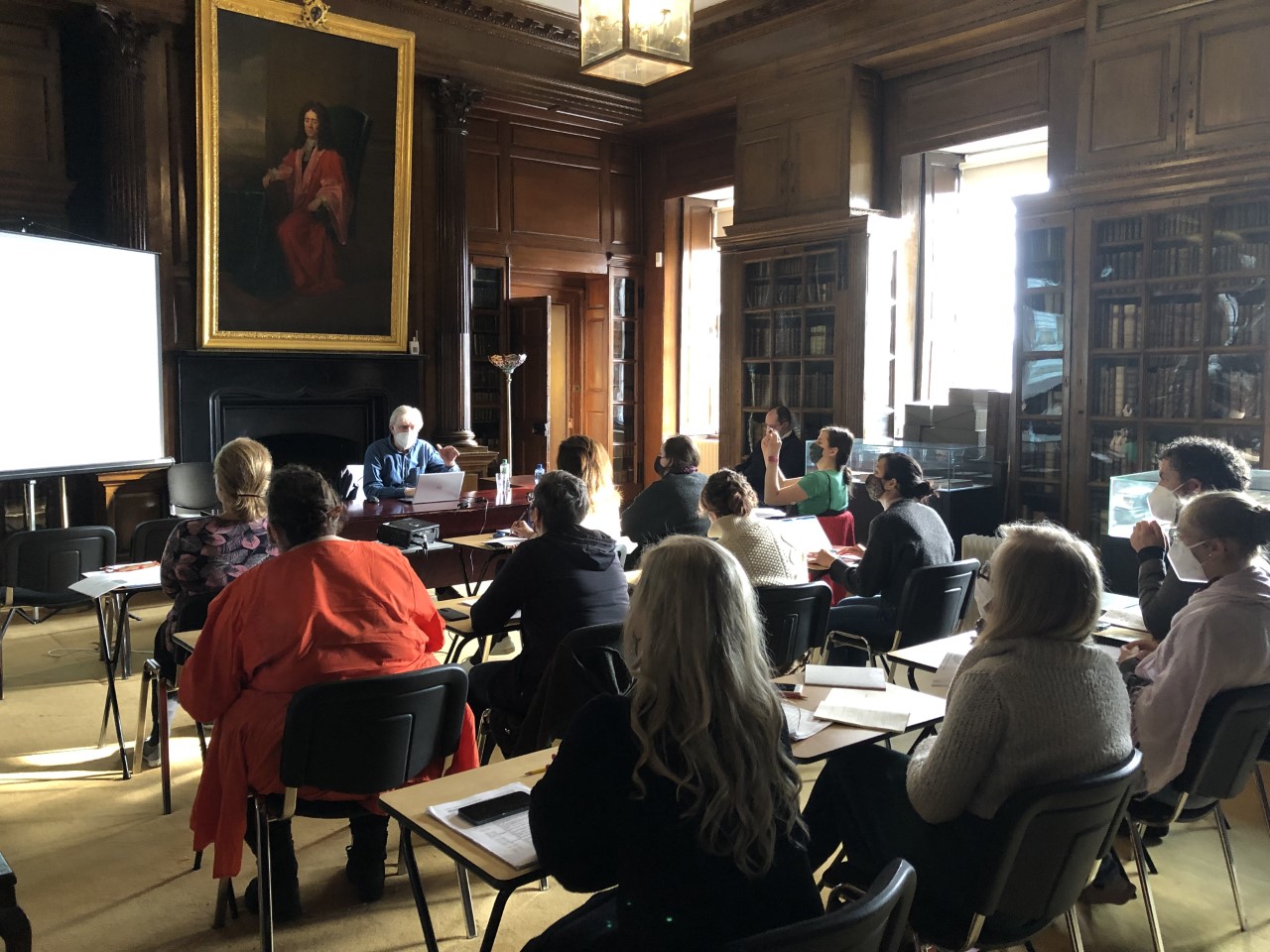
(Fig 2) - Prof. Nicholas Pickwoad teaching European Bookbinding at the Edward Worth Library. Photo courtesy of Elizabethann Boran

Professor Nicholas Pickwoad‘s course on European Bookbinding, 1450-1830 was every bit as meticulous but rewarding as I had hoped it would be. It consisted of rich lectures every morning and hands-on sessions in the afternoons looking at specimens from the Edward Worth Library. Two afternoons included excursions to Marsh’s Library and the Chester Beatty for classes examining their collections in greater detail.

Participants came from a variety of diverse backgrounds, traveling from Estonia, France, England, Germany and Sweden. Eight students were book and paper conservators, while three were Irish librarians (including a digital librarian and two special collections librarians). It was fascinating to see the mix of backgrounds and I was heartened that there was representation within my own profession. Without the know-how to catalogue and describe binding structures as accurately as possible, we are losing great opportunities to provide researchers and scholars with enough material evidence to support important historical research including questions of who bound a book, where and for what purpose?

As a rare materials cataloguer, I have always tried to include at least a brief description of each book’s decorative binding. This course has now given me the knowledge and vocabulary to describe other important elements and how they were made. For example, recording the presence of uncut edges is vital for understanding the status of the book and to be cautious when recording the prices on title-pages to understand exactly what they mean - as without other supporting historical annotation, it can be meaningless - is it the price of the textblock, the print, or the binding?

(Fig 3) - Selection of bindings to examine from the Edward Worth Library 


(Fig 4) -Selection of European bindings from the Chester Beatty


We concentrated on the structural analysis of bindings particularly regional techniques and materials present rather than decorative finishing. We also examined how to date bindings in the medieval period, how to identify the raw materials used (with caution), how to check leather that has been tooled by hand through symmetry, sewing and stitching techniques, recessed supports, spine linings, edge treatments, board types and endleaves – all of which can tell us the where, why and hows of the history of the book as an object.

As books regularly travelled from the bindery to private collections across Europe during this time-period, they were often rebound to suit the taste of their wealthy owners. Patrons could choose their books to be bound in various uniform colours or stripped back to the plain old basics. Thus, Professor Pickwoad emphasised the importance of intact historic collections as one of the most important for studying original bindings - since they were often commissioned for one or perhaps two collectors and unlikely to have moved around. Some Irish examples in this context include the St. Canice’s Cathedral Library Collection on long term loan from the Church of Ireland held at Maynooth University, the Bolton Library at University Limerick and indeed the Edward Worth Library itself.

(Fig 5) - Example of customised fore-edge painting by Cesare Vocellio from the Pillone Library


Week 2 - Identifying and Recording Bookbinding Structures of the East Mediterranean
 
For week 2, the course was divided into two inter-related sessions delivered by Dr Georgios Boudalis and Dr Athanasios Velios, both conservators respectively working on the St. Catherine’s Monastery Project in Egypt. In the first session, Dr Boudalis focused on the major structural and decorative features of different bookbinding traditions that developed in the Eastern Mediterranean, including Coptic bindings, Arabic, Armenian, Georgian, Syriac and Ethiopic books– with a special focus on Byzantine and post-Byzantine bookbindings. We examined various precursors to the multi-gathering codices such as wooden, legal and wax tablets and papyrus rolls.

(Fig 6) - Week 2 Ligatus School 2022 participants at the Chester Beatty. Photo courtesy of Kristine-Rose Beers


While showcasing bookbindings from various museums and libraries (including St. Catherine’s Monastery), we were guided through the development of these closely related binding structures and their influences from the West. Dr. Boudalis emphasised that by examining representations of the codex in iconography, we can ascertain evidence of decorative and functional characteristics that may no longer survive and how they may have been utilised once upon a time. We concluded this session by visiting the Chester Beatty again to view and study examples of these various traditions with an impromptu visit to the Conservation lab hosted by Kristine Rose-Beers, Julia Poirier and Hoa Perriguey.
 
(Fig 7) – Coptic binding fragments from the CBL dating to 600 AD 


(Fig 8)  - Bone ties decorated with characteristic concentric circles used to keep leather ties in place

In the second session, Dr Athanasios Velios introduced participants to the semantic web, Linked Data and the CIDOC Conceptual Reference Model (CRM) for cultural heritage objects. We were also introduced to the consolidation potential currently being explored in a Linked Conservation Data Pilot.

The session consisted of a combination of presentations and hands-on group-oriented workshops. We explored the importance of standardised vocabularies for book descriptions and the significance of using Uniform Resource Identifier’s (URI) to assist systems in linking to a global thesaurus for maximum discovery impact. The afternoons were spent writing xml schema for various book components and mapping these to CIDOC-CRM using 3MEditor, a web application to view xml mapping files and publishing the Linked Data in ResearchSpace, an open-source platform that supports knowledge preservation.

At the end of the course, I received a certificate of completion for my continuing professional development (CPD) records.
 
Reflections on the course
 
I am looking forward to applying new knowledge of concise binding descriptions to my role in Maynooth University Library and perusing our holdings again as we enter an exciting and challenging new phase of the Russell Library Cataloguing Project to enrich records from the collections of St. Patrick’s College Maynooth with copy-specific features related to bindings. If contemplating how to describe bindings, I would highly recommend consulting the Language of Bindings thesaurus as a reference. The course has given me a deeper appreciation for the study of bindings as artefacts and how materiality impacts history. As Prof. Pickwoad declared during one tea break when I revealed that I need to go back and amend a few entries in our catalogue - “I want you to go away from this course feeling worried”… And I do, but in an optimistic way! 

12 Dec 2017

"Outreach is easier if you reach people through others” A summary of the Rare Books Group Annual Seminar 2017: Bringing New Audiences to Special Collections,

Michelle Breen is a librarian at the University of Limerick. Michelle manages the library’s communications, conducts a range of assessment activities and performs research linked to customer service and quality initiatives in an academic library. 
Michelle has presented widely on information management and assessment topics and has had her work published in peer reviewed journals, conference proceedings and LIS practitioner literature. 
Michelle is an active member of the LAI, advocating for CPD for library staff and she acts as a moderator and content creator for the RudaĂ­23 MOOC. 

Picture courtesy of Elaine Harrington

The Chair of the Rare Books Group David Meehan of DCU welcomed an enthusiastic group of librarians and archivists to the Chester Beatty library on November 24th. The delegates from all over Ireland’s museums, archives and libraries, (academic special and public) discussed how to bring new audiences to Special Collections.

I am a member of the LAI and treasurer of the Western Regional Section so I know first hand the value of the contributions of the various sections within the LAI but I must confess this was my first Rare Books Group event. It won’t be my last.

I am also a member of CONUL’s Communications & Outreach group and I am very interested in Outreach and how libraries can become better at it.

I won’t repeat here all of the topics and talk titles from the programme, you can view a summary on Twitter at #RBGseminar17 or view the speaker details on the programme. What I found most interesting on the day was the different successful approaches to outreach that are being practiced in Irish libraries and archives.

Outreach is defined as "an organization's involvement in the community," so libraries who provide services to their external audiences are ticking one particular type of outreach box. However, outreach to traditional audiences could be considered a declining business. The traditional scholarly or academic community is moving online because that is where they expect to find the material they want for their research. Inreach, (which is outreach inside your organisation) could therefore become a significant strand in your library’s activities, engaging your most loyal supporters, already key stakeholders, in your collections and what you are trying to achieve through them.

Perhaps you’ve lost the outreach opportunity to the family historian with the growing dominance of Ancestry. But there are new audiences out there; children, teenagers, and young people for whom there is a resurgent interest in the past. Is it the 1916 factor? The public has an insatiable demand for history at present. Giving teachers, learners, senior citizens, and occasional users a helping hand in our libraries is crucial for libraries. With community impact highlighted through funding agencies such as the Wellcome Trust it is smart to think about outreach to these new audiences.

Picture courtesy of Elaine Harrington

How do we ‘do’ Outreach?

Doing outreach is hard when there are physical barriers in the way of your collections. The very thing you want to show off is under lock and key, so consider your audiences as if they were going to be guests in your home. Send them an invitation, make the environment welcoming, provide a hot or cold drink, give them Wi-Fi and access to the bathrooms. They are your guests!

Run a lunchtime lecture, don’t be afraid that only 5 people will turn up, they WILL tell their friends, and you will get more people the next time. Consider carefully where you host your event, the hard to access parts of your campus or building or town might provide mystery and intrigue to your audiences and they might be thrilled to be there. Do good signage, promise them coffee and they will come. Plan your event carefully and you will naturally find the collaborators you need.

If you are in the glorious position of being able to design a seminar space, like the beautiful seminar room in Chester Beatty Library, then ask your audiences what they’d like to see in there. Make it clear what you can offer them, what they are getting when they come. If you are ever in need of advice about Outreach and how to do it well I recommend you tap in to the expertise of the Rare Books Group of the LAI. I am sure that their chairperson David Meehan can steer you in the right direction or you can ‘reach out’ to them through their Twitter account or their webpage.

Keep up the good work everyone at LAI RBG! Go raibh maith agaibh.

15 Jun 2016

CONUL ANLTC Library Assistant Award 2016: The Kelmscott Chaucer

*Joint Second Prize, won by Helen McGinley, The Library of Trinity College, University of Dublin *


The Kelmscott Chaucer


It is difficult to choose a favourite item in Trinity College Library’s collections but one of mine is the Kelmscott Chaucer, shelfmark Press B KEL 1896 2. It is not particularly colourful – red and black are the only inks used, and the former only sparingly – but despite the unpromising binding of Trinity’s copy it is a beautiful book. How can you not admire the sheer amount of work involved in designing and creating it?

The first opening 

William Morris (1834-1896) set up the Kelmscott Press in 1891, making it one of the earliest private presses. In the seven years of its existence, the press produced a staggering 52 works in 66 volumes. (It was not a private press in the strictest sense of the word as Morris did employ workers but it only published limited editions of material he chose and he had full control of every aspect of production. He admired early calligraphy and typography and said: ‘I began printing books with the hope of producing some which would have a definite claim to beauty, while at the same time they should be easy to read’ (1).

Morris was in no doubt that his books should be printed on hand-made, chemical-free paper and was delighted to find that Joseph Batchelor in Little Chart, Kent was able to produce some for him modelled on a fifteenth-century Bolognese example. Although not keen on vellum, Morris realised that some collectors preferred it and printed a small number of vellum copies of most of the Kelmscott Press titles. He managed to find two suppliers in England who could meet his high standards after the Vatican bought up most of the good Italian vellum. In fact, although the book is printed on paper, TCD’s copy of the Chaucer has two vellum leaves bound in at the back which were trial pages for Froissart’s Chronicles. Morris intended to publish this in two volumes but later abandoned the project.


Morris had strong views on layout, spacing and type, saying that ‘the letters should be designed by an artist, and not an engineer' (2). He spent a good deal of time examining enlarged photographs of existing typefaces and drawing his own fonts, even rejecting some letters after they had been engraved to his specification (3). Each book produced by the Kelmscott Press was in one of three fonts, all designed by Morris and cut by Edward Finch: Golden (based on Roman type), Troy (based on Gothic black-letter type) or Chaucer – this last being simply a smaller version of the Troy created when he realised the larger variant was just not practical for such a large book.


Finding ink to satisfy Morris was far more difficult than sourcing either paper or type had been. He contemplated making his own, but never did, instead trying a variety of suppliers. His friend Emery Walker, who later set up the Doves Press, came to his rescue by suggesting Jänecke of Hanover, whose inks were untainted by “those damned chemists” as Morris saw them. However, this was very stiff ink, making it extremely hard work for the pressmen and nearly causing a strike (4). After further trials of other suppliers, and much correspondence between Kelmscott Press and GebrĂ¼der Jänecke, Morris settled on a thinned-down version of their black ink and a vermillion produced by Winsor and Newton of London (5).


Morris began speaking of producing an edition of Chaucer’s works as early as June 1891 (6) and the illustrations were mentioned rather excitedly in The Athenaeum on 22nd October 1892 under the heading “Fine-art gossip”. The Book Buyer (a periodical published in New York) declared on 18th November 1895 that it would be ‘without question the grandest book of the century’ (7).


Morris, an inveterate doodler (8), designed decorative initials, small devices, 14 large borders and 18 image frames for the work, as well as the title page. His old friend Edward Burne-Jones, with whom he had read Chaucer aloud when they were students at Oxford, provided 87 illustrations. The woodcuts were engraved by Charles Edward Keates, Wilhelm Spielmeyer, George Campfield and William Harcourt Hooper, although Robert Catterson-Smith had to simplify Burne-Jones’s very detailed drawings for Hooper.

Opening from Romaunt of the Rose containing initials, a frame and a border by Morris, and an image by Burne-Jones


Printing began on 8th August 1894 (9) and was finally finished on 8th May 1896. 438 copies (425 paper and 13 vellum) of The Works of Geoffrey Chaucer; now newly imprinted, probably now the bestknown work from the press, were published. A glowing review in The Athenaeum on 3rd October 1896 stated ‘In its own style, the book is, beyond dispute, the finest ever issued’.

Colophon


All images (including the flowers) are from The Works of Geoffrey Chaucer; now newly imprinted, TCD shelfmark Press B KEL 1896 2.


(1) A note by William Morris on his aims in founding the Kelmscott Press together with a short description of the press by S. C. Cockerell, & an annotated list of the books printed thereat (London, 1898) p.1. 
(2) William S. Peterson (ed.), Essays and lectures on the arts of the book by William Morris (California, 1982) p.69. 
(3) William S. Peterson, The Kelmscott Press: a history of William Morris’s typographical adventure (Oxford, 1991) p.87. 4
(4) Emery Walker in a letter to John Johnson, quoted in William Morris and the art of the book (New York, 1976) p.82. 
(5) William S. Peterson, ‘William Morris and the “Damned Chemists”: the search for an ideal ink at the Kelmscott Press’ in Printing History, 3:2 (1981) p.7–11. 
(6) A note by William Morris... p.44. 
(7) Peterson, The Kelmscott Press p.228. 
(8) H. Halliday Sparling, The Kelmscott Press and William Morris, master-craftsman (London, 1924) p.67. 
(9) Ibid. p.164. 


11 Jun 2016

So you want to work with rare books?

So I was really disappointed when I got to library school and realised that there was no longer a module for those of us interested in rare books librarianship. However, a lack of formal education on the subject shouldn’t stop you pursuing it. I have been very fortunate to find myself working with very old and rare materials and it really has been a case of learning on the job. But, also learning ‘off the job’ so to speak.

The first thing I would say to anyone looking to get into the area without formal training is to look for opportunities and ask for help. I visited libraries and spoke with librarians and attended events where I knew librarians working in the area would be speaking. Being pro-active in this way gives you an opportunity to assess whether the area might be a good fit for you. And if it is, these activities also help to demonstrate a genuine interest when looking for experience or during interviews.

Language skills in Latin, German and others can be an advantage as well as others skills such as palaeography. However, I wouldn't say they are a requirement; far more important is a willingness to learn and some curiosity. You can seek out the answers you need using some of the resources I have outlined below and go and find others.

Last November I attended the CILIP Rare Books and Special Collections Group New Professionals Day which I found very useful. There is a good write up about the day on the group’s Spring 2016 Newsletter available on the CILIP website. It includes information about the work of the different presenters, some useful advice and resources such as books that could help steer you in the right direction.

In my current role, as a project cataloguer, I work with rare books and incunabula. It’s been a very enjoyable experience but there are things that prove difficult at times. For example, sometimes the language and text can be difficult to interpret and handwritten provenance information can be a pain. Though, for me personally, the history of the books, and the sometimes beautiful illustrations or quirky marginalia I find more than make up for the times of frustration.

For those interested, the following are a number of resources I have found useful and some I intend to use in the future:

Glossary of book terms - http://www.alibris.co.uk/glossary/glossary-books
Short guide to book bindings - http://www.abebooks.co.uk/books/RareBooks/collecting-guide/understanding-rare-books/understanding-bindings.shtml
Guide to Latin place names - http://rbms.info/lpn/ - useful for identifying where items were published.
British Library’s Incunabula Short Title Catalogue – Contains links to digitised versions to help with identification and to check for variances.
Copac – To check other library holdings and sometimes to help with decisions about Subject Headings etc.
Reading old documents – The National Archives have a useful set of tutorials - http://www.nationalarchives.gov.uk/help-with-your-research/reading-old-documents/
Database of British Armorial Bindings - http://armorial.library.utoronto.ca/
I also tend to use Google Translate a bit – it’s not the most accurate but sometimes it can help.

In terms of further education or CPD there are a few options that I know of:

MOOCs – Both Harvard and Stanford offer MOOCs about the history of the book and printing.
Aberystwyth University offer add-on postgraduate short courses on rare books librarianship.
There are also a number of rare books schools and summer schools, the London Rare Books School being one.
Plus, as mentioned, a lot of conferences and new professionals events have excellent speakers who have worked in the area so keep an eye out and attend if you can.
Of course, I have only been working in the area for a short time and by no means am I an expert so if anyone knows of any other useful resources or has any further advice, please do contact me, leave a link or comment in the comments section.

My final words of wisdom are it might also be good to identify, and then try to get some experience working with, different aspects of the job. For example, this could be working with social media or writing funding applications. Even if you can’t find a special collections or rare books librarianship role maybe look at the various aspects of the work and try to build up your relevant experience so when that perfect job does come up you can be far more confident about your application.

By G. M. Crespi - Source Wikimedia Commons Public Domain.

Posted on Saturday, June 11, 2016 | Categories: ,