Showing posts with label classification. Show all posts

25 Jun 2021

Controlled vocabularies should no longer be created and used because they are biased.

Blogpost by Alison Kindegran. MLIS student at UCD. Graduating in 2022.

"LCSH" by Travelin' Librarian / CC BY-NC 2.0.

Introduction: 

Controlled vocabularies are organised and arranged word and phrases used to retrieve items via navigation and searches. The purpose of this essay is to form an opinion on the narrative:

“Controlled vocabularies should no longer be created and used because they are biased.”

To form a well-rounded opinion extensive research was conducted. While it was easy to find many articles and journals agreeing that controlled vocabularies are biased and therefore should no longer be used, the argument to continue the use of controlled vocabularies was under represented. There were by far more challenges noted than benefits. However, the writer of this essay did take into consideration all points and did not allow the majority of those in agreement with the statement to sway their opinion from the outset and used self-debate for both sides with supporting articles for each side to form the understanding of both sides and ultimately to form a conclusion.

Benefits of Controlled Vocabularies:
The main areas that are beneficial are:

•    Users with limited knowledge of a topic:
It is believed that even if a user has limited knowledge on a topic they wish to perform a search, the main benefit of controlled vocabularies is that once you have the heading then all classifications or variants will be found.  

•    Vocabulary Deficits:
The use of controlled vocabularies is beneficial for vocabulary deficits; this is where one user may have limited terms on a subject. The benefit is, if they have one term it will still retrieve their search, showing the additional terms available thus adding new terminologies to the user’s vocabulary which would close the gap of deficit in the future and an additional benefit to the user.

•    Topics/Concepts Covered:
Controlled vocabularies guarantee the topic and concepts are covered in the article if the subject heading is listed this assures the topic is covered in the article. Controlled vocabularies can make a search more specific. The hierarchy structure will go from broad to specific as the user goes through the headings where they are narrowed down.

Challenges of Controlled Vocabularies:
The main challenges of controlled vocabularies:

•    Synonymous Concepts:
There are a number of popular used examples when researching the synonymous challenges and the most common examples for this are around soda, pop, soda pop and coke. Soda pop and coke are examples of words that often represent the same idea, or thing. However, those are used differently in different regions and some regional dialects use different terms altogether. The author would not use these words at all. As the author is from Ireland, the words used would generally be fizzy drink, mineral. Also here in Ireland, there is no use of a particular brand or drink type used interchangeably to refer to a number of drinks just the drink noted. For example, coke is used in the above example as it referring to any fizzy which seems to be acceptable in the USA. However, Coca-Cola also known as Coke is to refer to this drink only in Ireland as Coke would be considered completely different to Fanta Orange (alternative brand and drink type) this would not be used interchangeably.

•    Word Form:
Word form is also a challenge. An example would be the word “Online”. The writer would use online all in one and not hyphenated. However, the word online is also acceptable in other formats such as: on line and on-line.

•    Homographs:
Words that look that same but have different meaning, these may or may not be pronounced the same. The pronunciation is not an issue but rather the same spelling of different meanings which would result in the incorrect result. For example, if the user wanted to search bat referring to the animal their result would also include bat referring to the sports equipment. One could argue that the use of qualifiers would remove any issues with this for example: bat (mammal). Similar issues arise with homophones, words that sound the same but are spelled different such as fowl and foul.

The above is not an exhaustive list but an example of the main benefits and challenges with controlled vocabularies. So where is the discussion or argument for bias?

The writer would argue that the bias begins with ignoring that it exists. In the research carried out the challenges that were noted by those who overall would advocate for the use of controlled vocabularies did not address bias at all. This is a concern as not addressing these concerns from those who believe that controlled vocabularies are bias is not helpful in their efforts to portray the benefits and advocate for its use. By and large, those who advocated for the use of controlled vocabularies where libraries, universities or individuals associated with these libraries or universities where controlled vocabularies are used and/or a taught subject. The writer of this essay believes that as it is used and/or taught they do not wish to portray it in any negative light. However, the writer believes that anyone can advocate for something while still addressing any issues it has such as bias.

Ways in which controlled vocabularies are bias:
•    Outdated Terminology:
This is particularly the case in racial categories. There are not reflective of current terms and inclusive of all racial groups.

For those who identify as non-binary, the LCSH term “gender non-conforming people” is an exact match for “non-binary people”. Being gender non-conforming is not the same as being non-binary, although some will identify with both terms. People do not have to be non-binary in order to be gender non-conforming.

•    Too simple in terms and non-representative:
An example of this would be that all First Nations groups are not part of the LCSH or Library of Congress Name Authority File.

•    Non-Proactive Approach:
Most would accept that historic terms for certain groups of people could be described as historical, inaccurate, non-representative and offensive so would expect changes to be made. However, a major issue is the non-proactive approach in addressing these required changes. LCSH as an example have been slow to update the changes. There are a number of resources which would help them make these changes including representing bodies or groups if they were not fully educated on the correct terms. They are freely available.

•    Language Vocabularies:  All languages are not included.

With a number of clear bias found as set out above consideration was given to what the alternative would be if controlled vocabulary was no longer created or used. The result being keywords being used as an alternative. Using keywords, non-controlled vocabulary or natural language as it is also known has a set of advantages and disadvantages of its own which are outside the scope of this essay. In summary, these searches would likely result in a broader search which may include non-related topics.

It is difficult to portray in general terms the impact that these biases have on those they impact. In order to highlight that impact the writer will include an individual focus piece as part of this essay. The piece will focus on one particular individual and their experiences.

Individual Focus: Safiya Umoja Noble

Safiya Umoja Noble is an Associate Professor at UCLA in the Departments of Information Studies and African American Studies. She is also an author of the book Algorithms of Oppression: How Search Engines Reinforce Racism (NYU Press). She has also done a number of Tedx Talks including one entitled “How biased are our algorithms”.

Safiya talks about her mixed-race background and how she had grown up during a time of cultural revolution. The 1970’s was when civil rights movement was highly active and the Black Power Movement was “creating change for how African Americans saw themselves” (Noble, 2014).

Her white mother was aware of a previous study that was done in the 1940’s where black children were given a black doll and a while doll and asked which doll was the best, the prettiest, which one did they like the most? The black children would all pick the white doll. Her mother tried to instil her daughters’ pride in her own black heritage and did not want her daughter to feel negative thoughts and feelings towards her own race.

This experience led Noble to research this further in 2009. One of the first searches she conducted in 2011 was a simple entry into Google “black girls”. The results were of a pornographic nature where they sexualised black girls. In contrast a search for “white girls” returned blonde haired blue eyed general pictures of girls with no implied sexualisation for this general search term in the results. She worked to change this and only months later the algorithm changed and this result in a search for “black girls” is no longer the case.

She is advocating for the pursuit of socially responsible information and technology. She talks about the exploitation of children in the Democratic Republic of Congo where they work in deplorable conditions to source parts required for technology. She wants everyone to consider the part they play in all the above.

In her book, Algorithms of Oppression: How Search Engines Reinforce Racism (NYU Press) she talks about how the public generally views what they find on places like Google to be credible and fair. However, her research found that it was largely misrepresentative. Taking marginalised and oppressed people and making them further marginalised and oppressed with their racist and sexist algorithm bias. She talks about how it is designed to make some heard and others silenced. She finishes the book by seeking alternatives. She argues that there needs to be searches that are for public interest and not driven by marketing and money-making schemes.

The writer of this essay would agree that they also would have considered Google or any other search engine to be credible and fair. While the writer would not consider it the best resource for research, it is the most used way to source information in the modern digital age. The term “Google it” is often used as a response to a query raised by others rather than suggesting an alternative search engine or other resources. It has become an easy and acceptable form of mass use for information. The writer has used it for personal use and to find that the results were most likely skewed in a way that further marginalised people is alarming and seriously problematic. It has truly opened the writers mind to the impact of this on those it affects and the public at large.

Conclusion

There is no doubt that bias exists within controlled vocabularies. The bias has been formed due to historical bias, intentional bias, unintentional bias and unconscious bias. The individual focus piece opened up the problems further. However, it is the writer’s belief that the use of controlled vocabularies remains beneficial. The writer believes that with a number of changes the bias can be removed and the benefits of controlled vocabularies will remain. The end of controlled vocabularies does not address the biases but rather shifts it somewhere else. That is why the recommendations will focus on removing bias and making better more inclusive controlled vocabulary options.  The writer offers a number of recommendations to address and remove forms of bias within the controlled vocabularies. The benefits can be advocated for while making changes to the issues. It does not have to be one or the other.

Recommendations:

Education: While some bias will have been intentional the writer would like to believe that these are historical and that no truly inclusive database owners, creators and users would like to continue with these bias terms. It is fully acceptable that the desire to create change is there but the knowledge on terms may not. This is where the education around the terms will be required. There are a number of international and local groups that can assist with correct terminology who should be sought out and collaborated with to bring about these changes.

Support the change:  Change is a difficult transition for most people. Change is usually met with resistance. In order to support those affected by this bias, first of all, support change. This is an opportunity for those affected by bias to be supported and to support those addressing the change with guidance and education.

Evolving terminology: Understand that this change will be ongoing. A term that was acceptable decades ago can be considered outdated or offensive today. Understand that the same will be true for words used right now. They become obsolete and new terms will inevitably develop over time.  
 
Understanding: Just because a term does not offend or affect one individual, it must be understood that it may not be appropriate for those who are part of a particular community or group. Don’t use outdated terminology and don’t accept it within your controlled vocabulary or indeed anywhere else. Advocate for your family, friends, colleagues and even strangers who are part of these marginalised communities.

Accept Feedback: Provide an option for users to give feedback on existing controlled vocabularies. Those who are affected are best placed to assist with change.

Show Progress: All words which are under review for removal or areas where terms are to be created could be highlighted. The changes will take time and overall will be an ongoing challenge. Let everyone know that the bias is being challenged and addressed from within.

Proactive: This is one of the most important steps. Without being proactive and creating the changes required the argument turns in favour of no longer using controlled vocabularies due to bias.

References:

25 May 2021

The Politics of Subject Headings

Guest post by Ailbhe O'Rourke, MLIS student graduating in Summer 2021.

In February 2014, a group of students from Dartmouth College stumbled upon the subject heading “illegal aliens” in the Library of Congress database. With the support of their campus librarians, the Dartmouth Coalition for Immigration Reform, Equality, and DREAMERs (CoFIRED) submitted a request to the Library of Congress to revise the heading “illegal aliens” and replace it with the term “undocumented immigrants”.

Since the early 2010’s, the term “illegal alien” had been widely acknowledged as a racist and outdated phrase. By 2014, news outlets and politicians had dropped the expression from their vernacular and the term had been phased out of public discourse. In 2016, the Library of Congress announced the intention to replace the term "illegal aliens" with "non-citizens".

However, in this instance, the symbiotic relationship between LoC subject headings and U.S. politics became apparent as Senator Diane Lane moved to block the proposed change. This was the first incident of the House of Representatives blocking a LoC subject heading amendment.

One might ask how a presiding U.S. government can have authority over the manner in which subjects are catalogued. The question is all the more pertinent considering the American Library Association describes itself as content- neutral, unbiased and nonpartisan. Library of Congress subject headings are in ubiquitous use across the world. It is concerning that this institution, which welds such power across in both the U.S. and internationally, is at the mercy of the House of Representatives.

A brief history of the LoC within the context of U.S. politics

Politics and the LoC have an uneasy relationship dating back to the post- war years. During the Cold War, librarians fought to retain the “right to read” amid increasing attempts at censorship by the U.S government. The post-war climate was one of paranoia and fear. As the USSR continued its expansion across eastern Europe, American society was on high alert and feared that communist interlopers had infiltrated their society. The U.S. government was eager to censor any material that could be considered communist- this did not pertain only to socialist literature, but anything written by an author who had been accused of having communist sympathies. 1948, the ALA sought tostrengthen the Library Bill of Rights to preserve intellectual freedom andmaintain the “right to read”.

In the early 1950s Senator Joseph Mc Carthy commenced a series of senate hearings investigating “anti-government activities”. The era of “McCarthyism” had begun. Riding a wave of populism and fear- mongering, the charismatic Mc Carthy conducted hearings, ideally targeting well-known victims that would garner a lot of press. In a pre- twitter era, these hearings were headline grabs; no more than publicity stunts, aiming to capitalise on a fraught nations’ post -war paranoia. Rarely were any of Mc Carthy’s accusations proven or prosecuted.

Two of Mc Carthy’s right-hand men, Roy Cohn and David Schine, were sent on an overseas tour to ensure that European libraries had removed books from perceived “communist” authors. Cohn and Schine were instructed by Mc Carthy to remove and burn books by authors that had been “blacklisted” as a result of refusing to testify during Mc Carthy’s Senate hearings, however a directive then changed these instructions to removing and storing these books in a place where their corrupting influence could not be felt.

In 1953 Dwight Eisenhower had been elected president. He was no fan of Mc Carthys, but needless to say he had been quite happy to capailtise on the controversial figures’ popularity to win the Presidency in the previous year. As a retort to Cohn and Schines enthusiastic auditing of European libraries Eisenhower made his position clear, saying:

“Don't join the book burners. Don't think you're going to conceal faults by concealing evidence that they ever existed. Don't be afraid to go in your library and read every book.”

Coincidentally, this speech took place at Dartmouth College, where the conflict between librarianship and politics would reignite sixty years later. Mc Carthy’s reign was brief but impactful, and by the late fifties his senate hearings had fizzled out. However, the long-term affect upon the library as a tool to reinforce political ideals would continue to be felt in the decades to come.

The Delta Collection

For author Melissa Adler, a browse amongst subject headings would reveal outdated social attitudes entrenched within the LoC catalogue. Headings related to homosexuality had been historically classified under “sexual deviation”, harking from the days when queerness was universally accepted to be a symptom of psychological illness. She looked for “homosexual” or “bisexual” within subject headings and found the subject heading “Paraphilias” occurring within the cataloguing of books about LGBTQ issues.

As well as policing personal politics, in post- war U.S. the government attempted to police sexuality. In common parlance, the words “communist” and “homosexual” were interchangeable terms, and a relentless fear of the perceived “other” permeated social discourse. (In fact, Mc Carthy would become a victim of his own methods when his opponents heavily implied that he had a sexual relationship with Roy Cohn.)

And so, the Delta Collection was born. Housing materials deemed too obscene for the public, including books such as Lolita and Ulysses, titles within this collection were assigned subject headings such as “sexual perversion”. Books such as Kharmasutra and Fanny Hill as well as books about birth control and sex within marriage were amongst the books assigned to this collection in the late 1880s. However, during World War 2, the Delta Collection took on a patriotic role as political materials deemed as anti- American were also added to the collection. “This climate no doubt altered the very nature ofthe Delta Collection from being a repository of the cultural record to being apolitical actor in the post-war era, one with increasing significance asMcCarthy’s policies and rhetoric came to dominate.”

One can trace the evolution of social progress through the changing LoC subject headings relating to sexuality. From 1898- 1972, books that contained LGBTQ material were catalogued under “sexual deviation”. From 1972 to 2007, “sexual perversion”. And from 2007 to this date, “Paraphilias”. “Homosexuality” was added to the sub heading in 1946, reflecting a newfound social awareness of homosexuality in popular culture. “Lesbians” was not added until 1974. “Homosexuality” was cross referenced with “sodomy” and “social pathology” until 1972.

Renowned cataloguer and trailblazing librarian Sandford Berman, in conjunction with the Task Force on Gay and Lesbian Liberation, were instrumental in petitioning for the changes that occurred in 1972. The changes that Berman facilitated removed connotations between homosexuality and mental illness. In 1975, in a gesture a progressive gesture that was ahead of its time, the ALA and LoC issued a statement advocating for minority groups to be permitted to describe themselves, rather than submitting to the descriptions of psychologists or politicians.

Looking to the future- the role of the cataloguing librarian

In the spring of 2016, the House of Representatives ordered the LoC to continue using “illegal aliens”. This was the first time the House of Representatives had intervened in a planned subject heading change. Politically, 2016 was a fraught time of transition. Promising a wall between Mexico and the U.S., Donald Trump had become president. Brexit was looming across the Atlantic. Both of these incidents had been enacted by a rising wave of emboldened racist discourse.

This means that the intervention by government in the subject heading change was a symbolically significant event. Just as the ALA had had apprehensions of what loomed on the horizon in the late 1940s, this decision sent shockwaves through the world of librarianship. Much as the subject heading “sexual deviant” had sought to reinforce social norms in the post -war years, by preserving “illegal aliens”, Republicans sought to control the language in which undocumented immigrants were discussed. History seemed to be repeating itself. Trump further evidenced the power of language and the intent of the U.S. Congress by resurrecting the then defunct term “illegal aliens” during campaign rallies. By resurrecting this term, both Trump and the Republican party sought to spread fear and create a sense of “othering” much as Mc Carthy had sixty years previously.

Still, the librarians rebelled against the U.S. Congress. Harvard and CSU library replaced “illegal aliens” with “undocumented immigrants” within their own library systems. Over forty other libraries have followed suit with the same course of action. As of April 2021, “illegal aliens” remains a subject heading within the LoC.

Much has been said and written about the librarian’s role in fighting the rising tide of “fake news”. It is increasingly impossible for librarians to remain unbiased and nonpartisan in the multi literacy age, however looking back at history once may be forgiven for wondering if they ever truly could be.

Less has been said about the way information is catalogued, and how it can have long term ramifications for democracy, human rights and social progress. The LoC subject headings of any particular era are a snapshot of cultural norms and social attitudes- language is how we shape the world around us. But in the case of LoC subject headings, language can also be wielded as a weapon and instrument of oppression.

2 Mar 2015

Marvellous Mapping: Reflecting on online identities and practices using Visitors and Residents Mapping - Workshop, NUIG 13 March 2015


Guest post by David White, Head of Technology Enhanced Learning at the University of the Arts London & Donna Lanclos, Associate Professor for Anthropological Research in the J. Murrey Atkins Library at UNC Charlotte. Dave is the originator of the Visitors and Residents concept, and both he and Donna are on the research team which has developed the related JISC infoKit

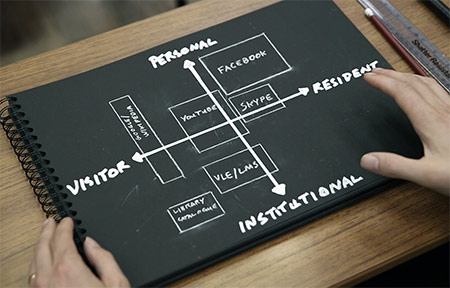
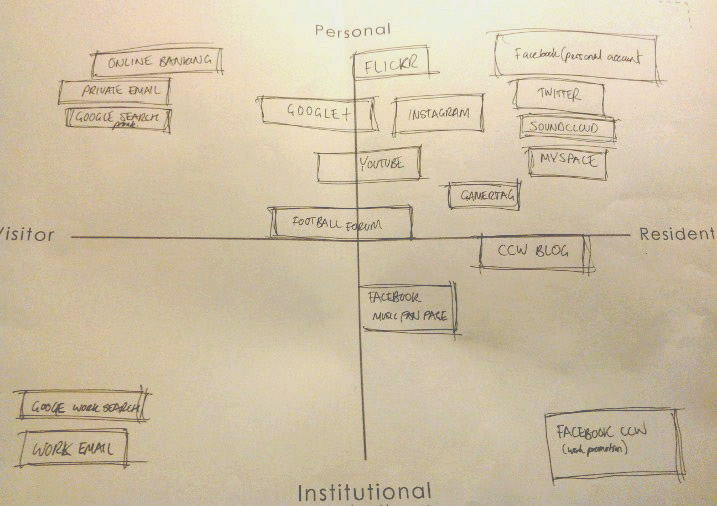
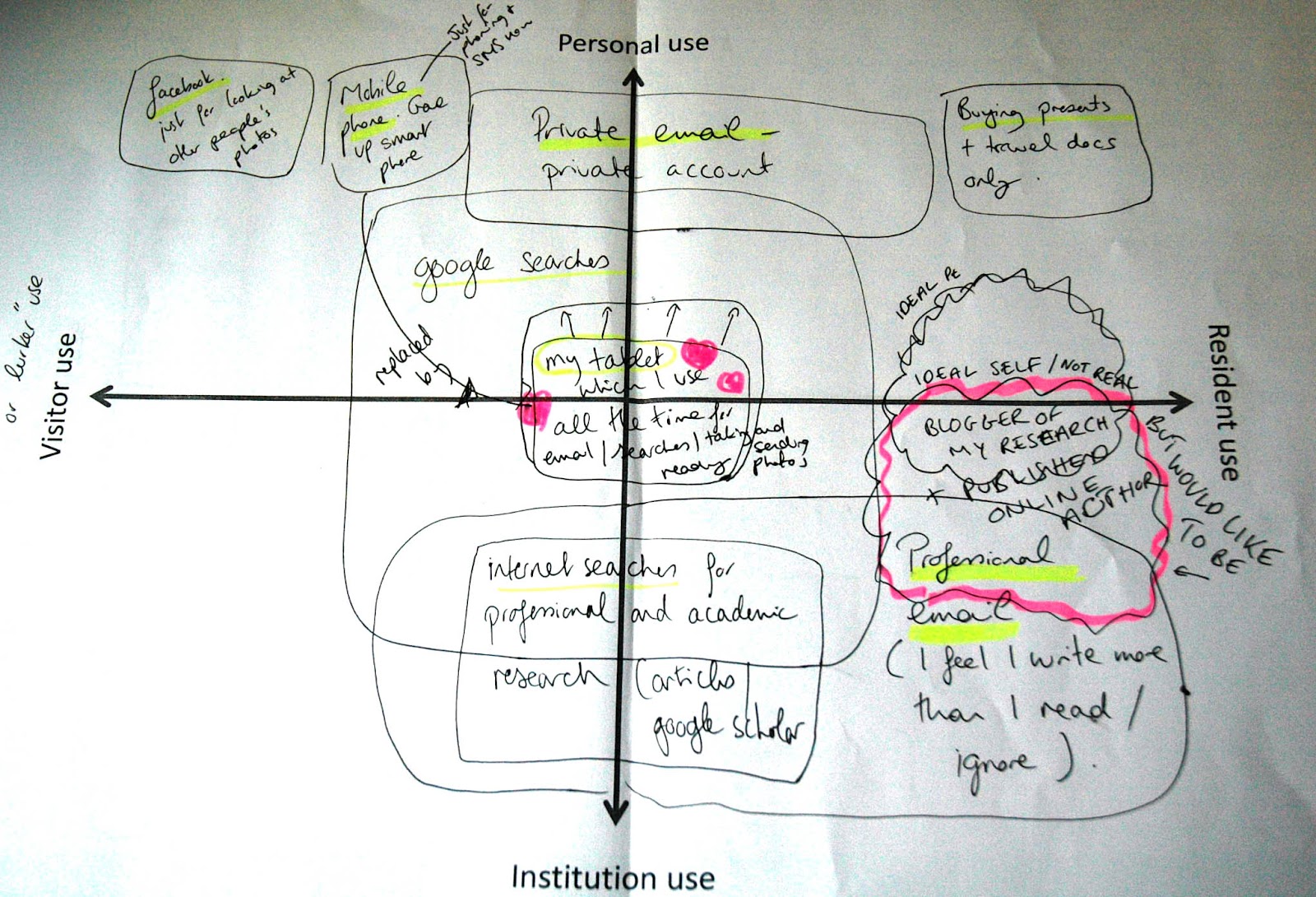
On the 13th March, at the invitation of Catherine Cronin  and with the support of the National Forum for the Enhancement of Teaching & Learning, the two of us will be running a ‘Visitors & Residents’ mapping workshop at the National University of Ireland, Galway. Visitors and Residents is an idea we and other colleagues have been developing as a simple way of describing the broad range of ways in which individuals use the Web. It’s based on motivations to engage rather than age or technical skill.


The mapping process has been refined over the last couple of years and is one of the outputs from an ongoing longitudinal study into how learners engage online. The strength of the process is the way in which it helps individuals to reify and visualise the various ways they engage online. This is especially because most of us do have a sense of the ‘geography’ of the various sites and services we use online but it’s not easy to express.

Most individuals also have a well developed model of who is in each network they are members of in Resident modes and the character of the dialogue they will be in across those networks. For example, we understand the modes of engagement in work email and how they differ from being active within a Facebook group of a personal interest but it’s unlikely they we will have mapped these engagements side-by-side even if they, at times, influence each other.


SS_Other_Face-to-face_Student_25-35_nm2_id238.jpg
1st Year Health & Social Care Student

AH_Student_35-45_su1_id50.jpg
3rd Year PhD Student
More recently we have been working on a detailed guide for the mapping workshop. The process has evolved as we have run the mapping workshop with various groups from a variety of academic disciplines and a range of higher education institutions, and via feedback from others who have run workshops for themselves. During this time we have also created a suite of mapping related resources including a pool of the maps from participants which act as examples of specific styles of online engagement. The guide gives a suggested structure for the workshop and collated these resources. Significantly the guide also highlights recurrent themes that have emerged from discussions around maps and offers constructive ways to explore those themes with groups.

The Marvellous Mapping session in Galway will be our first chance to pilot the format we have suggested in the guide. As such we see it as an important stage in the evolution and application of the Visitors and Residents idea. If you can, do come along to the workshop or take a look at the guide to see if you could run a mapping session at your institution.


Marvellous Mapping: Reflecting on online identities and practices using Visitors and Residents mapping will take place at NUIG on Friday, 13 March 2015 from 11:00 to 15:00. For booking information for this free event see here .
If you cannot make the event the main section of the workshop will be live streamed. The event will be live tweeted using the Visitors and Residents hashtag #vandr
 

18 Feb 2015

Framing an exhibition – reflections on Sir Henrys@UCC Library


UCC Library  hosted an exhibition entitled SirHenrys @UCC Library throughout the summer of 2014. The exhibition told the story of the much loved, now defunct, Sir Henrys Bar and Nightclub that was located on South Main Street, Cork. This club was a vital part of Cork’s social, cultural and musical life from 1977-2003. It was renowned locally, nationally and internationally for its vibrant music scene – both rock and dance scenes – and the sense of community that these scenes inspired in those who attended the club on a regular basis.

The exhibition was very much a creation of the virtual, social media, world. It began with a simple tweet that turned into a discussion and it snowballed from there.


The exhibition was promoted primarily through social media, specifically through the exhibition’s Twitter, Facebook and Blog accounts. The actual items and material on show in the space, loaned by people who created the club, attended the club, worked in and ran the club, were garnered primarily through these networks. In essence the exhibition was crowdsourced. Or crowd harnessed as a comment on the exhibition comments’ book put it.

Literally over a thousand items spanning the beginning to the demise of the club was gathered. It is this material, and the whittling down to what was finally chosen for inclusion in the actual physical exhibition that the remainder of this post is concerned with. The remainder of the post is specifically a reflection on the selection process for the pieces, ephemera and texts and narratives used in the exhibition. The post looks at the curating of the exhibition and the framing that is inherent in the act of curating.


When selecting, along with the other curators Stevie Grainger and Eileen Hogan , the actual material that would go into the exhibit cases and feature on the storyboards I was reminded of a lecture I attended as a third year Sociology student. The module was Media Studies and the lecture examined the concept of ‘Framing’. Irish sociologist, (and the lecturer for that course)  Ciaran McCullagh in his book Media Power provides a succinct definition of what framing is and does:

“The basic argument about framing is that the media do not simply provide us with information on certain issues and events; they also provide us with perspectives on them. These place the events and issues within particular contexts and encourage audiences to understand them in particular ways. In effect, the media do not simply select events to cover; they also offer interpretative frameworks through which these are to understood”

Through choosing what items to include I became very aware that we as curators were in fact framing how ‘Sir Henrys the Club’ was going to be perceived in ‘Sir Henrys the Exhibition’. I was aware that we were not just presenting pieces in an exhibition in a neutral way. We were providing a particular perspective on Sir Henrys. As McCullagh says, we were creating an interpretative framework through which Henrys could be, and would be understood by those who came to visit the exhibition. This framing effect would be magnified for those who never attended the club. For example those students not born when the club was in existence would be learning a very small part of the story and that story they learned was framed by what we decided to include in the actual physical exhibition space.

This is a particular issue when you consider that Sir Henrys existed as a club for over twenty-five years. Twenty-five years is time enough for three or four generations of club goers and many music scenes to have stepped through its doors and climbed those infamous steps. How could we objectively condense twenty-five years into an intimate exhibition space? Would it be even possible to do so? Is it ever possible to do this?

Any one piece we chose to exhibit meant excluding another twenty or thirty pieces. Choosing a picture of one band meant leaving out countless others. Choosing to reference DJ V meant excluding DJs W, X, Y and Z.

The act of curating by its very nature is an exclusionary exercise.


It becomes a further issue when you consider that this exhibition took place in a university library. This problematizes because the university is an institution that can bestow legitimacy upon objects and areas of study. When we chose an object we were elevating it above another. When we chose one band we were, tacitly, claiming they were more important than another. This is not something we took lightly.

The way we tried to get around this issue of framing was to highlight the virtual part of the exhibition – our social media aspects – Twitter, Blog, Facebook. These virtual sites were truly part of the exhibition. The social media side, for us, was as much a part of the exhibition as the physical space in the foyer of UCC Library. For us, the material on the Facebook page was, and still is, a richer representation of what Sir Henrys was. It goes someway towards providing a true representation of what Sir Henrys was and remains to those who went there. The Sir Henrys Blog is alive with people’s memories and stories in the form of guest posts. These blog posts composed of people’s memories of Henrys captures Henrys and its spirit far better than any physical exhibition could. The countless stories, pictures and comments, tweets, blog posts provide a richer, far deeper representation, of what Sir Henrys was and remains to be for those who attended it.

Perhaps for a curator / curators to really represent an object or phenomenon they need to incorporate the virtual world? This virtual world, by its very nature, provides a much larger canvas upon which to display the work.


Conclusion
 The main lesson that I have learned from the process of curating this exhibition is to always ask the questions of who, how, why and what.

When I next attend an exhibition – whether that be in a museum, a gallery, a library or wherever, as well as enjoying the exhibition I will ask myself the following questions. Who did the choosing of the pieces contained within – what is their connection to the exhibit, who are they? How did they choose the pieces on show? How did they select them? Why did they choose these particular pieces as opposed to other pieces? What pieces are not on show? What pieces are lying in archive boxes? Or stored on shelves in some storeroom in the building? What pieces are not on show?

I will ultimately be asking what story is being told?  How is this show framed?


(This post was originally posted on the The Riverside UCC)
Martin will be presenting a case study on Sir Henrys @UCC Library at the 2015 A&SL Annual Conference & Exhibition

18 Nov 2012

Introducing the Hurdy Gurdy Museum of Vintage Radio...

Ye Olde Hurdy Gurdy Museum of Vintage Radio
On a hill in Howth resides the Hurdy Gurdy Museum of Vintage Radio in the historic setting of Martello tower no. 2. Since 2002 Pat Herbert, the curator, has housed all manner of artefacts, relating to Marconi and the history of communication.

Various constraints meant that the museum's catalogue remained undeveloped, until this year. So when looking to jump into a cataloguing project, choosing the Hurdy Gurdy was not a difficult decision. The criteria? A greenfield in terms of cataloguing, a rich collection and an agreeable management team. Evaluating the IT infrastructure within the tower, it was apparent that a local server solution was not feasible. In order to promote the museum’s collection an online public catalogue would be preferable. Financially speaking open source was the only option, and so Omeka.net ticked all these boxes.

Omeka.net was constructed for museums to archive their artefacts in the cloud. Functionalities such as exhibiting collections online and Google analytic plug-ins made the site attractive. Dublin Core metadata is the primary descriptive method on Omeka. Visually attractive, Omeka would allow the team at the Hurdy Gurdy to exhibit online their various collections in an effective and informative manner.

Downstairs exhibits
Dublin Core suited our collection considering the wide variety of objects in the museum. There are a number of specific collections within the museum, such as radios, valves, household products and historical documents from the foundation of the Irish state amongst items relating to the history of telecommunications.


With the upcoming anniversaries relating to the foundation of the Irish state such as 1913 lockout, 1916 Easter Rising, 1919 War of Independence and the 1922 Civil War, we recognised that certain areas of the collection would generate interest.


As we became more familiar with the various aspects of the collection, we began to formulate a cataloguing policy.

Rental receipt from 1922 with (Irish Free State) stamp
As we began to virtually classify items, the activity surrounding this allowed us to re-evaluate the exhibits within the museums physical space. Fuelled by tea, Wagonwheels® and a love of all things vintage, we classified items within specific collections on Omeka. As the catalogue took shape online, we began to construct mirrored collections within the museum itself, areas such as a valve corner, an Irish history space and an Ever Ready® dry battery display. This has only enhanced what is already a splendid collection of radios, valves, artefacts and batteries, this is an untapped treasure trove of historical items within the Howth environs.

So far a thoroughly rewarding endeavour and will hopefully continue to be so.

Marie-Therese Carmody - Cataloguer Hurdy Gurdy Museum of Vintage Radio
Sarah Connolly - Cataloguer Hurdy Gurdy Museum of Vintage Radio

18 Oct 2012

How to create a taxonomy

David Haynes delivered a one-day workshop last week on behalf of the LAICMG on how to go about organising and classifying information. The day was structured around taxonomic theory, classification and metadata, development of controlled vocabulary and a brief overview of taxonomy software tools. Practical examples and hands-on exercises throughout the day created a rounded training experience.

Source: Wikimedia / Page  837 from the
 10th edition of Linnaeus's Systema naturae (1758),
explaining the so-called "sexual system" of plants.
The term taxonomy requires clarification. Essentially, a taxonomy represents a hierarchy of items based on shared characteristics that are internal to them. A prominent example would be the Linnaean taxonomy of rank-based biological classification.

A more pertinent rendition for our purposes here would be something like ‘a systematic way of organising knowledge, providing a hierarchical structure of concepts, using terms that help in the development of a common language to aid knowledge sharing’ (Wylli in Raschen, 2005). Taxonomies organise unstructured entities (living organisms, documents, webpages, artefacts, concepts and ideas etc.) and their contents into categories with the aim of being meaningful to information seekers.

Likewise, the terms ‘classification’ and ‘ontology’ need qualifying too as they are closely related and tend to confuse. Merriam-Webster describes ‘classification’ as systematic arrangement in groups or categories according to established criteria. An example here would be the separation of animals in the classes tasty, edible and not edible. ‘Ontology’, on the other hand, is a higher order concept and branch of metaphysics concerned with the nature and relations of being or a particular theory about the nature of being or the kinds of existents. For a qualifying characterisation of the terms ontology, taxonomy and classification and their respective differences, see van Rees.

What are the benefits of creating taxonomies?
  • They promote knowledge sharing through logical classification of in-context entities
  • They aid information retrieval
  • They facilitate differentiation between the meanings of similar sounding descriptive words or words with multiple meanings
  • They structure the semantic Web
Challenges:
  • Always consider the end-user/target audience
  • Keep the taxonomy straight forward and tangible
  • Aim for solid built and scalability (future proofing)
  • Consider potential word ambiguities (use of synonyms)
The training showcased some interesting taxonomy examples, such as the Tree of Life Web Project and reflected upon common approaches to classification (DDC, faceted classification, Colon classification). The idea of metadata was discussed, including Dublin Core as a common metadata standard within the context of describing Web resources. The importance of deploying controlled languages as a means to achieving greater precision in the description of information resources and more comprehensive retrieval was also discussed in detail.

The merits of software tools for taxonomy development were also considered: automation of routine and clerical tasks, coordination of multiple contributors, keeping track of individual terms, keeping track of relationships between terms, ability to represent taxonomy/vocabulary in different formats and facilitating upkeep and maintenance of your taxonomy.

All the same, an appraisal of common software tools and specific usage examples would have greatly enhanced this part of the training.

Check out this survey on taxonomy building tools, which considers software that is readily available and variably useful for the design process.
Thesaurus tools:
MultiTes, A.K.A, Ontology Manager, TermTree, Webchoir/TCS-10
Brainstorming tools:
MindManager, Bubbl.us, FreeMind
Ontology tools:
SWOOP, SemanticWorks, Protégé, TopBraid Composer
Visualisation tools:
RDF Gravity, ManyEyes, OwlSight, Wordmap

This excellent presentation on metadata is helpful too as it discusses the different types of metadata in great detail including relevant examples.

Finally, David kindly gave me permission to share his taxonomy resource list and 7-steps to development of a classification scheme.

Ref:
Raschen, B., A resilient, evolving resource: How to create a taxonomy Business Information Review September 2005 22: 199-204, doi:10.1177/0266382105057495


13 Nov 2011

The social web and constructive alignment

 The article below presents an interesting discussion of the potential for using the social web for IL instruction within the context of constructive alignment. Bobish presents a variety of teaching & learning activities using blogs, flickr, wikis and bookmarking sites, which are direcly aligned with the specific learning outcomes derived from the ACRL IL standards.

Bobish, G. (2011). Participation and Pedagogy: Connecting the Social Web to ACRL Learning Outcomes. The Journal of Academic Librarianship, 37(1), 54-63. 

Too often, I feel there is a rush to adopt new web apps and tools for the sake of it (i.e. they are shiny, exciting and the latest trend), rather than because they add real value to library functions and services (be it reference services, IL or marketing). In a previous blog post, Alex also raised the issue of the reliability of many of these tools over the longer-term; I am sure we have all experienced instances where companies and/or products have been merged or even wound down, taking your data and TLAs with them.

However, Bobish highlights the real practical value of the social web. For example, for one of the performance indicators for standard two ("Identifies keywords, synonyms and related terms for the information needed") the following is one of the TLAs suggested:

"Social bookmarking: After students have located a variety of online resources on their topic, have them organize them in Delicious by creating their own tags relevant to the project they are working on. Discuss why they chose these tags rather than pre-existing ones, or if they prefer the pre-existing ones, why they prefer them."

I think the way this activity could encourage the individual to reflect on the 'aboutness' of the resource and what it directly means to them (in formulating their own individual tags) as well as where it fits within the broader/external context (pre-existing tags) is interesting, and could link more explicitly into a discussion on the concept of subject headings and consistency as well.

Like anything, it is about integrating it in a way which is meaningful and relevant to users!