Showing posts with label Inclusivity. Show all posts

16 May 2024

Academic & Special Libraries Conference 2024 ‘Fair for all: creating Equitable and Universal Access to Information’


Guest post by Mona Power, Library Assistant at UCC Library

Early on the morning of the 21st of March, I was surrounded by sleepy commuters on the train to Dublin, some already starting their workdays on laptops and tablets. I was struck anew by the Doctorow quote about technological advances, which had caught my eye on the A&SL website several weeks prior:

Universal access to human knowledge is in our grasp, for the first time in the history of the world. This is not a bad thing.

My own journey to being an LIS professional was made entirely possible by the advances Doctorow refers to. I undertook the MLIS at UCD's iSchool during the height of the Covid-19 pandemic, and was able to attend lectures, access library materials, connect with fellow students, and even make lifelong friends - all entirely online.

Yet the access to information that I enjoyed during this time is not strictly universal. And it is not free. This injustice is damaging to global society on many levels, and something I’d not thought about very deeply until I began the MLIS. Becoming a qualified librarian has opened my eyes to the power and importance of universal information access. If we cannot collectively draw from it and contribute back to it, the global pool of knowledge is diminished. Knowledge is not a finite resource. By sharing it, we do not deplete it. By making knowledge access universal, we create the circumstances under which it can be built upon and furthered.

These thoughts carried me to the Ashling Hotel, the venue for this year’s Academic and Special Libraries Conference. I’d been eagerly anticipating the conference since the bursary winners were announced, and even felt a little nervous as I found my way to the conference room. This would be my first experience of an in-person conference, and all week my colleagues at UCC Library had been offering sage advice (chat to people from outside your own library, take some time to look at the posters, take lots of pictures).

The first keynote speaker of the day was Marilyn Clarke, who opened her talk, ‘Libraries as Liberatory Spaces: knowledge justice, sites of memory, and acts of resistance’ with a poem by Ferdinand Levy, Jamaican poet who had lived in Dublin in the 1930s. Marilyn used Levy’s poem, and the fact that he is not well known as a figure of literary history in Ireland, as a jumping off point for her talk. She focused on the question of who is and is not remembered – and who we do, and do not, study in the classroom. Marilyn’s talk was expansive and inspiring, and even as I took notes, I knew that I would have a challenging time doing it justice in this review. Four words that I underlined several times in my notebook are: Recognition, Reparation, Restitution, Representation. These are words, Marilyn says, that she comes back to whenever she needs to think about what she is doing, and in answer to the question “what does social justice mean to you?” Listening to Marilyn speak, it became clear to me that knowing your “why” - the reason or purpose behind your actions - is a deeply valuable compass for life.

The first of the morning’s three case studies, ‘Inclusive Technology is everywhere: Why is it then so hard to find?’ was presented by Trevor Boland, who, according toinformation gathered by the A&SL Committee, can crochet a pair of slippers in three hours. Trevor’s presentation took us on a whistle-stop tour of some incredibly useful Assistive Technology (AT) – from the glasses many of us wear on our faces each day, to document conversion systems like SensusAccess, and Optical Character Recognition (OCR) technology that can read text within a digital image.

Dean Watters and Dr Ruth O' Hara delivered the second case study of the morning, ‘Diversifying Dewey: Changing the DDC23 to better represent Irish Travellers’. This uplifting presentation was a brilliant real-life example of librarians challenging established systems and making positive changes. The presenters stressed the importance of doing this work not just because it is vital, but because it is work that inspires others and that people will build on in the future.

Eilís O' Neill concluded the morning’s presentations with her case study ‘Let’s take it outside (the classroom): Implementing UDL practices in non-teaching roles’. Eilís provided a compelling argument for undertaking a universal design for learning (UDL) course, and applying UDL principles to library work. She emphasised the importance of simplifying language and letting go of jargon.

The second keynote speaker of the day was David Hughes, who gave a rousing presentation entitled ‘Why Do We Need "Open", Anyway?’ David approached an answer to this question by introducing what he termed the “four horsemen of the library apocalypse”: Hyper-capitalism, academic publishing, artificial intelligence, and the fact that John Deere tractors now come with a remote kill-switch. David then launched into compelling arguments for each of his horsemen, citing Cory Doctorow’s "Entshitification" model, and the importance of true open access (OA) publishing. Some of David’s slides drew audible gasps from the audience, in particular his screenshots of blatantly AI-generated text that had made its way past the peer review process and into academic journals. For David, “open” is not just about publishing, but a philosophy and a rallying call. He urged librarians to lead by example and promote open educational resources and diamond OA.

The second round of case study sessions started with a presentation by Laura Rooney Ferris, entitled ‘Building a culture of Open Research for Health and SocialCare Practitioners’. Laura described the significant barriers to open publication for health practitioner researchers. A particularly powerful point that she made was that, in her own words, “medical research conducted on the public should be accessible to them.”

Jane Buggle and Marie O' Neill followed with their case study, ‘Diamond Open Access Publishing: Navigating the Impact of a Single Library Published Journal’. Jane and Marie made a passionate case for diamond OA, citing the destructive influence of the gold OA publishing model, and echoing David Hughes’ point that the truth is paywalled while lies are free. "We're not going away", said Marie, “this is only going to get better.”

Paola Corti’s case study, ‘Librarians as agents of change - SPARC Europe's Strategy to advance Open Education in Europe’, introduced us to the work of The European Network of Open Education Librarians (ENOEL), a network of academics advocating for open education in Europe. Paola praised the generosity of librarians for sharing their knowledge and encouraged anyone wishing to get involved with ENOEL’s work to become a member.

The final case study of the day, presented by Ann Byrne and Emberly Davey, was titled ‘Digital literacy for all: reflections on creating a Digital literacy OER’. Ann and Emberly described their journey of developing an open educational resource to improve digital literacy. Modelling the precise generosity Paola Corti had cited in her presentation, Ann and Emberly have made their course open to all.

The day's talks emphasised the vital role of libraries in promoting knowledge equity, in particular at the intersection of technology and social justice. These speakers demonstrate that the future of librarianship will be shaped by a commitment to inclusivity, openness, and dismantling barriers to information access.

For my part, I feel privileged to have attended the A&SL conference. The passion and generosity of these librarians is inspiring. It is a wonderful thing to attend a conference and feel that you are among “your people” - I am grateful to the A&SL Committee for awarding me this Bursary.

Image by A&SL Committee

7 Nov 2023

Unlocking Voices: DCU Library Creative Writing Competition and the Mountjoy Education Centre

This blog post by Grace O'Connor from Dublin City University was highly commended in the CONUL Training and Development Library Assistant Blog Awards 2023.

Since 1999, DCU Library has hosted an annual Creative Writing Competition for participants of adult reading and writing schemes in North Dublin. It aims to reward those who have returned to education to improve their reading and writing skills. Each year we receive entries from more than 12 literacy groups in North Dublin.

Library staff volunteer to participate in the judging and organisation of the competition, and an awards night for all writers and their friends and family is held each year. There is one overall winner announced by a guest judge, and 10 commendations given.

The competition has a real impact on winners, some of whom decided to pursue writing as a full-time career, or complete their Junior Certificate English exam.

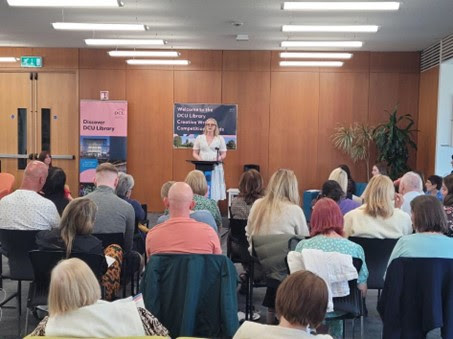
Guest Judge Sophie White addresses attendees at the 2023 DCU Library Creative Writing Competition Awards Night in O’ Reilly Library Pic: Eilís O’ Neill

Involving Mountjoy Education Centre

In 2023, we once again emailed all eligible writing groups seeking submissions for this year’s competition. For the first time in the competition’s 24 year history, tutors from Mountjoy Prison Service got in touch to submit entries from members of the City of Dublin ETB Mountjoy group.

The aim of the CDETB service [in Mountjoy] is to help prisoners cope with their sentences and prepare them for release, and particularly to offer them the opportunity to discover and develop new potential within themselves.

“Everyone has a story to tell, and it’s [on] that basis that I run the creative writing classes” says Margaret Hannigan, an English teacher in the Mountjoy education centre. Margaret has taught here for 24 years and is always looking for different competitions and writing festivals for her students to enter. It was through a new colleague, Christine Smith, that she heard about the DCU Library Creative Writing Competition.

Christine Smith has only worked with the Mountjoy Education Centre since October 2022, but prior to this had been a tutor Cabra Adult Education Service, where she tutored many previous entrants and winners of the competition. She was aware of the positive impact it had on her students and their confidence as writers, so she was keen to have her new students in Mountjoy participate.

Anonymous Judging for Fair Evaluation

Judges receive the stories anonymously, with all author and writing group details removed, so they can judge the entries on their own merits. However, entrants' names and details are recorded on entry forms, and any shortlisted writers are asked to attend the awards night to read their story. All stories along with the entrant’s full name are included in a booklet for attendees to take home.

Navigating GDPR and Confidentiality

In a phone discussion about the entries, Christine let us know that because of GDPR/confidentiality reasons, only the first names of the finalists should appear on the booklet, website and on social media. It wasn't difficult to accommodate that, but we had to be careful with aspects like the certificates all shortlisted entrants receive, which were photographed showing the surnames of the finalists. These were removed from the images before posting them on the website and on social media.

Mountjoy Education Centre tutor Clare O’ Connell accepting the Creative Writing Award from author Sophie White, on behalf of her student Dermot Pic: Kyran O’ Brien/DCU


We understood from the start that the finalists from Mountjoy Education Centre wouldn't be able to attend so Outreach librarian Eilís O’ Neill encouraged the tutors to invite their family and friends to register to attend, to represent them on the night. While Christine suggested playing pre-recorded readings, it was decided that live readings would create a more engaging experience for the audience. Thus, the CDETB Mountjoy tutors presented the finalists' entries on the awards night, and recordings of the writers reading their own pieces were made available on the library's website.

 Standout Entries and Performances

Julie, a library assistant who has been judging the competition since its inception, finds that the personal stories resonate deeply with her. She noted that the 2023 entries exhibited a raw quality, providing profound insights into the authors' experiences. Among the exceptional submissions, "Surprise" by Dermot emerged as the clear winner, captivating the judges with its compelling narrative. Library assistant and judge, Alana, praised this story for its ambition and execution. Alana also particularly enjoyed hearing the audio recordings of the authors from Mountjoy Education Centre reading their stories. She said of one (Hardcore by Eric) “...while I read this poem initially as a stand-alone piece of writing, I think this post- competition performance emphasises the art of language and how some stories sing once performed orally.”


The 10 runners up and winner of the Creative Writing Competition 2023. Runners-up from Mountjoy were represented on the night by their tutors. Pic: Kyran O’ Brien/DCU

Fostering Connections

The competition held special significance for Margaret, as one of her learners became a runner-up, receiving a certificate, book voucher and a DCU Library tote bag. Margaret expressed her delight at this achievement and eagerly looks forward to entering the competition again next year. Recognising the value of the creative writing classes at Mountjoy Education Centre, DCU Library seeks to foster a meaningful relationship with the institution. As a gesture of support and appreciation, the library has been invited to attend one of Margaret's creative writing classes in the near future.


Listen to the winning 2023 story via the Youtube link here: Surprise by Dermot


30 Jun 2021

Reflecting on Kildare Library Service's Online Events in 2020

Photo courtesy of authors
Guest Post by Amye Quigley, Bridgette Rowland and Shona Thoma of Kildare Library Service

Amye Quigley is an Executive Librarian with Kildare Library Service. She coordinates Kildare Readers’ Festival as part of her role as the Kildare Right to Read coordinator.

Bridgette Rowland is an acting Executive Librarian with Kildare Library Service and helps coordinate the STEAM programme for primary schools as part of her role.

Shona Thoma is an Executive Librarian with Kildare Library Service, coordinating events for children and young people, including the annual Children's Book Festival 


In April 2020 it became apparent that the pandemic would curtail library events for a long time to come, even if we couldn’t have predicted how long the lockdowns and restrictions would last. 

At Kildare Library Service, programming across all areas from children’s activities to age friendly, and from local history to Grow it Forward are now delivering successful online events. In this blog post, we offer reflections from three perspectives on how we made the transition from being entirely location based, to developing a range of virtual events for all ages. 

Shona Thoma, coordinator of the Children’s Book Festival, reflects on the challenges of delivering a festival programme with limited resources. Bridgette Rowland, coordinator of the STEAM programme, highlights new potential when working with schools. Amye Quigley, coordinator of the Kildare Readers Festival, outlines the process which led to the first online programme for the festival, and what that means for the future. 


Kildare Young Readers Festival and Children’s Book Festival

Children's literacy and creativity are supported and celebrated by Kildare Libraries events throughout the year. Two festival periods, the Young Readers Festival in May and Children's Book Festival in October, bring a particular focus to author events and workshops, giving children the opportunity to meet writers and illustrators, and explore their creative abilities. In May 2020, amid pandemic disruptions and significant time constraints, all events were provided online, with 20 events scheduled from 16th to 22nd May. 

In March and April, many library staff had been redeployed to work on the Community Call helpline, and IT restrictions prevented most staff from accessing emails at home. Organisation of events and managing bookings was very challenging without the library team and access to branch emails. Despite this, we felt that the Young Readers Festival should still take place in some way, offering fun activities to children stuck at home, and continuing to work with artists at a very difficult time for live performers. 

Pre-recorded video content was commissioned from two artists: storyteller Niall de Búrca, and illustrator Tarsila Krüse. Working with existing suppliers reduced the need for paperwork which would have been particularly difficult to arrange amidst so many of the unknowns in the early days of the pandemic. Six live events took place online, requiring registration, and providing much valued interactive sessions with children and their parents, these included storytelling, Yo-Yo-Yoga, and craft workshops. The safety and privacy of attendees was a key consideration, with great care taken to gather parental consent and ensure their supervision, and again working with existing suppliers with valid Garda Vetting in place. 

Photo Courtesy of Authors

With schools closed, all events were available for open booking, quite a departure for the May festival, but something that worked out very well. Schools delivery has been crucial in the past to reaching a wider audience of children than regular library users. Without the ability to publicise events through library branches, we promoted the festival via our recently launched blog, social media and eNewsletter. 

Feedback showed excellent satisfaction and that these events reached a different audience than when taking place in libraries or schools, many parents attending library events with their children for the first time. 

“It engaged him and allowed him to interact with kids his age and made him feel part of something outside this house and that means a lot to our kids right now.” —Parent feedback, Young Readers Festival May 2020

In October 2020, a further 34 online workshops and author visits were scheduled for the Children’s Book Festival. These comprised of live and interactive online events taking place via videolink to classrooms throughout the county, and 10 events held during the mid-term for children and parents to enjoy at home together.

The opportunities and challenges that we have faced by providing online programming will be familiar to anyone operating in this environment, we have highlighted some of the most significant when working with children and schools in the list below. 


STEAM Programme

Overview of the Programme

The Kildare Libraries’ STEAM programme supports the primary school curriculum across the county through workshops and talks in the subjects of Science, Technology, Engineering, Arts and Maths. Popular workshops have included planetarium visits, Lego engineering workshops, CSI forensics workshops and robotics workshops, with the emphasis on a hands-on model making the children active participants in the learning. The programme is planned a year in advance and aligns with the main national STEAM festivals throughout the year, starting with Engineers’ Week in February and concluding with Science Week in November.

Adaptation Following Covid

In March 2020, when Ireland first entered a lockdown due to the COVID-19 pandemic, just nineteen workshops out of a total of 154 planned for the year had taken place and, with libraries and schools all closed, we found ourselves with neither a venue nor an audience. What we did have, however, was pre-booked facilitators many of whom were more tech savvy than average due to the subject of the workshops and who were keen to adapt and innovate. In addition, with the schools closed and both teachers and parents scrambling to navigate the home-schooling environment, we recognised that the STEAM programme could fulfil a need for high-quality educational supports.

Some facilitators chose to create pre-recorded content that we could use on our social media channels and which could be viewed at any time whilst others adapted their workshops for live delivery through Zoom and both deliveries had their advantages. For example, environmental scientist Nikita Coulter filmed a series of beautifully illustrated biodiversity videos talking children through the meaning of biodiversity and Ireland’s ecosystems. While Tech Create delivered live coding, digital design and 3D printing workshops to children using open-source software which the children could access for free.

When the schools reopened in September, the STEAM programme was reimagined again for online delivery to schools. With children no longer taking part from home on individual devices we had to work with facilitators on a format that would be suitable for whole-class delivery and, where possible, would still include a practical, hands-on element. This had to be balanced with ensuring the delivery was in line with Covid health and safety protocols in schools. To this end, many of our facilitators supplied resource packs to accompany the workshops, with a minimum of one pack per class pod, which allowed children to carry out activities in real time with the facilitator. 


The 2021 STEAM Programme and Beyond

With the pandemic and restrictions ongoing, the decision was made to retain the online delivery model for the STEAM 2021 programme. However, we have been able to capitalise this year on some of the key opportunities the online medium allows – chief amongst them being the potential for bigger events and for access to a larger variety of speakers. In March 2021 we held a hugely popular talk for families by Professor Luke O’Neill entitled ‘Vaccines, Viruses, and the Immune System: The Real Science Behind Covid-19’. In June, we also held a panel discussion with a range of speakers from STEAM backgrounds in partnership with Maynooth University. The convenience of the online model and the potential for larger audiences makes booking high-profile speakers more viable and schools get to engage directly with leading STEAM figures.


Opportunities and Challenges

The online delivery of children’s programmes at Kildare Libraries presented various opportunities and challenges:

Opportunities:

  • Increased engagement – we had many schools engage with the programme for the first time based on the convenience of not needing to arrange costly transport into the library or permission slips from parents.
  • Increased accessibility – we received feedback from parents and teachers that for children with particular additional needs the online delivery removed some of the anxieties they may have faced around visiting a new venue.
  • Potential for larger events – we were no longer bound by limited capacities within libraries and could have multiple classes attend an online event.
  • Increased choice of facilitators/speakers – we can potentially engage speakers from anywhere in Ireland or indeed abroad.

Challenges:

  • Potential weakening of the library’s role – With the workshops no longer taking place within libraries, there was a risk of the visibility of the library’s role and our wider supports being diminished. To counteract this, we encouraged staff to introduce the workshops and to promote our other library supports and use the workshop as an opportunity to build their relationship with their local schools.
  • Wi-Fi/technical problems – while this could not always be anticipated our staff and facilitators offered to do technical trial runs if a teacher was unsure of the technology or their internet connection.
  • Adapting workshops for delivery online – not all of our 2021 facilitators were able to adapt their workshops and some have been postponed until such time as they can delivered in person again.
  • Risk of school closures due to Covid – All of our facilitators offered a plan B where, in the event of a school closure, the workshop could still be delivered remotely to the children at home with the support of the class teacher.
  • No shows – with the schools not having to travel to a venue, and despite frequent reminders, we have had the occasional incident of a school forgetting to log in on the day.


Kildare Readers Festival

Kildare Readers Festival has been held in Co. Kildare every year in October since 2010. It is programmed by a committee of Kildare library staff. The audience has a mixed age bracket with an unknown level of technical skills. It runs for a fortnight with events hosted in the seven main library branches, culminating in a weekend of events held in the Riverbank Arts Centre.  

Planning for the Kildare Readers Festival starts in January every year. When Ireland went into lockdown in March 2020 the committee put all planning for the festival on pause. As the pandemic restrictions extended, many other literary festivals were postponing, rescheduling, or cancelling their 2020 programmes. The decision was made in June 2020 that we would have to move the festival to an online platform if it was to go ahead. We started to plan for a reduced number of events over the festival weekend only, up to a maximum of six events. For contrast, in 2019 we held 27 events over a fortnight. 

The committee had no experience of bringing events online. We attended as many events as possible held by festivals that were going ahead to get an idea of what other organisations were producing. There was plenty to consider; how to hold the events, live, pre-recorded, on what software platform, would IT give us access to that platform, would we be able to manage it all ourselves, would we have to get outside expertise, how much would this cost, would technology let us down, would anyone attend, etc. We chose to go with pre-recorded content. 

We planned to record the events in our usual theatre venue. However, between the county specific lockdown for Kildare, Laois and Offaly, and availability of the Arts Centre, we had to quickly reassess, and plan to record events over Zoom. Staff did not have the software to do post-production on the videos recorded so this had to be outsourced to a production company. 

We then had to decide on what platform we wanted to present the festival. There were discussions around Facebook or YouTube, and whether events should be ticketed, or open to all. We decided to upload the events to Kildare Library’s recently launched Vimeo channel. They were password protected and “released” to the public on a scheduled date and time, to make it feel more like an event to be viewed together. Despite our initial plan to only hold six events over the weekend of the festival, we hosted 13 events over a week with just over 1,600 views of the events. 

What did an online festival allow us to do? 

It provided us with access to authors we would not have otherwise been able to invite to the festival due to budgetary constraints. We should have taken greater advantage of this in hindsight, but it allowed us to invite a poet and an author living in the US. 

It freed up budgets from transportation and accommodation costs, but this was counteracted by higher production and post-production costs so that the recorded events had the same look and feel to the branding. 

What would we do differently?

While we provided a set of guidelines to our authors/guests around ensuring their sound and cameras were clear, checking their internet connections, etc., more rigorous pre-checks would have helped deliver higher quality. We should have been clearer about the use of technology required, as a couple of recordings were made on phones and tablets which were being held by hand. We should have been more confident in our abilities as a committee, as we soon found that we managed live events with great success. 

The festival committee subsequently programmed our events for the national Ireland Reads Campaign in February 2021. We held eleven live online author events for various age groups using Zoom. We are now also using Eventbrite to manage the bookings. 

Based on the feedback received, being able to catch up on the events later was appreciated. Being able to attend from locations further afield than Kildare and its surrounding counties was a bonus for some. A hybrid approach of online and live events is planned for 2021, which will be dependent on Government guidelines closer to the time, frustrating the planning process once again this year. We realise that events that would normally be held in our libraries will more than likely have to be online again in 2021. We are looking at the possibility of using the Zoom webinar function instead of meetings, which is being tested with other library events this summer. Due to the availability of some guests we would like to invite to the festival this year, some events may have to be pre-recorded, but feel this blended approach will be successful. Bigger literary festivals than Kildare Readers Festival have gone with this model of live and recorded events in 2021. 


No going back! 

All events, but particularly those for adults, such as Kildare’s Parenting Programme and Toys, Technology and Training series have reached record numbers by being hosted online. The improved accessibility afforded by online events is the aspect most commented on now by the programming team in Kildare, with the knowledge that we won’t go backwards in this regard. We have developed the interactive element of our online events, which is important for giving a sense of occasion and sustaining community around our activities. Looking forward, post Covid, we hope to adopt a hybrid approach, with in-person workshops forming the core of programming but being complimented by online talks from international guests, and the broadcasting of in-person, in-Kildare, events to wider audiences. 


12 Apr 2021

Libraries of Sanctuary: Supporting Migrant Communities

Guest post by Louise Cooke-Escapil  Louise works as a Library Assistant at Maynooth University Library. She is interested in the social impact of libraries.


Introduction 

The City of Sanctuary is a collection of groups across the UK and Ireland - including theatres, schools, colleges, universities, churches, and gardens - that aim to build a culture of inclusiveness for incoming migrants. Specific organizations involved include Places of Sanctuary Ireland and, as of June 2020, Libraries of Sanctuary. The Library of Sanctuary title is awarded to libraries working to fill gaps in provision of information and resources to refugees and asylum seekers. Libraries playing this role is not novel, however the introduction of this title is a welcome step towards further developing public library services for those who may otherwise be left unseen.


Proto-Library of Sanctuary

It was this aspect of libraries working as powerful regenerative educational institutions that first drew me into librarianship as a profession in 2015. My first paid library job was in the Public Information Library in the Pompidou Centre in Paris. This experience shaped how I think about libraries and showed me the important social role they can play in people’s lives. In 2015, a new wave of migration into Europe had reached an all-time high. I worked in the autodidactic section of the library, where patrons came to borrow materials to help them learn new skills, such as driving, study skills for secondary school exams, or, most frequently, learning a language. I found myself working in a library in France that had more resources on learning Irish than my local library had back home in Ireland. If people chose to, they could borrow materials on learning up to 250 languages, including Sámi, Zulu, and Navajo to name a few. This section of the library also had a huge variety of materials, from books to CDs, DVDs, computer programmes, newspapers, magazines, and TV channels from 11 different countries.


Photograph: Pixabay


During the year I worked in the library, I realised how necessary this service was to many of the patrons. Before taking up this post, I had experienced language learning in a very different context. Learning a language was something people did out of love of the language or to be able to travel with greater ease. Now, many of the patrons who regularly came to my desk came to learn French out of necessity. Often, patrons could not speak French or English and did not have the means to ask for what they were looking for in the library. Word must have travelled and as more patrons would come up to our desk we quickly learnt to adapt. Myself and my desk colleagues started to keep a list of languages at the desk, each language written in its own script. We would ask the patron to go through the list until they identified a language, be it Arabic, Pashtu, Urdu, Farsi, or any of the other dozen languages we had listed. Once we had determined the patron’s mother tongue, we would find language-learning materials for them and set them up at a work desk. Eventually, those who kept returning would be able to ask for the materials they wanted in French. It was so rewarding to see patrons’ progress month by month as they moved on to more difficult materials, grew more confident in their abilities, and became more fluent in French.


Home to Ireland

After my time in France, I worked for a short spell at King’s College London. That was cut short by COVID-19. In January of this year, I took up a post in Engagement and Information Services (EIS) at Maynooth University. Returning to Ireland, I was delighted to see similar work to that I had encountered in Paris. Last year, Maynooth University became a University of Sanctuary and we currently have three students who live in Direct Provision undertaking degrees.


Libraries of Sanctuary

New initiatives such as Libraries of Sanctuary are encouraging libraries across the UK and Ireland to strengthen their services to refugees and asylum seekers. Like the Public Information Library in Paris, Libraries of Sanctuary have identified a new need, particularly pronounced over the last few decades, to pay particular attention to emerging communities in their locale, as well as existing ones. A resource pack, created by John Vincent, was released in June 2020 which gives libraries interested in this initiative a roadmap towards being recognised as a Library of Sanctuary.


The first Irish library to qualify for this title was Portlaoise Library on the 10th of March 2020. Librarians worked with communities from the local Direct Provision Centre to foster a space where everyone in the community could find tools and resources which were tailored to them (City of Sanctuary, 2021). At the award ceremony, County Librarian Bernie Folan said on the day;


“Places of Sanctuary is a movement that seeks to promote a culture of welcome in every sphere of society, a network of places of sanctuary where refugees and migrants are welcomed and included. We know that newcomers have a lot to offer, and we believe that as barriers come down and connections are made, the whole of society benefits” (Kiernan, 2020)


Photograph: cityofsanctuary.org


Going Forward

Libraries are in a unique position in that they are situated in almost every village and town in Ireland. Library staff are reaching out to migrant communities in their area and provide much needed services. They are a bridge for new communities, providing services to all. The first library to be awarded this the title of Library of Sanctuary, Thimblemill Library in the West Midlands in England, offered a number of services to emerging communities in their area such as ESOL classes for those who wanted to improve their English, welfare and asylum sessions to help with the mental and physical impacts seeking asylum can cause, and “Welcome to Your Area” events that aim to introduce locals to each other and allow newcomers to feel welcome (Vincent & Clark, 2020). It’s exciting to see this work being recognised and encouraged in libraries. Over the next few years, I hope many more libraries all over Ireland will continue to develop their services for refugees and asylum seekers. Public libraries have a key role in creating an inclusive and welcoming society.


More information on moving forward with qualifying for the title of Library of Sanctuary can be found at the Irish City of Sanctuary group’s contact us page. The Library Association of Ireland’s Career Development Group will also be holding an information evening later this year where John Vincent, the creator of the Libraries of Sanctuary resource pack, along with other speakers, will discuss the process of qualifying for the Library of Sanctuary title. In order to be the first to hear about booking information for this event, be sure to sign up to the LAI’s Career Development Group’s mailing list, or follow them on Twitter and Facebook.


References

Kiernan, L., 2020. Launch: Multicultural Portlaoise to receive Library of Sanctuary award. [online] Leinsterexpress.ie. [Accessed 9 March 2021].


Places of Sanctuary Ireland. 2021. Portlaoise Celebrates Ireland’s First Library of Sanctuary. [online] [Accessed 9 March 2021].


Sinnott Solicitors. 2015. Direct Provision 'A Severe Violation of Human Rights' - Sinnott Solicitors. [online]  [Accessed 9 March 2021].


Vincent, J., 2020. Libraries of Sanctuary Resource Pack. [ebook] City of Sanctuary. Available at: [Accessed 9 March 2021].


Vincent, J. and Clark, B., 2020. Libraries of Sanctuary. Alexandria: The Journal of National and International Library and Information Issues, 30(1), pp.6-7.


4 Jun 2020

Supporting Integration and Diversity


Guest post by Helen O’Connor, Maynooth University Library


Staff at Maynooth University library attended a day long CDP programme on ‘Supporting Integration and Diversity’. There were three facilitators – Camilla Fitzsimons, Philomena Obasi and Veronica Akinborewa. All three are attached to the Department of Adult and Community Education at Maynooth University.


The aim of the workshop was to give an opportunity to think and talk about the impact of increased diversity across the Irish university sector. In recent years, there has been an increase in migrant students, some of whom are international students, and some who have moved to Ireland to work, or to seek asylum from another jurisdiction.   As well as an increase in migrant students, there is also greater diversity in terms of the Irish ethnicity which has contributed to a growing number of Black, Asian and Ethnic Minority (BAME) students on campus.


The workshop was held over two days to give all library staff an opportunity to attend.

There was 25 people in each group. Handouts were given out at the beginning of the workshop and staff were invited to introduce themselves and say something about their name. Staff were then divided into smaller groups to discuss a range of topics, using flip charts. Each group then gave a short presentation to the bigger group. I thought this was really good as it gave people time to think and discuss the different topics.


Conversation topics helped library staff to explore their own cultural identity, to consider the implications of working in intercultural settings, to understand the origins and impacts of racism and to reflect on our own beliefs and theories of interculturalism and diversity.


Evaluation forms were handed out at the end of the day and feedback was very positive.

A lot of people liked the group discussions and several found the session informative, people found the atmosphere relaxed and informal. People thought the facilitators were very clear and informative in their presentation.  


I discovered the word BAME (Black, Asian and Minority Ethnic), I had not come across this term before. The University has students and staff from many different ethnic backgrounds and we in the library encounter these staff and students on a day to day basis. I think the workshop brought home to me that we are all the same and just because we might have different colour skin or speak a different language, we should treat each other the same. 

The University and the library have a lot in place for students from many different backgrounds.  Perhaps we could expand this and hold a celebration event for all of these groups for them to showcase their different cultures.


Signage is also something that could be broadened to be more inclusive.


One of the highlights of the day was the beautiful ethnic lunch which was enjoyed by everyone.


Below is a listing of some articles on diversity and multiculturalism that I’ve been working on with colleagues.  Hope you find it useful.


ACRL (2012) Cultural Competency for Academic Libraries http://www.ala.org/acrl/standards/diversity

ACRL (1990) Academic libraries and the culturally diverse student population

https://crln.acrl.org/index.php/crlnews/article/view/19446/22803   

ALA (2013)   Ethnic and Racial Diversity in Academic and Research Libraries: Past, Present, and Future

http://www.ala.org/acrl/sites/ala.org.acrl/files/content/conferences/confsandpreconfs/2013/papers/Chang_Ethnic.pdf

CILIP (2017) Equalities and Diversity Action Plan

https://www.cilip.org.uk/page/EqualitiesandDiversityActionPlan 

Groarke, Sarah (2019) Attracting and Retaining International Higher Education Students: Ireland. Dublin: ESRI.
https://www.esri.ie/publications/attracting-and-retaining-international-higher-education-students-ireland
 

C&RL (2007) Achieving racial and ethnic diversity among academic and research librarians

https://crln.acrl.org/index.php/crlnews/article/viewFile/7869/7869

Fallon, Helen and Connaughton, Laura and Cosgrave, Edel (2020) Promoting a Culture of Equality: Diversity Training at Maynooth University Library. An Leabharlann. The Irish Library, 29 (1) Pages 20 - 27

http://mural.maynoothuniversity.ie/12804/

Higher Education Authority (2018) Key Facts and Figures: Higher Education 2017/2018.
https://hea.ie/assets/uploads/2019/01/Higher-Education-Authority-Key-Facts-Figures-2017-18.pdf 

Higher Education Authority Key Facts and Figures: Higher Education 2016/2017.

https://hea.ie/assets/uploads/2018/02/HEA-Key-Facts-And-Figures-2016-17-FINAL.pdf

Page 21

Higher Education Authority5 Key Facts and Figures: Higher Education 2015/2016.

https://hea.ie/assets/uploads/2017/05/hea-201516-key-factsfigures.pdf

Page 21

IFLA/UNESCO (2018) Multicultural Library Manifesto

https://www.ifla.org/node/8976  

HE4u2 (2017) Creating Intercultural Learning Environments: Guidelines for Staff within Higher Education Institutions.

http://he4u2.eucen.eu/wp-content/uploads/2016/04/HE4u2_D2-5_Guidelines_JS_FINAL-2.pdf

HEA (2017)  National Plan for Equity of Access to Higher Education 2015-2019

https://hea.ie/assets/uploads/2017/06/National-Plan-for-Equity-of-Access-to-Higher-Education-2015-2019.pdf 

Library Trends 2019.   Low Morale in Ethnic and Racial Minority Academic Librarians: An Experiential Study Kaetrena Davis Kendrick, Ione T. Damasco

https://muse.jhu.edu/article/746745/pdf

Mannion, David & Thornley, Clare (2011) The Experience of Chinese students in Irish third level libraries: an investigation of current challenges and an analysis of possible solutions.  An Leabharlann: The Irish Library,  20 (2), pp. 19-27. https://researchrepository.ucd.ie/handle/10197/3607  

Mellon, Bernadette, Cullen, Marie, Fallon, Helen (2013)  Implementing an online training course in disability awareness for frontline staff - Experiences at National University of Ireland Maynooth. Sconul Focus, 58. pp. 27-31.

http://mural.maynoothuniversity.ie/4607/  

Mestre. L. (2010) Librarians Working with Diverse Populations: What impact does Cultural Competency Training have on their efforts? Journal of Academic Librarianship, 36(6), pp. 479-488

O’Connor, M. & Kerrigan, C. (2013) Cultural Revolution: Reflections on an exchange. An Leabharlann: The Irish Library, 22(2), pp. 11-19.
https://cora.ucc.ie/handle/10468/1260  

Parkinson, Orla (1994) Do Irish public libraries have a role in engaging the host society in integrating immigrants. An Leabharlann: The Irish Library, Vol. 20(1), pp. 14-18
http://www.libraryassociation.ie/wp-content/uploads/2018/11/20_1_AnLeabharlann.pdf  Stokes, D. & Molly, J. (2019) The Innocents Abroad: The Experience of two Irish librarians teaching information literacy in China. An Leabharlann: The Irish Library, Vol. 28(2), pp. 4-10.  https://www.libraryassociation.ie/wp-content/uploads/2019/11/An_Leabharlann_28-2_Full.pdf
UUK, NUS (2019) Black, Asian and Minority ethnic student attainment at UK Universities: Closing the gap
https://universitiesuk.ac.uk/policy-and-analysis/reports/Documents/2019/bame-student-attainment-uk-universities-closing-the-gap.pdf  (accessed 9 March 2020)