Showing posts with label librarianship. Show all posts

8 Apr 2025

Ten great Records about Libraries


I was recently asked to contribute to the Vinylthon Zine, part of Vinylthon 2025 — an annual celebration where radio stations around the world spin at least one hour of vinyl -only music. With the brief wide open—anything to do with vinyl — I decided to bring together two of my favourite things: records and libraries. Here's what I came up with.


Libraries and music might seem unlikely bedfellows. One, as far as the cliche goes, demands silence, the other thrives on sound. But this is not necessarily the case. Get it Loud in Libraries, a UK initiative which brings rock music into libraries and, in a much smaller way, my experience hosting Shush! Sounds from UCC Library proves otherwise.

Shush! Sounds from UCC Library goes out live twice a week on the community radio station UCC 98.3 FM, Cork, Ireland. On Monday morning show I invite University College Cork staff to curate 45 minutes of their favourite music while sharing insights into their work, touching on the role of the library in their research, and the role it plays for the University College Cork community. The Thursday evening show is a chilled out, downtime hour of music

For me, music and libraries are both deeply personal things, often shaping who we are and for me to bring the two of these together is something I feel really lucky to be able to do.

And so for this deep dive into vinyl, I’ve gathered together a selection of songs that reference libraries, and librarians — whether literally or metaphorically.

Some celebrate the magic of books, others play with the idea of knowledge, and a few revel in the mystery of librarians themselves.

And for that reason, here are ten songs about libraries, all available on vinyl, that I believe you must hear.

A Design for Life – Manic Street Preachers

Though I’m not the biggest fan of Manic Street Preachers any song that opens with the line
Libraries gave us power must be included. 

So, for that reason I start this list with their 1996 smash A Design for


Karen – The Go-Betweens

Perhaps my favourite library song is Karen, the B-Side to Lee Remick, the first single from the Go-Betweens, released in 1978.
This is a real paean to the librarian's readers advisory skills.

I know this girl
A very special girl,
And she works in a library yeah
Standing there behind the counter
Willing to help with all the problems that I encounter

Helps me find Hemingway
Helps me find Genet
Helps me find Brecht
Helps me find Chandler
Helps me find James Joyce
She always makes the right choice


Libraries – Seabear

Icelandic indie folk band, Seabear, have a wonderful track called Libraries which can be found on their 2007 album The Ghost that carried us away. Libraries contains the beautiful lines

And I don't believe you live in a library
That sails the sea
Sleeping with a book-blanket out at sea 
Like you told me 


I Am the Sub-Librarian – Piano Magic

London indie ambient post rock collective Piano Magic have a wonderful track called I am the Sub Librarian which can be found on their 1998 EP The Fun of the Century and their third album, the 1999 released Low Birth Weight

The song is about a sub librarian who goes to work on the council bus from Chalk Farm to Highgate Woods, with a sports bag of borrowed books, listening to Carole Kings’ 'Tapestry' on her Walkman.

The full lyrics of the song are:

I am the sub-librarian, come in on the council bus
Chalk Farm to Highgate Woods, sportsbag of borrowed books
A steady diet of Brautigan, 'Tapestry' on the walkman
Paranormal ill-health from dusting off the top shelf
I am the sub-librarian, counter girl, tea-maker
I am the sub-librarian, swan feeder, spectacle breaker
I am the sub-librarian


Young Adult Friction – The Pains of Being Pure at Heart


Another contender for my favourite library related track is Young Adult Friction from shoegaze influenced indie pop band The Pains of being Pure at Heart

This track about young love was released as a single in 2009 and can also be found on their self-titled 2009 album

Bonus points go to the band for mentioning library terms such as stacks and microfiche in the lyrics

Between the stacks in the library
Not like anyone stopped to see
We came, they went, our bodies spent
Among the dust and the microfiche
Dark winters wear you down
Up again to see the dawn
In your worn sweatshirt and your mother's old skirt
It's enough to turn my studies down


Books About UFOs – Hüsker Dü

Even Hüsker Dü have a song about libraries.

Their track Books about UFOs describes a character who sees a girl in the library who reads all about UFOs and he gets attracted to her intellect as well as her weirdness.

He muses, one day he might even name a planet after her to get her to notice him.

This track can be found on their seminal 1985 album New Day Rising

Walking down a sunny street to the library
Checking out the latest books about outer space
Going to the fruit stand to buy a dozen oranges
She and the books and the oranges go back to her place


She tells the same old story to everyone that she knows
She's just sitting in her room reading books about UFOs

....
Her life revolves around all of the planets
And she is constantly aware of all the changes that occur
I'm going to turn into a lens and focus all my attention
On finding a new planet and naming it right after her


The Book Lovers – Broadcast


Birmingham band Broadcast have a track called the The Book Lovers. This dreamy, retro-futuristic track can be found on from 1996 EP of the same name. It was collected, along with other early singles onto the 1997 album Work & Non-Work

It contains the lines

Lines and lines
Of the spines
Colored everyone
Oh, oh-oh-oh

Down the aisles
Along the titles
Where you and your eyes
Read with your eyes


Lisa Librarian – Velocity Girl

BubbleGrunge rockers Velocity Girl, who released three albums on the Sub Pop label in the 1990s released a playful track called Lisa Librarian which can be found on their album Copacetic released in 1993

This track, like the Go-Betweens Karen, taps into the same mystique - portraying the librarian as a figure of fascination and admiration.

I try not to tell
Tell it to those other boys
But I'm just jealous
While you're reading books to girls and boys

Oh I want to see you
And I want to visit you at work
And I'll be quiet
And you could recommend a book


Let There Be Shelving – Thrilled Skinny

I’m not sure that Let there be shelving, a 1991 single / EP from Luton’s Thrilled Skinny is technically a library song,

But any song titled Let There be Shelving becomes an honorary library song in my view

This single, released in 1991, contains the lyrics

Let there be shelving 😊


The Librarians Are Hiding Something – Swingin’ Utters


And for my final selection I choose a, hopefully tongue-in-cheek punk song that plays on the idea of librarians as gatekeepers of secret knowledge. The Librarians are Hiding Something, a 2012 single by American Punk Rockers Swingin Utters.

The track finishes with the enigmatic lyrics

Oh the librarians, contrarians
Can't fly on a wing
Oh the librarians, barbarians
Are liking nothing

Which leads me to believe one thing
The librarians are hiding something


Above is but a small selection of Library related songs which I want to highlight. If you asked me next week this list might have changed to include tracks from acts like Frank Zappa, Engine Alley, Green Day, Arctic Monkeys, Jimmy Buffet, Daniel Johnston (several tracks), Angie Hardy amongst others

Martin O’Connor is Communications Coordinator at University College Cork, Ireland.

He presents two weekly radio shows on UCC 98.3FM, Cork, Ireland. He presents a show every Morning at 11 – 12pm GMT. He also presents another show at 6 – 7pm GMT – this drivetime show is an hour of ambient chilled downtime tracks.

For more information and to listen back to all the previous show check out Shush! Sounds from UCC Library check on linktr.ee/ShushRadio



29 Nov 2022

Reflections on my past year as a Digital Learning Specialist in UCC Library

https://twitter.com/iamstephanie_c/status/1572606591131684864

Guest post by Stephanie Chen. Stephanie is the Digital Learning Specialist in University College Cork Library where she explores ways to integrate new library technologies and spaces into the learning experience to support student engagement and success.


This past year (and a half), I’ve been working in a new role in University College Cork Library. When I say new role, I mean new role. Not only is this role new to me but it’s entirely new to the Library. Navigating into a newly created role can have its challenges – no handover, no previous documentation, no idea of what the role is supposed to be but within those challenges are opportunities. 

This role is also my first “professional” librarian role in a University (even though the word librarian doesn’t appear in the job title). Previously, I’ve worked as a solo Librarian in the Royal Society of Antiquaries of Ireland shortly after graduating with my Masters in Information and Library Management from Dublin Business School. After moving to Cork, I worked as a Library Assistant in Cork Institute of Technology (now MTU) Library for just under a year before moving to UCC Library as a Library Assistant. 

After about 7 months in UCC Library, the role for a Digital Learning Specialist was advertised…in March 2020. I applied for the role but, due to obvious reasons, recruitment was paused for the foreseeable future. It wasn’t until a year later in April 2021 that I was invited to interview for the role, an interview that (spoiler alert!) I was successful in and so I started my role as the Digital Learning Specialist in UCC Library on May 1st, 2021. 

The Role Itself

What exactly does the role entail? Good question!

When I started my role, as far as I could tell, there wasn’t an equivalent anywhere else in Ireland. There were some overlaps with other roles, such as Eileen Kennedy, Library Digital Experience Developer in University of Galway and Marta Bustillo, Digital Learning Librarian in University College Dublin but there was no Digital Learning Specialist in any university library. 

The job description for the role stated: 

“…the Digital Learning Specialist will lead on the design, delivery and evaluation of offerings that showcase innovative new learning spaces within the library such as the Library recording Studio, the dedicated virtual reality lounge, the evolving library makerspace, and other technology-enhanced spaces in development. The Digital Learning Specialist will lead the library’s efforts in adopting new technologies and spaces for innovative pedagogy and will partner with colleagues within the library and elsewhere to make use of new technologies to visualize, consume and experience library collections and services. The Digital Learning Specialist will develop educational resources and outreach services for digital, information and new media literacies.

The Digital Learning Specialist will also grow the library’s presence within the University’s new virtual learning environment, Instructure’s Canvas platform, to deliver high-quality, impactful and engaging digital library services. The post holder will also work collaboratively across the library to develop online supports directed at academic staff and researchers.”

New learning spaces, new technologies, new resources and outreach services, new VLE. And all of this while COVID was still happening. 

I dove headfirst into the role and took advantage of it being a new role to try new things. Some of the projects I undertook include: 

Challenges

Now that I’m a year (and a half) into the role, I’m trying to do something which I have a hard time doing and which I certainly don’t do enough of: reflecting. 

There were definitely challenges. As mentioned, this was an entirely new role and it was on me to make it my own. 

Variety is great but it can also mean having too much going on at the same time. Having to find and create your own work allows for a lot of autonomy but sometimes it’s nice to be told what to do. There were some days when I felt overwhelmed by my ever-growing to-do list and my own ambitions for what I wanted to do. 

I might have been overzealous in asking for student help – making sure they had work when I wasn’t even sure of the work I was supposed to be doing. I found a priority for me was to ensure they were okay and supported which meant there was less time for other things. 

I don’t have a technical background (my undergraduate degree is in Anthropology). All this new technology, all these new platforms and software – I had to learn about it myself. Luckily, for some things like 3D printing, I could defer to my fellow colleagues who had more experience. But this meant some days I felt like a fraud. How could I talk to someone about VR and how to use it in teaching and learning when I’m only just figuring it out myself? Getting past this idea that I must be the “expert” required a lot of unlearning my own way of thinking and my own approach to work – something I’m still working on. 

There was also a bit of self-doubt. Am I doing enough? Is what I’m doing okay? Am I on the right track? It could also be a little isolating at times – I had gone from working with a great group of colleagues on the Services Desk Team to pretty much working on my own. 

Plus, all the usuals that come with starting a new “professional” role: policies and procedures, more meetings, strategic planning, promoting yourself and your role, talking to people about what you do constantly. 

Opportunities 

But the challenges pale in comparison to all the opportunities this role has allowed for. I’ve had the opportunity to work with a variety of colleagues, both within the Library and in UCC. Elaine Harrington, Special Collections Librarian in UCC Library, and I worked closely on a number of projects with student help. Outside of the Library, I, along with the Library’s Learning and Teaching Team, was able to work with the Graduate Attributes Programme to develop content for their UCC Graduates Attributes & Values Compass. I helped develop two Pressbooks with Dr Briony Supple and Marnina Winkler. And I’ve worked with some amazing students – students who were involved in the Learning, Teaching & Assessment (LTA) Enhancement Fund 2021 summer project and my two student assistants for the 2021/2022 academic year.

https://twitter.com/UCCLibrary/status/1552575285152944128 

I’ve had the opportunity to explore new things. New technologies, new platforms, new services that I otherwise wouldn’t have been able to. We’ve 3D scanned date stamps, created a virtual 360 tour of a part of Cork city, and created interactive learning objects using H5P. 

I’ve had the opportunity to attend conferences, such as LILAC: The Information Literacy Conference, Wikimedia+Libraries International Convention 2022, IFLA World Library and Information Congress, and meet people doing loads of interesting stuff. 

I get to try new things and if it doesn’t work out, that’s okay because it’s all entirely new. Some things will work and some things won’t. 

Final Reflections

What’s next? 

As part of my interview for this role, I was asked to prepare a presentation on ‘Empowering students as co-creators of knowledge using emerging technologies in a physical and virtual UCC Library​.’ As part of the presentation, I weaved a hypothetical story of the Library helping to empower a student in UCC to have the experience and confidence in using technology. By engaging with technology available in the Library, such as the 3D printing or VR or the Library studio, this student would become digitally fluent and an independent and creative thinker. In line with UCC’s Graduate Attributes, they would be empowered to create and communicate knowledge. The Library would become an engaging, collaborative, and technology-rich physical and virtual space. This student could create a 3D model on one of the computers in the Library, experiment with it in the Library’s VR lounge and 3D printing it using the Library’s 3D printer. They could present on this process by recording a video using the Library Studio and editing it on a computer in the Library. That video could then be published online as an open educational resource for other students to learn from. 

Now that I feel I’ve found my feet a little, I’d like to start focusing on being more strategic with what I decide to do. I’d like to return to that “vision” I had of the Library supporting that hypothetical student and really focus on how I can make that happen. It won’t be an easy journey and I’m 100% sure I’ll make mistakes along the way and there’s still plenty for me to learn but if the last year (and a half) has taught me anything, it’s possible! 

Acknowledgements

All my achievements this past year (and a half) would not have been possible without the support and encouragement of my fellow UCC Library colleagues. In particular, Martin O’Connor has been a great resource in all things UCC Library and libraries in general and a fantastic sounding board. My line manager, Alan Carbery, has been nothing but supportive and encouraging every step of the way. I’m grateful to him for allowing me the autonomy to experiment and try new things.


https://twitter.com/iamstephanie_c/status/1516829232328028175


9 Aug 2022

CONUL Conference 2022: three short reports...

Below we have three short reports from the recent CONUL Conference held in Limerick. These reports are written by the CONUL Conference Bursary Winners for this year., Catherine Gallagher, Eilish McLaughlin, and Niamh O'Brien.


Photo courtesy of Catherine Gallagher

Report one is from Catherine Gallagher, Senior Library Assistant, Reader Services, TUS Midlands 

Reflections on Library Futures: My experience of CONUL 2022.


When I received the news that I had been selected as the awardee for one of the CONUL Conference’s bursaries, I was absolutely delighted! At the time I was working in the Library at Carlow College, St Patrick’s, and put simply, the bursary was the difference in being able to attend the conference or not. Little did I, nor anybody else know, the global crisis that was just around the corner that would change not only how libraries would have to rapidly transform their services to meet the needs of their stakeholders, but indeed the world at large. As the world began to shut down and ‘remote learning’ for all students became the new business of the day, it became apparent fairly soon that the conference wouldn’t happen. I would be omitting a truth if I didn’t say that for a few moments I had the small, it’s-all-about-me thought: typical this would have to happen when I win a bursary to go to CONUL….

Fast forward to 2022 and the e-mail from Nicola Smith that I still had the bursary from 2019, well there may have been a silent whipeeeee at my work desk!  Much had changed, including my role, as I had moved from Carlow College to what is now a thriving and expanding University, TUS: Midlands Midwest. 

Where to begin? This was my first library conference and I have nothing but good things to say! It was tough to decide which talks to go to and in terms of planning which talks to go to and where, I found the CONUL app very useful for organising this. Many of the talks focused on the rapid pivot libraries had to make due to COVID-19 in terms of rolling out supports and services from largely on-site to online and libraries demonstrated their ‘capacity for agility’ as Emma Goode from NUIG aptly described it. I also found interesting her comment that libraries are like the ‘wall paper of institutions’; we are often not noticed but badly missed if we weren’t around. COVID-19 certainly had the effect of demonstrating to students and all stakeholders alike, the important role libraries play in providing not only spaces for student learning, but providing students with the skills and access to quality scholarly information. We are all now only too familiar with the concept of ‘fake news’ and as Ciara McCaffrey from UL and Emma Goode from NUIG noted in their talks, it has become just as important to teach students how to deal with all information, not just scholarly information.

Open and equitable scholarship was another key theme present in many of the talks. Keynote speaker Chris Bourg from MIT highlighted this in her talk where she discussed MIT Libraries’ urgent mission statement in response to the pandemic. Top of the list on Chris’s ‘urgency principles’ was the concept of ‘Digital First’ and where digital is certainly not new, the accelerated pace at which libraries have had to provide digital resources and equip students with digital literacy skills is. Ciara McCaffrey in her talk likewise posed interesting questions around the future of print collections and the impact of eBooks on libraries.

As my passion is for Teaching & Learning, I thoroughly enjoyed Michelle Breen’s talk on digital literacy for students. I came away with some great tips that are worth sharing:

  1. Teach what students want to learn
  2. Use succinct messaging on relevant channels, e.g. Social media
  3. Tweak, refine, adjust and have another go
  4. Make academics your advocates
  5. Use multiple formats

On the topic of using multiple formats, Kathryn Briggs from ATU gave a great talk on applying the principles of UDL to information and digital literacy. The key message I took from this to apply to my own teaching role is to minimise barriers for student learning and offer them flexibility. This is essential, and it was inspiring to see how other libraries are incorporating the UDL principles into library instruction.

I could go on and on, I really could. I found Martha Bustillo’s from UCD’s talk particularly inspiring. In her discussion on her role as the Digital Learning Librarian, she provided some excellent tips on how librarians can develop successful intra-campus social interoperability and it reminded me of Emma Goode’s comment I mentioned earlier on how the library can often be like the wallpaper of institutions, often not noticed but badly missed if it wasn’t there. They were all excellent but the 3 main takeaways that resonated or me were:

  • Speak their language.
  • Timing is essential.
  • Be confident in your value.

The conference was rounded up with lively panel discussion on day 2, and I found it particularly heartening to hear Dr. Patrick Ryan from UL’s words of praise and commendation for the stalwart role academic libraries have played in not only keeping the show on the road, so to speak, during COVID-19, but indeed to reflect on and transform library services and supports to meet the needs of our ever diversifying and expanding student population. I was reminded of one of Michelle Breen’s tips referred to earlier, and of two more of Martha Bustillo takeaways: make academics your advocates, secure buy in, and know your audience. If we are to take Dr. Patrick’s sentiments as a guide, we are clearly on the right track. 

So if in doubt, apply for the bursary!! Like me, you may not think you’ll get it, but you might, and if you do you are in for a fantastic experience! Lots to learn and lots of people to meet!


Report two is from Eilish McLaughlin

My name is Eilish McLaughlin and when I won the student bursary in 2020, I worked as a cataloguing library assistant at Queens University Belfast and acted as the students and new professionals officer for CILIP Ireland. I have also previously worked as a graduate trainee in the library at the University of Bradford and at Shrewsbury International school’s library in Bangkok. I have just recently completed my Master's Degree in Library and Information Management with the University of Ulster. Since winning the bursary, much has changed (to say the least!) I’ve moved from Belfast to Portsmouth, began a new post as a Sales and Marketing Consultant for PTFS Europe, and finished my studies. 

I had seen the bursary advertised on Twitter and thought it’d be a great way to engage with other students and new professionals in attendance and gain insight into the sector and its future outlook. It was also my first real-life conference I’d be attending after two years of virtual events. While I’d learned a lot from taking part in virtual events, which proved to be something of a professional lifeline during the pandemic, I was excited to have the full 3D, in-person experience in Limerick! 

After a year of living and working out of the country, I was also excited to be back and in touch with the academic library sector in Ireland. Upon my arrival at the Limerick Strand hotel, I was delighted to run into two former Queens University colleagues who were presenting a lightning talk that morning on creating video training materials for staff. This followed an excellent Keynote by Chris Bourg, Director of Libraries at Massachusetts Institute of Technology who, despite having begun their talk with a disclaimer about being a bit rusty on presenting, delivered a compelling talk on MIT libraries and their concept of the future of libraries—which is indeed now!

Much of the discussion focused on how library and information professionals navigated the physical limitations brought about by the pandemic and how this operational context could be balanced alongside the need to provide in-person support for students and colleagues. Speakers presented much scope for innovation in the areas of blended learning, hybrid working, and flexible library spaces to name but a few key topics. I was particularly interested in Day 2’s keynote from Melissa Highton, Assistant Principal for Online Learning and Director of Learning, Teaching, and Web Services at the University of Edinburgh. I studied for my undergraduate degree at the University of Edinburgh and also completed my master's degree via online learning so I enjoyed hearing Melissa talk about the University’s continued success with online modes of learning and her advice for supporting those studying and working in this way. 

PTFS Europe, the company I currently work for, is dedicated to providing Open Source solutions for libraries. Since I began working for PTFS Europe last year, I have become extremely invested in the Open Source movement and its analogues; Open Science, Access, Education, etc. One of the aspects that I most enjoyed about CONUL was the positive conversation around these Open Movements and the changing scholarly communication landscape. I also enjoyed catching up with colleagues from Interleaf, PTFS Europe’s Irish equivalent, who had a lot of Open Source Wisdom to share! It was encouraging to see that in a programme that looked to the future of libraries, Open Source was very much part of that vision. 

I had a wonderful time and was so glad to attend. I’m very grateful to CONUL for awarding me the student bursary and would recommend that any current MLIS students apply for the chance to take part in a brilliant opportunity for professional development. 


Photo Courtesy of Niamh O'Brien


Report three is from Niamh O'Brien, ICT Support, Library Assistant, TUS Midlands

Pandemic delays, posters, and prizes: reflections on my first in-person conference  #CONUL2022

I was sitting in the UCD library with my head stuck in my laptop trying to finish my assignment at the end of the first semester of my MLIS when I received the news that I had won the student bursary for CONUL2020.

Fast forward a couple of months and I had moved back in with my parents, was studying from my childhood bedroom, stuck in lockdown and found out CONUL would not go ahead in 2020. It feels like a lifetime ago now. 

*****

I’d just received a job offer for my first library assistant job position in December 2021, when the conference organisers got back in contact with me to let me know they would honour the bursary I originally received in 2019 for CONUL2022 in Limerick.  Five months later I packed my suitcase and headed to Limerick with my conference poster and coffee in hand. 

Once I got my poster up, I headed for the free stuff. I love free stuff, and you know what online conferences don’t have? Free stuff. I started gathering souvenirs to bring back to my co-workers immediately but was quickly side tracked when I bumped into some familiar faces from Galway who showed me the ropes in the Hardiman library when I did my pre-MLIS work placement. Soon I was chatting with former colleagues and classmates that I hadn’t seen in over two years, and meeting twitter mutuals in person for the first time. 

I also had the pleasure of meeting Ellen Breen who was my conference mentor. A lovely bonus for receiving the student bursary was that I was assigned a conference mentor. It was great to have someone to touch base with throughout the conference and someone to ask for some advice before the conference. Although I had attended plenty online conferences, I had a feeling I couldn’t wear pyjama pants to CONUL so I reached out to Ellen beforehand for some dress code insights!

CONUL opened with (well the official opening but after that) a keynote from Chris Bourg from MIT who talked about how libraries have had to focus on a digital first (but not digital only) approach to providing resources, especially since the pandemic. 

After the keynote I scurried upstairs for the first session Technology and Innovation in Libraries. The first presentation in this session starred David Carlos Rinehart who went on to win an award for his ability to hold it together and stay calm despite a myriad of technical difficulties. David wrote a hilarious blogpost about that here (Link: https://www.libfocus.com/2022/06/keeping-calm-in-face-of-technological.html). At the time I assumed he was very calm but I’ve come to learn he’s a great actor! 

During lunch, I took up my position beside my poster to present the Laptop on Loan scheme at TUS Midlands, answer questions from the other delegates, and pass out the bookmarks I had made about the scheme. 

The second session of the day centred around the very important subject of library services at the heart of EDI. To close the conference-y part of day one, there was a fantastic panel focused on the future of libraries, sustainability, and the key external influences for academic libraries. Then I wandered back to my room, drank more coffee, and got myself ready for dinner. After dinner I went back to my room at a very reasonable hour and got loads of sleep so I would be refreshed for day two. Okay that’s a lie. I stayed up all night chatting with all the lovely librarians I had met during the day. 

Dr Melissa Highton kicked off day two with her keynote where she spoke about her role as digital technologist at University of Edinburgh and how they meet the challenges and demands that arose from the sudden university wide pivot to online learning.

Later that morning Molly Twomey from UCC presented on Using Social Media and Humour to Engage with Students. I found out later that Molly is a poet, so I ordered her poetry collection and found out she’s very talented. I think I’ll be a bit start stuck if I meet her again. 

In the second session of day two, the OER team from NUIG discussed their OER project. Having previously attended a longer, half day workshop on creating OERs in Galway I was seriously impressed at the amount of information these guys fit into their 20-minute presentation slot. 

In the final session of the day I regrouped with all the gang from TUS Midlands to cheer on our colleague Assumpta who presented with the Library Carpenters.

Before the final panel discussion and conference close, the winning conference posters were announced. My colleagues Emmet and Catherine came joint third place, and I came second! This was a great thrill and a great way to end what was a very enjoyable conference. 

I’d rate my CONUL experience very highly and look forward to next year! 


Photo courtesy of Niamh O'Brien


20 Apr 2022

My Top Tips for CVs, Cover Letters and Interviews


Guest post by Marie O’ Neill, Head of Enhancement, CCT College Dublin

I was delighted to be invited by the Career Development Group (CDG) of the Library Association of Ireland recently to speak on all things pertaining to job seeking, CV preparation and interviews. It was an honour to speak alongside peers that I admire greatly such as Emma Doran of Kildare County Council Library, Martin O’ Connor of UCC Library, Johanna Duffy of AIT Library and Linda Fennessy of the National Library of Ireland. The work of the Career Development Group of Ireland is a vital support to those wishing to develop their careers further. Membership of the Library Association of Ireland connects library students, graduates and staff to a vibrant, dynamic and supportive national community of practice. Students of a recognized LIS course can join the Library Association of Ireland for free (course details and year must be provided). Further information about joining the Library Association of Ireland is available at: https://www.libraryassociation.ie/membership/

A little bit about me. I am a graduate of the library schools of University College Dublin and the University of Northumbria. I have been a librarian for 30 years, working in libraries such as King’s Inns, Technological University Dublin, University College Dublin, the HSE, the Welsh Office, the Oireachtas and Dublin Business School where I was Head Librarian for 12 years. I was the originator and co-founder of the MSc in Information and Library Management at Dublin Business School. More recently I have migrated into an academic enhancement role at CCT College Dublin. I remain as active as ever in the library sector. I am a Council member of the Library Association of Ireland and a Committee member of the Library Association of Ireland’s Library Publishing Group. I am a judge for the third year in a row on the Library Association of Ireland’s National Library Champion Awards and a mentor in the Library Association of Ireland and CILIP Ireland’s Virtual Mentoring Scheme

My talk for the CDG event focused on my top tips in relation to job seeking, CVs and interviews. I was allocated 15 minutes. Below is a brief summary of my main points which includes my top tip in relation to adapting the STAR approach to answering competency-based questions for additional success in interviews.

Avoid tunnel vision. Don’t forget the information management component of your qualification. If you can’t get a library job immediately after graduation, apply for roles in data protection, GDPR or freedom of information. An increasing number of library graduates are also working as taxonomists for companies such as Amazon. Reach out to professionals working in these roles for advice. These roles can help you to transition into a library role. Alternatively, many graduates pursue successful roles in the broader information management area in the long term. See this job vacancy for a taxonomist role at Amazon as an example at: https://www.ucd.ie/t4cms/Amazon Description.pdf

Find a Mentor: Ask a librarian working in a role that you would like to work in, to be a mentor. Seek advice from this mentor virtually or in person in relation to your career development. Ask your mentor to peer review your CV or to conduct a mock interview. The library community is a generous profession. Consider joining a formal mentoring programme such as that offered by the Library Association of Ireland and CILIP Ireland. Conducted on a virtual basis, the LAI/CILIP programme is extremely beneficial for mentors and mentees alike. 

For further information, see: https://www.cilip.org.uk/members/group_content_view.asp?group=201287&id=970445

Some extra considerations in relation to CVs. If you are interested in becoming an information literacy librarian or a systems librarian as examples, ask an experienced librarian in this area or a mentor to peer review your CV.  Include a Technical Proficiencies Section in your CV in which you list as many technical proficiencies as you can, as all areas of modern librarianship have a strong technicality. Proficiencies could be platforms and standards such as an LMS, MARC, Dublin Core etc.

What’s missing from cover letters! Cover letters shouldn’t exceed one page. Additionally, they shouldn’t be just about you. Close your letter with reasons as to why you want to work in the recruiting library with specifics. Perhaps the library is a centre of excellence in health librarianship. Perhaps you admire a specific objective in the recruiting library’s strategic plan. Always mention in your cover letter that you are a member of the Library Association of Ireland. This indicates to recruiters from the outset, a commitment to your profession.

Go the extra mile in relation to job preparation. Read the strategic plan of the recruiting library and of the organization in which it operates. Do a PDF search of the library on Google. Reports can appear that have not yet been published on the library website. Check out the library website and the website of the recruiting organization. Look at the library’s social media platforms to get a sense of the institutional culture on the ground. Repeat this search for the organization in which the recruiting library is located. Check out the recruiting library’s institutional repository to see what library staff are publishing. Do a Google news search on the Library. Libraries regularly feature in the news media in relation to events, new developments etc. Talk to a former employee of the library. Reach out to librarians working in the role in the wider sector (not in the recruiting library) to get additional information. Knowledge is power!

STAR is not Enough!  The STAR approach to answering competency-based questions in interviews requires that you evidence competencies by discussing the Situation, Task, Actions and Results. I encourage people that I mentor to add an additional two S’ to the process; one S representing the strategic plan of the library and the other, the strategic plan of the institution in which the library is located. For example, if you are applying for a job at Maynooth University Library as an example, talk through your competency using the STAR approach and close out by adding how this competency aligns to both the strategic plan of Maynooth University Library and the overall strategic plan for Maynooth University. This process indicates how your competencies align to the strategic priorities of the library and institution and presents you as someone who can contribute to the goals of both the library and the institution. 

More on the STAR technique at: https://www.careerhigher.co/career-advice/answering-competency-based-interview-questions-124224/


Image: Slide from Marie O’ Neill’s presentation for CDG event

Do a mock interview. Get a colleague, family member or better still a mentor to ask you questions. Make sure that you do this several times. You can also ask a librarian in an equivalent role who is not working in the recruiting library. Muse.com has information on 53 questions typically asked at interviews with answers. Whilst not library specific, they are helpful in providing some ideas in relation to how you might answer questions. See: https://www.themuse.com/advice/interview-questions-and-answers

Stand out with value added professional development: Ireland is a small island. Applicants can be similar. Stand out by engaging in additional value-added professional development. It doesn’t have to be library related, for example a certificate in digital marketing. Consider undertaking a National Forum for the Enhancement of Teaching and Learning open course/digital badge. The National Forum offers badges in academic writing, research and universal design as examples, topics that are highly relevant to the library profession. Consider taking a free MOOC in a library related topic or general topic such as leadership.

The benefits of professional development frameworks. Familiarize yourself with a professional development framework. The Library Association of Ireland offers a digital badge in partnership with the National Forum for the Enhancement of Teaching called the L2L Joint Digital badge which promotes engagement with the National Forum’s Professional Development Framework for all Those Who Teach in Higher Education. Librarians have a strong teaching component to their work informally and formally whether they are working on the readers services desk, are a systems librarian or work in an information literacy role.

Add competitive edge by including a link to an e-portfolio in your CV: Create and maintain an e-portfolio that showcases your professional development. An e-portfolio that I really like belongs to Robert Alfis of ETBI. He maps his entries to the National Forum’s National Professional Development Framework by adding tags aligned to the Framework’s domains and typologies. See: https://robertalfis.wordpress.com If you have a Gmail account, consider creating an e-portfolio using Google Sites which is a user-friendly e-portfolio platform.

Watch your body language. Remember to smile and to appear affable. Organizations want to recruit people who are pleasant to work with. If you are a shy person or have autism, you can evidence how you support your colleagues through competency based examples. When all things are equal between the two final candidates, a candidate who has evidenced a strong team working approach can edge ahead of the other candidate.

Don’t ask a question at the end of an interview for the sake of it: I have never asked a question in 30 years, and it has not prevented me from being successful in an interview. Having done a successful interview, a candidate can occasionally ask a question that exposes a lack of knowledge. Equally a candidate can ask a question that an interview panel is unable to commit to, for example, “can you fund my PhD?” It is perfectly okay to say that you have no questions and that the information provided in advance of the interview was very comprehensive. A tired interview panel is often relieved and happy to hear that they have met your information needs successfully. It also means that you close out your interview by thanking the recruiting library.

Dealing with pre-interview nerves Go early to your interview. Find a coffee shop nearby and do something nice. Have a slice of cake and watch something funny on your phone (Father Ted, Monty Python etc.) This small technique is very effective at reprogramming your brain into a calmer, more relaxed space. Many people who have undertaken this advice, have reported back how effective it was in relaxing them. 

Communities of Practice, A critical way to develop your career is to engage with your community of practice. Join a Library Association of Ireland committee, attend conferences in your areas of interest and follow librarians in your areas of interest on social media platforms. 

Best of luck with your career development and interview opportunities. Remember that librarians are very generous. Reach out to librarians in roles that you aspire to work in for advice and support. To see my slides from the CDG event, go to: 

https://bit.ly/3KGLwQS


21 Feb 2022

New Maynooth University Library Service is born during Covid-19 Pandemic,

Guest post by Bridie O’Neillcurrently working with Maynooth University John Paul II Library as a Library Assistant. 1st Year student with University of Ulster (Master in Library Information Management). 

Like all other libraries both academic and public, Maynooth University closed its doors in March 2020 due to the Covid-19 Pandemic.

This blog explores the new click and collect service devised to assist both Academic staff and students at Maynooth University (MU) Library. This service allows access to books on the library shelves when visiting in-person was not an option. As with other Libraries, Maynooth had to implement new digital services overnight. Social Media played a key role in advertising the new services available. The Library homepage  was updated daily to reflect the fast-paced changes occurring both in restrictions and online services.


Preparing essential and accessible technology for both staff and students was vital. Our (72) laptops which had been for in-house use only, were loaned to both students and staff. This was accomplished in collaboration with the Maynooth Access Programme (MAP), laptops were delivered to students at home.  Being able to access both our catalogue and electronic books entailed connecting to our server via our ‘Off – campus link’ for both students and staff which connects  differently than when used on campus.  


Library staff, some of whom were on site, while others were working from home dealt with a lot of queries about off-campus access via the chat function on the library website, email, and by telephone. The complexities from equipment set-up, broadband speeds to browsers used all played a part. As the title indicates “Click & Collect” is a service where a user, having searched the library catalogue to ascertain if a book is available in physical or electronic format, can request the physical copy if no e-book is available.  The user submits a request for a book in stock and includes the title and author of the book and most importantly the classification number for ease of retrieval by library staff. Staff receive click and collect request electronically via Lib-Answers which is linked directly from our webpage. The details of the click and collect request are checked. E.g., has the library user completed all required fields, are they indeed a current member of staff or a student? The book is then located by library staff from the library shelves and issued to the requestor’s account. This is not always straightforward as restrictions apply to the limit of books that a library user can borrow at any given time an e.g., short loan books can only be borrowed for xxx days, making them unsuitable for click and collect. Once the book is registered to the borrower’s account an email is sent to them stating the date and time for collection. We were able to streamline the service with standard reply emails informing the library user if the request has been successful or in some cases unsuccessful. Why not? Sometimes books are no longer available in our library catalogue, and they need to be requested via an Inter library loan (this again recommended the use of e-books or scanning up to one chapter.). Books could also be out on loan, lost or not present in the library at the time the Click and Collect request was submitted. We had specific times allocated for collection assisted our security team who facilitated access to the library.


Success!

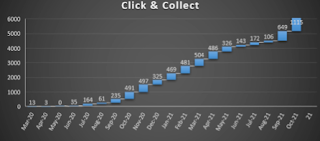
The service has been highly successful and well received by both students and staff with a 50/50 split take up. The graph below displays the usage of this service over a 16-month period.

Statistical analysis of click and collect – compiled by Bridie O’Neill


On a personal note, continuing to communicate with both students and staff gave a normality to an exceedingly difficult situation. The camaraderie with other staff in our combined efforts to not only meet but exceed our users’ expectations was a rewarding unexpected well-being bonus.

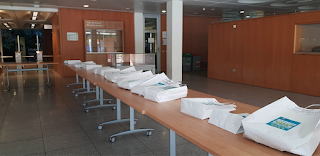
Click & collect books ready for collection in Maynooth Library Foyer © Emma Boyce MU Library

The service has proved invaluable with feedback received via our poll survey. An example of such feedback is the following: How would you rate the service - “Excellent” and do you want the service to continue? “Yes, please.” At the peak we receive up to 80 click and collects requests in a normal 9 am – 5 pm working day. We welcome our library users' feedback and Click and Collect was born out of necessity and has become a popular new library service.

What Next?

In conclusion Click & Collect has proven to be an invaluable service and we have received numerous requests to continue this service now that the doors to the library have reopened.  The click and collects success has raised the question how we can improve this service further?   A parcel motel approach is being investigated to allow click and collect books to be left in the Library foyer in coded lockers for users to collect at times convenient to them.