Showing posts with label CPD. Show all posts

24 Jun 2026

Developing RDM expertise: A Librarian’s Review of the Introduction to Data Stewardship Micro-Credential

This guest post is by Margaret Irons, Librarian, School of Celtic Studies, 

Figure 1: Data Management Plan. The Turing Way project illustration by Scriberia
Good data governance is a core component of high quality research. Researchers are now being asked to produce robust DMPs (data management plans), to comply with funder requirements, apply FAIR (findable, accessible, interoperable and reusable) principles, select appropriate repositories and ensure that research outputs remain accessible, secure and reusable.  

As librarian at Dublin Institute for Advanced Studies, RDM (research data management) has become an important part of the library’s contribution to research excellence, open scholarship, institutional policy, funder requirements, data and metadata management and compliance.

If you are increasingly being asked to assist with and advocate for RDM or Open Research best practice, and you are looking for formal accredited training whilst also working full-time, then look no further than the Sonraí DH5001 Introduction to Data Stewardship micro-credential which meets these challenges head-on, with a thoughtfully designed programme that is both academically rigorous, seriously practical and conveniently accessible for busy professionals.

Figure 2: Sonraí Irish Data Stewardship Network logo
Micro-credentials are accredited courses available to improve skills you already have or to develop new skills in relevant emerging areas. Delivered by Sonraí, the Irish Data Stewardship Network, and hosted by University College Cork, this thoroughly practical level 9 micro-credential provides an accessible yet comprehensive introduction to RDM and data stewardship. Delivered in a flexible hybrid format over 13 weeks it is aimed not only at current and aspiring data stewards but also at researchers, research support staff, librarians, knowledge managers, research administrators and technical staff supporting research infrastructure.

Figure 3: University College Cork logo
Over thirteen weeks, myself and the 25 or so other students on DH5001, engaged with topics including research data and data stewardship, data management planning, metadata and organisation, data curation and preservation, FAIR principles, policy and compliance, rights and licensing, ethics and governance, and GDPR. Guest lectures provided valuable real-world perspectives on subjects such as Open Research, reproducibility, research security, copyright and licensing, and research ethics.

The course delivery method is particularly effective for working professionals. Lectures and guest presentations are recorded and released alongside transcripts, slide decks and comprehensive reading lists, making the course highly accessible and flexible. I particularly enjoyed the optional online Q&A sessions hosted by the Sonraí team, which offered an informal and supportive environment for all students, whilst also knowing that the Sonraí team were available regularly via email to answer any questions. I also enjoyed the timed release of each module on a weekly basis which helped to keep me working at a steady pace and on schedule.

The course is assessed through a combination of practical assignments and online learning activities. Continuous assessment consists of the completion of an initial version of a data management plan, followed by a final revised research data management plan. Between the first and the final assignment I could really see how my expertise in the area had developed and I now feel even more qualified to offer advice to researchers in my home institution.

In addition, participants complete six online e-tivities in the form of self-assessment exercises and discussion board contributions, which encourage reflection, engagement with course content, and peer learning. These online self-assessment exercises, offered insights into other students’ interesting and varied projects and also offered a supportive forum for learning and expansion of knowledge through active engagement.

I thoroughly enjoyed this course, not only as a professional development opportunity but also because RDM and open research have become a professional passion of mine and to be able to practically expand my knowledge around the subject was both rewarding and exciting. Combining critical thinking with a directly relevant and comprehensive course was both stimulating and challenging in equal measure. It was definitely a bonus to be able to develop my expertise without the added commitment of undertaking another Postgraduate Degree or Masters.

The Sonraí team should be commended for developing and delivering such a high-quality programme. In particular, I would like to acknowledge Dr Aoife Coffey, whose dulcet lecturing tones became something of an unexpected highlight of the course. Aoife’s lecturing style is enthusiastic, engaging, and calming all at once. The programme was enriched by the contributions of many excellent Sonraí lecturers and a diverse range of guest speakers, all of whom brought valuable expertise and perspectives.

In a time where institutions, funders, and publishers increasingly expect robust data practices, this course has further equipped me with skills that are immediately transferable and professionally valuable. I believe this micro-credential represents an important advancement in the professional development landscape for data stewards nationally and it offers the opportunity to remain relevant in rapidly evolving research data management environment.

The next intake to the course will be January 2027 and registration will open in the autumn. Follow Sonraí on LinkedIn for further information.

Acknowledgements:
  • I acknowledge the use of ChatGPT to refine my original text and to correct spelling and grammar.
  • Thank you to The Registrar, Dublin Institute for Advanced Studies for providing funding to participate in this course.
References:
  1. UCC Micro-credentials courses https://www.ucc.ie/en/dh5001/
  2. Sonraí – The Irish Data Stewardship Network https://datastewards.ie/
  3. The Turing Way Data Management Plans https://book.the-turing-way.org/reproducible-research/rdm/rdm-dmp/
  4. Data Management Plan. The Turing Way project illustration by Scriberia. Zenodo. The Turing Way Community & Scriberia (2024) https://zenodo.org/records/13882307
  5. Coffey, A., Joy, C., Hayes, A., McCabe, G., O'Dwyer, L., McCarney, E., Clarke, R., Madden, F., Stokes, D., Quinn, C., Dalton, M. and Noonan, E. (eds.) (2025) Navigating Open Research - A guide for early career researchers. CONUL Research Group. https://doi.org/10.33178/10468/17586
  6. National Action Plan for Open Research https://norf.ie/national-action-plan/

26 Nov 2025

Join the Library Association of Ireland, Career Development Group Committee.


Guest post by LAI CDG Group

Are you a library or information professional looking to connect with others, build your network, and help shape professional development opportunities in our field? The Career Development Group (CDG) is welcoming new members this December, and we would love to have you on board. 

The CDG is a friendly and welcoming committee made up of enthusiastic professionals from across the LIS sector. Committee members from all over Ireland meet once a month via Zoom to plan activities, share ideas, and collaborate on initiatives that support career growth and community building. 

By joining the CDG, you will have the opportunity to: 
  • Network with colleagues from a variety of roles and backgrounds. 
  • Co-organise relevant events and workshops that benefit the wider LIS community. 
  • Gain experience in committee work in a supportive, low-pressure environment. 
  • Contribute your voice and ideas to our ongoing projects and planning. 
Whether you are early in your career, an MLIS student, or a tenured LIS professional looking to get more involved, CDG is a great place to connect, learn and grow, while having fun doing it! 
Interested in joining? Please fill in our New Members Form and attend our online AGM on December 9th when we form our committee. There are three officer positions: Chair, Secretary, and Treasurer. There are also roles in our Communications team which supports the CDG’s outreach and promotions.
 
We look forward to hearing from you. 

Your voice matters. No prior experience required, just enthusiasm.

4 Nov 2025

From Dublin to Seoul and Back Again: A Transformative Vision for University Libraries

Congratulations to Emily Daly from Dublin City University Library, whose blog post was highly commended in the CONUL Training and Development Library Assistant Blog Awards 2025.

A Journey That Changed How I See Libraries
When I took a five-month break to travel in Asia, I thought I was stepping away from library work. But in Seoul, surrounded by books under open skies, my idea of what a library could be began to shift. It was October, the city buzzing after Han Kang’s Nobel Prize win, when I stumbled across the Seoul Outdoor Library. Soon, I realised libraries don’t have to stay behind four walls; they can be woven into daily life. Now, in my role as a Library Assistant in the Public Services and Outreach Directorate at DCU Library, that vision continues to shape how I see our work. Outdoor libraries aren’t a novelty, but rather a powerful way to connect with the community.

Seoul Plaza: ‘Sky Gazing, Book Gazing’
I had planned to visit the Seoul Metropolitan Library, but walking through the adjacent plaza, I stumbled across something unexpected. Thousands of books filled colourful trolleys and boxes. Friends, couples, and families read and relaxed on beanbags, while others played in activity zones woven among the seating. Classical music floated from a nearby stage. Playful and open, it invited not just reading but connection and discovery.

1. Readers sink into stories on pink and blue beanbags outside Seoul Metropolitan Library as evening falls. (Photograph: Author, 2024).

Gwanghwamun Square: ‘Mountain Gazing, Book Gazing’
A short walk away, Gwanghwamun Square unfolded beneath the gates of Gyeongbokgung Palace. Another 5,000 books mingled with food stalls, K-pop shows, and exhibitions. Children raced to pick books while tourists and locals browsed. It was part library, part street festival, in the heart of the city.
 
2. Gwanghwamun Square becomes a pastel sea of beanbags and books, set against Seoul’s iconic gate and mountains. (Photograph: Author, 2024).
3. A mother and child read under a tent at Gwanghwamun Square while a tired dad sneaks a nap (Photograph: Author, 2024).
Cheonggyecheon Stream: ‘Water Gazing, Book Gazing’
Another short stroll led to Cheonggyecheon Stream, where the mood shifted to a quiet intimacy with red chairs, book boxes, lanterns, and tables lining the waterway. Couples, families, and friends posed for photos, read side by side, and dipped their feet in the water. The gentle stream mingled with soft conversation. Tucked among the titles, I spotted some Irish writers.
 
4. Seats, tables, and book boxes line Cheonggyecheon Stream, offering calm spaces to read, chat, and unwind. (Photograph: Author, 2024).
5. Couples, families, and friends share intimate moments by the stream. (Photograph: Author, 2024).

A Library Network Woven into the City
What struck me was how seamlessly these library sites blended into public space. Though temporary and seasonal, they felt intentional, designed to meet people where they were. Each had its own mood, yet together they formed a citywide invitation to read in public. At their heart was a quiet trust: books left out for anyone to browse, linger with, and care for. That trust was met with joy and respect. Since 2022, Seoul’s outdoor libraries have welcomed over six million visitors (Park, 2025).

6. Official brochure maps Seoul’s outdoor library network across city spaces. (Source: Seoul Metropolitan Government, 2024).

Beyond the Walls: Reimagining Libraries in the Open
Since returning home, I’ve often wondered how Seoul’s outdoor library model could work in Ireland. At DCU, our Library Strategy (2023–2028) promotes innovative services and diverse spaces which “enrich experiences and enable creativity and connectivity” (DCU Library, 2024), aligning with the university’s broader mission to “transform lives and societies” (Dublin City University, 2025). The opportunity is right in front of us. Our campuses are full of green, open spaces — so why not bring the library out into them? Picture beanbags under trees, book trolleys by the coffee van, outdoor study zones during exams. We already join in events like Culture Night, but they’re occasional. Mobile libraries visit festivals, yet often remain on the fringes. Seoul’s approach is different: a daily, visible presence woven into public life. It showed me that transformation can begin with something simple: books outdoors, visible and inviting. That simplicity sparks curiosity, connection, and spontaneous moments of engagement. Why not open these spaces to the wider community too, turning campuses into living cultural landscapes?

7. Green spaces in front of DCU O’Reilly Library, a canvas for creative outreach. (Source: DCU Communications, 2022).

Conclusion: Envisioning a Living Library Landscape
Seoul’s outdoor libraries weren’t just outreach; they were a shift in thinking. They brought books into public life in a way that felt joyful, visible, and relevant. Back at DCU, I see that same transformative potential. If we step outside the traditional model, literally and figuratively, we can build a library experience that is lived, shared, and felt beyond four walls.

References
DCU Communications (2022) Our Campuses. Dublin City University. Available at: https://www.dcu.ie/commsteam/our-campuses (Accessed: 29 July 2025).

DCU Library (2024) Library Strategy 2023–2028. Dublin: Dublin City University. Available at: https://www.dcu.ie/sites/default/files/inline-files/dcu-library-strategy-2023-2028.pdf (Accessed: 29 July 2025).

Dublin City University (2025) DCU Strategy 2023–2028. Dublin City University. Available at: https://www.dcu.ie/strategy (Accessed: 29 July 2025).

Park, U. (2025) ‘Seoul’s outdoor libraries draw 1 mil. visitors in 3 months, exceeding expectations’, The Korea Times, 3 July. Available at:
https://www.koreatimes.co.kr/southkorea/society/20250703/seouls-outdoor-libraries-draw- 1-mil-visitors-in-3-months-exceeding-expectations (Accessed: 29 July 2025).

Seoul Metropolitan Government (no date) Seoul Outdoor Library. Seoul Metropolitan Government. Available at: https://english.seoul.go.kr/seoul-outdoor-library/ (Accessed: 29 July 2025).

Seoul Metropolitan Government (2024) Wow! Seoul Outdoor Library [brochure]. Seoul: Seoul Metropolitan Government.

21 Oct 2025

Mentorship: Creating a fertile ground for character growth and academic advancement at DCU Library

Congratulations to Lorcan Cahill from Dublin City University Library, whose blog post was highly commended in the CONUL Training and Development Library Assistant Blog Awards 2025

Mentorship involves the guidance of individuals or groups towards a common goal. Mentors are those in a position of influence who adopt an attitude of forward thinking. They achieve this outlook by placing value on an individual or group’s trajectory in life. They understand that confidence breeds competence. Mentors empower others by delegating opportunities for character growth and possess the skill of anticipating the future by setting forth a vision that is grounded in the realities of today.(Burnison. 2012. Chap 6) 

At DCU Library, we are aware of the importance of mentoring students and staff. We hold the personal and academic development of our library users in equal measure. (DCU Library Strategy. 3) We endeavour to facilitate an engaging environment that simultaneously encourages people to academically succeed and grow in character. This culture is not born out of passive activity, but rather it is born through high-contact engagement and meaningful relationships with our users. 

The front-facing library assistant, who assists in identifying educational resources, is fundamental to mentorship. The initial interaction at the front desk is crucial as it can either positively or negatively impact the individual’s future relationship with the library. Moreover, the library’s greatest asset is its staff, especially those who are front-facing. Library users must feel comfortable asking for help. To seek assistance is to make oneself vulnerable to a lesser-known concept. It is the library assistant’s job to be conscious of that and address the user’s needs. These include explaining the use of an online search catalogue, showcasing the use of an online journal database, providing advice on a reading list, resolving library account queries, or even giving directions to a lecture hall. 

Patrick Dennan, DCU Library Assistant at Cregan Library, assisting students at our library reception

Credit: Kyran O’Brien

At Dublin City University, we value a shared mindset ‘to transform lives and societies.’ (DCU Strategy 2023 - 2028) This mindset permeates all positions within the library and is keenly felt at library assistant level as the help desk is where active engagement is most evident. The advantage of a front-facing role is that participation and interaction are inevitable. Similarly, the potential for authenticity and connectivity to flourish is paramount. Authenticity and connectivity, in this context, mean removing excessive individualism and favouring a shared sense of purpose. (Goffee & Jones.2015. Introduction) Once these conditions are evident, an environment is made fertile for not only academic advancement to occur, but for character growth to materialise. 

To achieve this climate of personal and academic development, DCU Library remains collegial and collaborative. (DCU Library Strategy 2023 - 2028. 3)We understand our geographical importance of being situated on the northside of Dublin and the close proximity we share to local primary and secondary schools. Mentorship at DCU Library, therefore, is not exclusive to DCU staff and students, but it is extended to the local community. Our outreach initiatives such as Leaving Certificate students availing of a study environment in the lead up to their examinations is illustrative of this. The library also offers Leaving Certificate students an opportunity to avail of free masterclasses in subject areas like English, Irish and Mathematics. Similarly, community engagement is fostered through long-standing campaigns including regular creative writing workshops and competitions, art exhibitions, and inviting members of the community to celebrate cultural heritage on Culture Night. 

Dave Rudden introducing a Leaving Certificate masterclass on English, Seamus Heaney Lecture Theatre, DCU St. Patrick’s Campus

Credit: DCU Library

As well as building engagement, mentorship is primarily provided to our students and staff. This provision is made possible by forward thinking. Forward thinking, in the context of an academic library, means drawing upon the real-life experiences of our users and implementing new strategies to improve their overall experience. It means, in other words, leveraging our user experience by enlarging and evaluating the already existing experience of our users. 

Woodlock Hall Library, DCU All Hallows Campus (Mahon and O'Neill)

                                    Credit: Kyran O’Brien 


Forward thinking occupies the liminal space between the ‘what’ and ‘why’ of an organisation. At DCU Library, we are particularly committed to championing and empowering users with neurodivergent needs. Woodlock Hall Library, which was opened to our users in 2021, was initially designed as a quiet alternative library. It has since become popular with patrons in need of a sensory-friendly study space. Consequently, the quiet study environment is frequently promoted via our social media channels. This is reflective of our commitment to mentor our diverse community by eliminating educational barriers and anticipating their needs. It is also illustrative of our adherence to value our people. 

We are aware that by valuing our users, DCU Library, as an organisation, grows in value itself. There is a symbiotic relationship between the library and our patrons. If one augments in value, the other follows. By committing to our purpose of mentoring both the academic success and wellbeing of our users, DCU Library remains inwardly sound and outwardly engaged. Mentorship is extended to our users by offering a study and social environment that encourages collaboration, engagement and participation. Furthermore, our ultimate goal is to equip users with self-confidence. By building confidence, the ground is made all the more rich for our patrons to gain self-awareness and thrive both academically and socially. 

SECONDARY SOURCES 
PUBLISHED WORKS 
Burnison, Gary, The Twelve Absolutes of Leadership (New York, 2012, eBook edition). 
Goffee, Rob & Jones, Gareth, Why Should Anyone Be Led by You? With a New Preface by the Authors: What It Takes to be an Authentic Leader (Boston, 2015, eBook edition). 
O’Neill, Alana Mahon, & Shanahan, Rosemary, ‘All Hallows Campus and Woodlock Hall Library’, LibFocus, 18 July 2024 (accessed 05/06/2025). 

INTERNET RESOURCES 
Definition of Mentorship, Merriam-Webster Dictionary (accessed 05/06/2025). 


17 Oct 2025

LIR Annual Seminar 2025: Communities of Practice

This guest post is written by Jenny O'Neill on behalf of the LIR Community.

A woman standing at the top of a room in front of two large screens. She is speaking to a group of seated people.
Daniela Bultoc speaking at the LIR annual seminar. Picture credit: HEAnet User Group for Libraries, 2025. 
Four Questions to Ask When Forming a Community of Practice

In April 2025, the LIR HEAnet User Group for Libraries held its annual seminar at the HEAnet offices in Dublin. This year’s theme focused on community engagement within the library sector, particularly through communities of practice and social media networks.

One of the keynote speakers was Dr. Daniela Bultoc, who delivered an insightful talk on Communities of Practice in Higher Education. Daniela outlined three key goals for her presentation:

  1. To define what we mean by communities of practice
  2. To understand their benefits in higher education
  3. To identify opportunities for incorporating them into our work

What Are Communities of Practice?


The concept of communities of practice has its roots in the apprenticeship model, where learners would meet and learn from one another. This approach is supported by social learning theory, which suggests that around 70% of what we know is learned through others, through doing, and through experimentation.

In the complex organisational structures of universities, many professionals find themselves working in isolation or as the sole expert in a particular area within their department. Yet, others across the institution may be working on similar challenges. Communities of practice offer a way to break down these silos, enabling us to connect, share, and learn from each other.


Membership and Sustainability

There are several models for community membership. Members may self-select or be nominated based on their expertise. However, it is passion and commitment that truly sustain a community. Crucially, line management support—linked to appraisals, career development, or talent development—is essential.

Daniela made an important point: a community of practice will last only as long as there is interest, passion, and energy. When that fades, it’s perfectly okay for the community to come to a natural end. Flexibility is key to the lifecycle of a community.


Why Libraries?


In libraries, communities of practice can be transformative. They support professional development, encourage innovation, and ultimately enhance library services and student support.


Benefits of Communities of Practice

Daniela’s evaluations revealed compelling benefits:

  • 80% of members said they were generating innovative ideas and solving problems
  • 77% were sharing resources, information, and experience
  • 72% felt a stronger sense of belonging and connection
Other benefits included:

  • Improved awareness of where and who to go to for information
  • Better communication across departments
  • A collective vision of excellence
  • Service alignment
  • A stronger sense of professional identity

Ready to Get Started? Ask Yourself These Four Questions

1. Purpose: Why Do We Exist?

Communities of practice aim to produce, extend, and exchange knowledge, connecting people with shared interests. They represent a grassroots model of change. Clarify your shared goals, skills, and expertise, and define what you want to achieve together. A clear and motivating purpose is essential.

2. Members: Who Belongs?

Once goals are clear, it becomes easier for individuals to decide if they belong. Typically, there’s a core group of active members who both learn and share. There may also be wider members with an interest but less expertise, and key stakeholders who contribute occasionally.

Daniela recommends a co-leadership model. Communities can be:

  • Self-organised/informal – member-driven and less visible
  • Supported/formal – intentional, strategic, and more visible
  • The “third space” – autonomous but with strategic support via a Champion
Strategic sponsorship helps align the community’s purpose with organisational goals.

3. Activities: What Are We Going to Do?

Define your collaborative projects and events. Create opportunities for meaningful interaction and focus on solving shared challenges. And celebrate successes!

Activities might include:

  • Relationship building
  • Knowledge sharing
  • Collaborative problem-solving
  • Learning-focused initiatives
  • Strategic alignment efforts
4. Process: How Are We Going to Do It?

Establish your meeting rhythm, communication channels, and processes. Start meetings with light, engaging interactions and prioritise psychological safety. Focus on quick wins to maintain momentum and energy.


Useful resources:


To join the community and keep up to date about future events please sign up for the LIR mailing list
 

9 Dec 2022

Ligatus Summer School 2022: Histories of Bookbinding

Guest post by Yvette Campbell, Collections and Content Librarian at Maynooth University Library. Yvette’s professional interests include the history of the book, codicology, descriptive bibliography, and digital preservation.
 
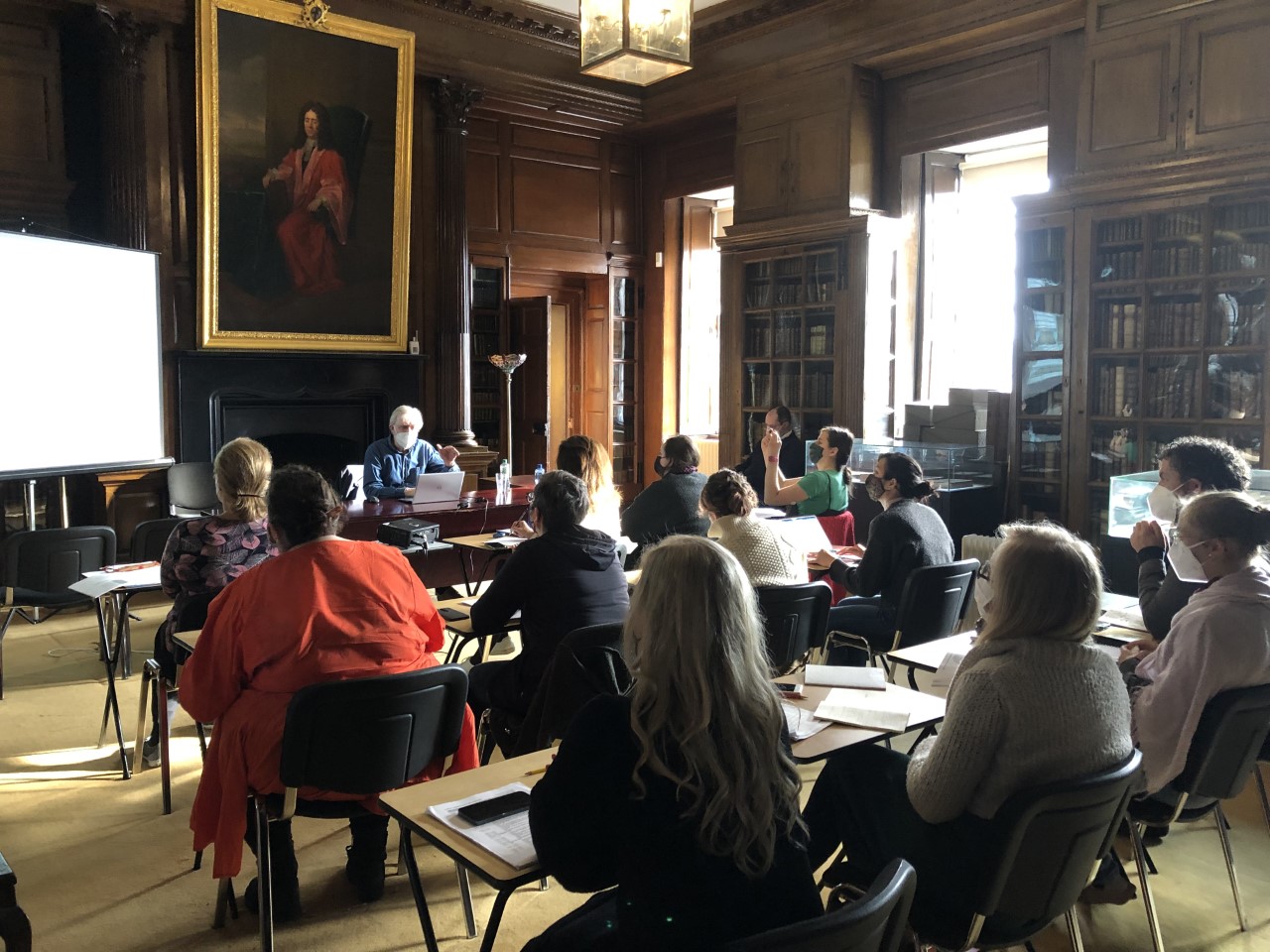
(Fig 1) - Week 1 Ligatus School 2022 participants at the Edward Worth Library. Photo courtesy of Elizabethann Boran

I was very fortunate to undertake a terrific professional development opportunity this year to attend the 2022 Ligatus Summer School for two consecutive weeks in September. The Summer School took place in Dublin and was hosted by the Edward Worth Library and included scheduled visits to both Marsh’s Library and the Chester Beatty.
 
The Ligatus Summer School is world-renowned amongst librarians, cataloguers, conservators, historians, and scholars who work with early books. It offers courses on bookbinding history and Linked Data - in particular, the development of historic bindings with a particular emphasis on description and recording of their various structures and materials.
 
Ligatus is organised in collaboration with many institutions including the University of the Arts, London and the Saint Catherine Foundation which supports conservation work at Saint Catherine’s Monastery in Sinai, Egypt. The Summer School takes place in a different city each year worldwide and 2022 was the first year it has been held in Ireland.
 
Call for applications
 
I noticed the call for applications to attend the school on social media and didn’t hesitate twice about applying. Anyone who works with unique and distinctive collections in Ireland will know what little opportunities are afforded to us in recent years to upskill in the areas of special collections curatorship. I also felt it was a great opportunity to visit some of the most important historical collections in other local institutions and to re-connect with colleagues in this area. I previously had knowledge of European bookbinding which for several years has been beneficial in my role as a rare materials cataloguer. In recent times, I have been drawn to the traditions of bookbinding that developed in the East (in particular, the Islamic manuscript tradition) and was very keen to expand my knowledge in this area. For me it was important to understand that bindings can be read as a text with a language of their own, and to describe them accurately is to learn their language.
 
The Application Process
 
The course fee (as of 2022) was €400 per week and candidates could choose to attend one or both weeks. Maynooth University Library kindly supported my application to attend both weeks. The application process was much the same as applying for a regular job. The school required an up-to-date CV and a supporting cover letter outlining who we are, our occupation and why we were interested in applying.

Successful candidates would be contacted in August, and I was delighted when I received the acceptance email. Shortly afterwards, I received the summer programme including a reading list for week 1 which focused on European Bookbinding 1450-1830. I was also provided with a list of software to download in advance of week 2 which was concerned with Identifying and Recording Bookbinding Structures of the Eastern Mediterranean.

Week 1 - European Bookbinding 1450 - 1830
 
(Fig 2) - Prof. Nicholas Pickwoad teaching European Bookbinding at the Edward Worth Library. Photo courtesy of Elizabethann Boran

Professor Nicholas Pickwoad‘s course on European Bookbinding, 1450-1830 was every bit as meticulous but rewarding as I had hoped it would be. It consisted of rich lectures every morning and hands-on sessions in the afternoons looking at specimens from the Edward Worth Library. Two afternoons included excursions to Marsh’s Library and the Chester Beatty for classes examining their collections in greater detail.

Participants came from a variety of diverse backgrounds, traveling from Estonia, France, England, Germany and Sweden. Eight students were book and paper conservators, while three were Irish librarians (including a digital librarian and two special collections librarians). It was fascinating to see the mix of backgrounds and I was heartened that there was representation within my own profession. Without the know-how to catalogue and describe binding structures as accurately as possible, we are losing great opportunities to provide researchers and scholars with enough material evidence to support important historical research including questions of who bound a book, where and for what purpose?

As a rare materials cataloguer, I have always tried to include at least a brief description of each book’s decorative binding. This course has now given me the knowledge and vocabulary to describe other important elements and how they were made. For example, recording the presence of uncut edges is vital for understanding the status of the book and to be cautious when recording the prices on title-pages to understand exactly what they mean - as without other supporting historical annotation, it can be meaningless - is it the price of the textblock, the print, or the binding?

(Fig 3) - Selection of bindings to examine from the Edward Worth Library 


(Fig 4) -Selection of European bindings from the Chester Beatty


We concentrated on the structural analysis of bindings particularly regional techniques and materials present rather than decorative finishing. We also examined how to date bindings in the medieval period, how to identify the raw materials used (with caution), how to check leather that has been tooled by hand through symmetry, sewing and stitching techniques, recessed supports, spine linings, edge treatments, board types and endleaves – all of which can tell us the where, why and hows of the history of the book as an object.

As books regularly travelled from the bindery to private collections across Europe during this time-period, they were often rebound to suit the taste of their wealthy owners. Patrons could choose their books to be bound in various uniform colours or stripped back to the plain old basics. Thus, Professor Pickwoad emphasised the importance of intact historic collections as one of the most important for studying original bindings - since they were often commissioned for one or perhaps two collectors and unlikely to have moved around. Some Irish examples in this context include the St. Canice’s Cathedral Library Collection on long term loan from the Church of Ireland held at Maynooth University, the Bolton Library at University Limerick and indeed the Edward Worth Library itself.

(Fig 5) - Example of customised fore-edge painting by Cesare Vocellio from the Pillone Library


Week 2 - Identifying and Recording Bookbinding Structures of the East Mediterranean
 
For week 2, the course was divided into two inter-related sessions delivered by Dr Georgios Boudalis and Dr Athanasios Velios, both conservators respectively working on the St. Catherine’s Monastery Project in Egypt. In the first session, Dr Boudalis focused on the major structural and decorative features of different bookbinding traditions that developed in the Eastern Mediterranean, including Coptic bindings, Arabic, Armenian, Georgian, Syriac and Ethiopic books– with a special focus on Byzantine and post-Byzantine bookbindings. We examined various precursors to the multi-gathering codices such as wooden, legal and wax tablets and papyrus rolls.

(Fig 6) - Week 2 Ligatus School 2022 participants at the Chester Beatty. Photo courtesy of Kristine-Rose Beers


While showcasing bookbindings from various museums and libraries (including St. Catherine’s Monastery), we were guided through the development of these closely related binding structures and their influences from the West. Dr. Boudalis emphasised that by examining representations of the codex in iconography, we can ascertain evidence of decorative and functional characteristics that may no longer survive and how they may have been utilised once upon a time. We concluded this session by visiting the Chester Beatty again to view and study examples of these various traditions with an impromptu visit to the Conservation lab hosted by Kristine Rose-Beers, Julia Poirier and Hoa Perriguey.
 
(Fig 7) – Coptic binding fragments from the CBL dating to 600 AD 


(Fig 8)  - Bone ties decorated with characteristic concentric circles used to keep leather ties in place

In the second session, Dr Athanasios Velios introduced participants to the semantic web, Linked Data and the CIDOC Conceptual Reference Model (CRM) for cultural heritage objects. We were also introduced to the consolidation potential currently being explored in a Linked Conservation Data Pilot.

The session consisted of a combination of presentations and hands-on group-oriented workshops. We explored the importance of standardised vocabularies for book descriptions and the significance of using Uniform Resource Identifier’s (URI) to assist systems in linking to a global thesaurus for maximum discovery impact. The afternoons were spent writing xml schema for various book components and mapping these to CIDOC-CRM using 3MEditor, a web application to view xml mapping files and publishing the Linked Data in ResearchSpace, an open-source platform that supports knowledge preservation.

At the end of the course, I received a certificate of completion for my continuing professional development (CPD) records.
 
Reflections on the course
 
I am looking forward to applying new knowledge of concise binding descriptions to my role in Maynooth University Library and perusing our holdings again as we enter an exciting and challenging new phase of the Russell Library Cataloguing Project to enrich records from the collections of St. Patrick’s College Maynooth with copy-specific features related to bindings. If contemplating how to describe bindings, I would highly recommend consulting the Language of Bindings thesaurus as a reference. The course has given me a deeper appreciation for the study of bindings as artefacts and how materiality impacts history. As Prof. Pickwoad declared during one tea break when I revealed that I need to go back and amend a few entries in our catalogue - “I want you to go away from this course feeling worried”… And I do, but in an optimistic way! 

29 Sept 2022

The coming together of librarians post Covid - WLIC 2022


Guest post by Aisling Smith. Aisling recently graduated with an MLIS in UCD and is currently working at TU Dublin Tallaght Campus 

When New Zealand found they were unable to hold the 87th World Library and Information Congress (WLIC) in 2020 due to their venue, the New Zealand International Convention Centre in Auckland, being destroyed by fire, Ireland seized its’ opportunity and stepped in to save the day by offering to hold it in the Convention centre in Dublin. As a result of the pandemic, it was delayed until July 2022 and the subsequent return to in-person meetings and networking after an absence of two years, probably made 2022 the best Congress ever and cemented Ireland's place in world librarianship.

Being a volunteer team lead ensured I was kept busy during the Congress, but I endeavored to attend the session entitled “News Literacy: Fighting Mis/Disinformation at your library” in full.  Fake news and misinformation really came to the forefront with the rise of Trumpism and continued to be a major issue during the pandemic with increased dependency on digital resources for communication, information, and learning. Liffey Hall 2 was packed for the session and the presentations and Q&A session was most enlightening. We appear to be in a post-truth society, where beliefs are influenced by emotions and opinions rather than reason. Freedom of information gives freedom to create and disseminate fake news but fake news is a threat when aimed at those who are in a vulnerable situation or unable to think objectively.

We were advised that Nigeria might even have more problems than most due to the proliferation online of dangerous remedies even before Covid-19 such as salt for Ebola and that fake news can spread panic, tension, and fear in populations. In our post-truth era, young people are predominately dependent on social media and other online sources for information so especially vulnerable to fake news and misinformation. Fulton and McGuinness (Ireland) related how they developed a course for training librarians in media literacy to enable them promote media literacy in the community. Rajic from Serbia reminded us that librarians had to be conscious of the sensitivities of users when promoting media literacy, to anticipate anger and upset when serving “as the patrons’ shield” against fake news. Nguyen Thi Kim (Vietnam) reported on research that indicated that the dissemination of fake news or misinformation was reliant on poor digital and media literacy and this view was postulated by all presenters. The ensuing Q&A session included a discussion on tools to teach critical thinking. I learned that the CRAAP test is now deemed only fit for general literacy as opposed to media literacy and might even have a negative impact on students and leave them worse off. The SIFT method introduced by Michael Caulfield was proposed as being most effective especially regarding digital literacy. The importance of agile project management in libraries was highlighted as librarians have had to adapt and use strategies from other professions ever more frequently in recent years especially since Covid.

The importance of informal interactions at such an event cannot be overlooked. IFLA’s mission ( 2019-2024) is to “inspire, enable, engage, connect” and the Congress gave participants a chance to reconnect with others and share experiences and ideas. The poster sessions were an excellent way of promoting one's work and ideas, and one would be hard put to find so many librarians interesting and passionate people in such a small space.  Covid-19 highlighted the importance of libraries to governments and the general public. IFLA's WLIC 2022 gave librarians from all around the world the opportunity to reconnect by discussing important issues, networking and dancing to YMCA at the disco in the Lexicon public library in Dun Laoghaire. Volunteering at WLIC 2022 presented the opportunity to experience the friendliest conference one could attend. To belong to the tribe of librarians means one is consistently in the company of empathetic, altruistic, opportunistic, and optimistic colleagues, this is what made WLIC 2022 such a success and explains why the future is bright for libraries!

20 Sept 2022

Review of Seminar on Academic Libraries at WLIC 2022.


Guest post by Naomi Faris, from Cork. Naomi has recently completed her MLIS at UCD) 

As an MLIS student with little practical experience in the library world, I volunteered for the WLIC IFLA that was held in Dublin at the end of July this year. Never having attended an event like this before I was unsure of what to expect but I found the experience to be interesting and enjoyable. Meeting volunteers from around the world and hearing their experiences of working in the library world was inspiring as was being able to sit in on various sessions. One session that was particularly memorable was given by three Irish librarians working in academic libraries. The topic was innovations in academic libraries during the pandemic. 

Aoife Lawton, a national health services librarian from the HSE library in Dublin, spoke about the problems associated with staff wellness during this difficult and unprecedented time and the steps that the library took to combat them such as energy pods for frontline staff. Innovation and creativity were key concepts and could be seen in other areas such as the LAMA bot (Library Ask Me Anything), a design thinking workshop and a maker lab. Aoife also exhorted the library as a third space and the importance of leveraging A1 technology, an up-and-coming area in libraries of the future. 

These ideas were also seen in the piece by Michela Hollywood, librarian at Maynooth University. Michela spoke about the library as a flexible space and the environment was the theme underpinning many of the ideas that Maynooth embraced during the pandemic. This involved a celebration of World Africa Day and the redesign of the reception area with light and plants to create a welcoming, eco-friendly space. Michela also mentioned the energy pods which were installed in 2018 and were the first for a library in Ireland. Other creative ideas presented were a short story dispenser and wellness days for staff. In terms of covid measures Maynooth library incorporated a click and collect service as well as staff training and development. 

Martin O’Connor of UCC library in Cork spoke about ‘Shush! Sounds from UCC Library’ on UCC 98.3FM, an innovative radio show featuring library news, shows stories and some of the DJ’s favourite sounds in the mix. This show is broadcast for 1hr on campus radio and is used as a promotional tool to promote the library to students who may not be aware of all the library has to offer. The show also features interviews on all things library related such as advice for new librarians and issues affecting librarianship in general. This appears to be the first dedicated library radio show in Ireland. 

What stood out most was the innovation that each librarian showed as well as how libraries rose to the challenge of a difficult set of circumstances that occurred in 2020. As a newly qualified librarian it was interesting too to note the commitment to wellness, the possibilities for AI in libraries and how problems can be solved with creativity and innovation. 


13 Sept 2022

LIR - Show & Tell Competition


The LIR HEAnet User Group for Libraries is currently inviting current LIS students and recent graduates to share their work in a pre-recorded PechaKucha presentation (20 slides with 20 seconds of commentary per slide; total presentation length of 6 minutes, 40 seconds). PechaKucha tips, resources, and examples can be found here. Some examples of a Pecha Kucha: Pecha Kucha on presenting a Pecha Kucha, The Art of Revolution in the Public Library!, Accessibility on Academic Library Webpages and Information Professionals in Non-Traditional Library Settings. 

This competition is limited to current LIS students and graduates from the past two years from Dublin Business School, University College Dublin, or Ulster University. 

This is an opportunity for students and recent graduates to develop their presentation, communication, and impact skills by sharing their research with LIR and the wider community. Research has shown Pecha Kucha presentations can “promote visual design literacy while building oral communication skills” (Beyer et al, 2013) and can help in creating engaging presentations and increasing confidence in giving presentations (Christianson and Payne, 2011). 

Submission topics can be anything relating to library and information studies (such as a Master’s dissertation, capstone project, coursework, groupwork, general topic overview or any other research). 

Prizes will be given to the top 3 submissions (One4All vouchers - €150 for first, €100 for second, €50 for third) and participants can win a LIR branded hoodie. A selection of videos will be showcased on the LIR Group website. 

For more information, visit https://lirgroup.heanet.ie/index.php/show-and-tell-competition-for-lis-student.  

Submit your video recording online at https://www.cognitoforms.com/LIRLibraryGroup/LIRGroupStudentShowandTellSubmissions

Deadline for submissions: Friday, September 30th 

References

Beyer, A. A., Gaze, C. and Lazicki, J. (2013) “Comparing students’ evaluations and recall for Student Pecha Kucha and PowerPoint Presentations”, Journal of Teaching and Learning with Technology, 1(2), pp. 26–42. Available at: https://scholarworks.iu.edu/journals/index.php/jotlt/article/view/3109 (Accessed: 31 August 2022).

Christianson, M., & Payne, S. (2011). Using the 20x20 format for presentation training. Language Research Bulletin, 26, 1-15.

About LIR: 

LIR HEAnet User Group for Libraries provides a forum for discussion on the use of electronic resources and networks by HEI libraries and assists in development and training for their effective use.

LIR encourages communication and co-operation between member libraries in accessing electronic resources.  LIR aims to help academic libraries explore and develop their digital capacity by providing seminars and workshops for members, as well as other such events which bring this community of practice together. 

Follow LIR on Twitter @LIRHEAnet 

Posted on Tuesday, September 13, 2022 | Categories: , ,

15 Aug 2022

Integrating into the library community of Ireland: my journey to IFLA WLIC 2022

Image courtesy of Nadina Yedid

Guest post by Nadina YedidNadina works as Assistant Librarian at the Heritage Centre of the Royal College of Physicians of Ireland. She has a Master's Degree in Libraries and Digital Information Services from the Universidad Carlos III de Madrid (Spain) and a bachelor's degree in Library Science from the Universidad de Buenos Aires (Argentina). She is the editor of the SLA-Europe newsletter and is part of the LAI-CDG and LAI-ASL groups.


Last month, like many other librarians, I had the most amazing one week professional journey as a volunteer at the IFLA WLIC 2022. But my journey had begun much before that. On the 21st of June 2021, I took a flight from Buenos Aires (Argentina) to Dublin, looking for a better future for me and my family. I knew nothing about Irish libraries, but I had been working in libraries for 13 years and I was certain I wanted to continue my professional development in this vibrant city. My case might be a bit extreme, but if you are looking to start a career in the Irish libraries you might as well stay and read some of my tips to integrate into the library community of Ireland.

Getting started

Library worlds tend to be small worlds. I found out that that statement was true both for Buenos Aires and for Dublin. I changed from being in a place where I knew everybody and everybody knew me, to not knowing anyone at all. I had so many questions to ask but, where could I start? Who could I contact? I decided to start with the people I had close to me, and believe it or not, it worked! Not long after arriving in Dublin, a former colleague of mine wrote me an email saying she knew an Argentinian librarian who was working in The Hague, had worked for several years at IFLA and had a lot of international connections. The email also said she had already contacted her, and she was waiting for my call. And here comes my first tip: TIP 1 - Tell it to everyone. If you are looking for a change in your career or you want to start a career in libraries, just tell to everybody (if you can). You never know whom the help might come from. Embrace any help you can get, even if it looks like a long shot. After all, it’s worth trying, don’t you think?

The Argentinian librarian living in The Hague didn’t know much about Irish libraries, but she handed me the tip of a cord to pull. She said her first advice for me would be to join an association. She of course didn’t know any Irish associations, but she knew a member of the European charter of the SLA (Special Libraries Association), a librarian from the British Library, whom she could put me in contact with. At the time I didn’t fully understand the implications of joining an international association, but I do now, and I would like to replicate her advice. So, this is my second tip for you: TIP 2 - Join an international association. Joining an association will allow you not only to avail of the benefits for the members, like attending webinars and other kinds of events but also to obtain a different perspective of the library field. If you can, explore the possibilities of joining a committee. The options to work within an association are vast, and they are always a very good way of acquiring experience and skills much requested for open vacancies. Plus, it will look great on your CV! 


The wheels in motion

The librarian from the British Library was, of course, delighted to have another person on board and she offered me to join one of their committees. She said she even knew some librarians here in Dublin she could introduce me to. And that was when all the magic began.

She took the time to write a personal email to each of these librarians, telling them my story and asking if they could help me in any way. Not long after, I got answers from all of them. With some of them I met for coffee, with others I had a video call, and with others I exchanged emails. But all of them offered me a great deal of help.

I want to be clear about this: I got help from four different Irish librarians, who didn’t know me at all, who at the time were introduced to me by a British librarian, who didn’t know me either, and who I had met thanks to the contact of an Argentinian librarian living abroad who, again, didn’t know me from before. All this chain of beautiful people, they helped me just because. They didn’t need to do it nor had any reason to do it, but the will of doing something nice for someone else. And with this comes my third tip: TIP 3 - Don’t be afraid to reach out. The librarians’ community is probably one of the most cooperative and solidary communities you might find. If you have a teacher, a colleague or an acquaintance to whom you would like to ask something, don’t be scared to do it. I’m sure they will be happy to help you in any way they can.


First steps

Chatting with these librarians meant a pivot point for me. They gave me tips on what kind of positions I should aim for, what kind of libraries, how to put together my CV, and they stressed two pieces of advice I followed, and now I would like to share with you too. So these are my fourth and fifth tips. 

TIP 4 - Get a Twitter account. There is a huge library twitter community, and a lot of what’s happening in the library world is reflected there. Vacancies in libraries, webinars, workshops, in-person events, and what other libraries/librarians are doing, most of those things get published on Twitter. If you don’t know who to follow, start with the easiest one: follow @LAIonline. The LAI (Library Association of Ireland) posts much interesting news for the library world. They also retweet interesting posts from other libraries/librarians. So once you are following them, you can start following the other people they are retweeting, and so on and so forth. The Twitter algorithm will take care of the rest. It will show you other users to follow based on your interests until you get your own personal connections in the library world. It’s not hard, give it a try!

TIP 5 - Join the LAI, and if you can join one of their many committees, so much the better! You don’t need to be already working in a library to join the LAI. Joining is very easy and it’s not expensive at all! They have around 16 groups you can join according to your interests and you can join as many as you want (or your time allows you). This is an excellent way to get involved with the library community. It will give you the opportunity of networking with other librarians, and to participate in the planning of many professional-related activities. At the time I joined the LAI-CDG group I wasn’t working in a library and I was sceptic about how I could help the group in any way. But I found out there are lots of different ways in which one can help, and for sure you will find your way to be helpful to the group. Taking part in a group will not take much of your time and you can have a lot of fun too! 


IFLA WLIC 2022

In February 2022 I saw in a LAI newsletter (and again, on Twitter) that a call for volunteers for the IFLA WLIC 2022 was taking place. By that time I was already working in a library but I thought that it could be the best opportunity for me to attend and collaborate with a conference I had never even dreamed about going to. The last time an IFLA conference took place in Latin America was in 2004, and I hadn’t even finished my undergraduate studies back then! But now, a conference was taking place in the city where I was living, and I didn’t want to lose my chance to be a part of it. I talked to my manager who immediately agreed to it, and on Sunday 24th of July, I joined a group of approximately 200 volunteers from around the world. That’s when I got a true sense of what IFLA WLIC was.

The congress is as thrilling as it is exhausting. The days start very early in the morning and end very late in the evening. Volunteering implies that you have to do some “work” during the conference, but you also get some free time to enjoy the sessions. There are plenty of different tasks you might be given, like collaborating with the social media coverage, taking care of the VIP delegates, help out with the registration or badge control, among many others. In my case, my assignments involved assisting in one of the rooms where the sessions were taking place, so even when “on duty” I was able to attend some talks! The duties of a Room Assistant are quite simple: check that there are clean glasses and bottles of water for the speakers before every session; play a loop-presentation on the screens in between sessions; keep the room tidy; and eventually help the speakers to start their presentation (if they need it). Not a lot to ask, right?

During my time as a Room Assistant I got to listen to very interesting talks. I learned, for instance, about programs to identify Open Access journals; I became aware of innovative ideas taking place in health and academic libraries; I got to know IREL, the Irish e-Resources Consortium, and the fascinating work they are doing; and I listen about publishing in Irish academic libraries, among many other interesting topics. Needless to say, I also got the best out of my free time at the conference, learning about digital skills, conservation, marketing for libraries, and so much more.

But for me, the most invaluable asset I got out of the IFLA WLIC was the personal connection with other librarians. The Irish caucus, the cultural evening, the breaks, the lunches, all of them opportunities to get to know new people, and to finally meet face to face with those colleagues I had been interacting with over Zoom, Twitter or email. Putting a face to that Twitter account that always has interesting information, knowing how tall a person you had only seen sitting on the other side of a camera actually is, or how the voice of someone you’d only “talked” over email sounds. Humans are social animals, and all of our institutions and organisations are constructed on the grounds of the people who are part of it. The same happens with all the activities we do, for pleasure or work (or for both, if you are lucky enough). It all comes down to the people walking the path with us.

And with this comes my sixth and seven tips. TIP 6 - Get involved. If you see an opportunity to volunteer at any event, or if you can take part in it in any way, don’t lose your chance! Get involved, participate, join the community. Many events are taking place now, some of them in person and some of them online, but all of them equally worthy. Many of these events are for free, but for many others there are ways to join even if you can’t afford the admission fee, like applying for a bursary or, as I did, volunteering to help.

I’ve left my seventh tip almost for the very end of this post, but I think all the tips I’ve given you so far are in a way related to it. And if I had to choose only one tip to give you, it would be this one: TIP 7- Network. For any person that wants to make a start in any professional field, this would be my first advice. Knowing people already working in the industry probably won’t get you a position, but it will help you understand how the industry works. They can give you advice, they can help you understand what a position involves, and they can even shout out when they see a vacancy that might be good for you. I’m sure you already know many people you can talk to, but the biggest the circle, the better.

Moving forward

Last but not least, I wouldn’t like to finish this post without mentioning two extra tips for the time you are already enjoying your beloved library position. Here they are: 

TIP 8 - Be grateful. Getting your longed-for position is probably a combination of different factors. You were probably born in a home where you were supported to study, you had choices, you put lots of effort and perhaps, there was a bit of luck involved as well. Be grateful for that. And above all, if along the way you met people who helped you reach the place you wanted to be, thank them. You might not be able to repay them, but let them know that their actions had a positive impact on your life. So if you allow me, I would like to follow my own advice, and take this opportunity to thank the four Irish librarians who first introduced me to the Library world in Ireland: Marie O’Neill, Fiona Lacey, Ann O’Sullivan and Lara Musto; to Martin O’Connor and Helen Fallon for their support and inspiration to write this blog post; and very especially to the person who believed in me and offer me my first Assistant Librarian position in Ireland, Harriet Wheelock. To all of you, THANK YOU!

TIP 9 - Keep the chain. If someone helped you along the way, as I’m sure someone has, keep the chain of kindness. Help someone else to achieve their goals, as you have achieved yours. And again, as I like to follow my own advice, I’m writing this blog post hoping that someone might find it useful to start their own journey to integrate into the library community of Ireland. And if I can, from my humble place, help you in any way, please do not hesitate to contact me. Look me up on Twitter @nadinayedid, or send me an email to nadyed@gmail.com.

Thank you for reading!