Showing posts with label CPPD. Show all posts

3 Jun 2026

Why publish in An Leabharlann?


Guest Post by Hugh Murphy, interim editor of An Leabharlann. 

This month marks the (counts on fingers) twenty ninth anniversary of me becoming a qualified librarian.  In some ways it doesn’t feel like that, but by most professional metrics I am a probably well into dinosaur territory.  What that brings of course is experience and (hopefully) a degree of professional, if not necessarily personal maturity.  And our profession needs that – I hope.  

However, our profession also needs freshness of perspective.  This is critical as library and information studies in Ireland are shaped not only by theory and practice, but also by the ideas, research, and voices of those within it.  One of the most powerful ways we can contribute to our wonderfully varied field is through academic writing and publication in professional journals.

Publishing may seem daunting at first, but it is underpinned by a diversity of perspectives. And for our more recent graduates, a fresh perspective and outlook is a strength. You are uniquely positioned to question established practices, explore emerging technologies, and reflect on the changing role of libraries in Irish society. Whether your interests lie in digital literacy, community engagement, unique and distinctive collections, or open access and scholarship, your insights can add really meaningful value to discourse within the profession.

More than that, engaging in academic writing also strengthens your own professional development. It should sharpen your critical thinking, deepen your understanding of key issues, and hopefully enhance your confidence as a practitioner. Writing for journals such as An Leabharlann (or other LIS publications) can really enable you to compare and contrast your local experiences to a national or even global conversation.  And importantly this can help ensure that Irish librarianship (in all its aspects) is visible and influential on a wider stage.

Publication in An Leabharlann is not reserved for seasoned professionals - we actively welcome contributions from early-career library staff and we have a wonderfully supportive review process. And the great thing about working in libraries is that much of what you could write about is practice based – writing about a project you have done can be an accessible starting point.

In our last two issues of An Leabharlann we have seen voices from students and early career staff through to the full cretaceous era dinosaur. But we need to ensure that this breadth continues, and is also represented in terms of diversity of library experience.  Academic libraries, public libraries, special libraries – all are part of the national experience and we need all voices. An article may be too intimidating, so perhaps review a book or give a conference report. And for those of you who have delivered blog posts on platforms such as this, perhaps an article, with its greater length and rigour might be a really beneficial next step.

By choosing to write and publish, you are not only building your own career—you are helping to shape the future of our profession. Your voice matters. Your experiences matter. Ireland’s library sector benefits when its newest members contribute thoughtfully and confidently to its shared body of knowledge.

Take the first step: write, submit, and become part of the conversation. Send us an abstract at editor@libraryassociation.ie 


15 Mar 2024

Presenting the 2024 UCC Library Annual Seminar:


Guest Post by Blazej Kaucz and Mona Power on behalf of the UCC Library CPPD Group.

Libraries: Connecting Minds and Cultivating Wellness 

Date: 11th of April 2024 

Venue: Creative Zone, UCC Library, University College Cork 

This year’s UCC Library Seminar explores the critical role that libraries play in promoting and supporting well-being and engagement. Libraries are not just repositories full of books but vibrant spaces that impact the lives of individuals and communities.  

The event will shed light on innovative library practices that enhance patrons’ quality of life, in both academic and non-academic settingsOur speakers will offer a range of perspectives, considering the viewpoints of libraries as well as the communities they serve  

The seminar is open to library staff at any grade working in any type of library, students or recent graduates in information and library studies, or anyone who has an interest in libraries. 

The keynote speaker is Marta Bustillo, Digital Learning Librarian (University College Dublin). 

Programme: 

10:00 Registration and morning refreshments 

10:45 Welcome and introduction 

11:00 Keynote speaker - Marta Bustillo (University College Dublin) “Digital well-being: A necessity or a luxury?” 

11:45 Second speaker - Wiktor Owczarek (ABC EduLibrary) 

12:30 Lunch 

13:15 Third Speaker - Andrea Bickerdike (Munster Technological University) 

14:00 Fourth speaker - Hayley O'Connell Vaughan (University College Cork Students' Union) 

14:45 Panel Discussion (all speakers) 

15:30 Closing remarks 


We aim to make this conference a welcoming, inclusive event and as accessible as possible. 

Please contact us at librarycppd@ucc.ie if you have any questions or requests. 


To register, and for further information about location particulars, please visit UCC Annual Library Seminar 2024. 


21 Aug 2023

Reflections from winners of LIR's 2022 Show and Tell competition


Guest post by LIR HEAnet, Niamh O'BrienStewart Killeen


My experience entering and winning the LIR Show and Tell Competition 2022 by Niamh O’Brien 

I was having lunch with the Systems Librarian at my library when she told me about the LIR Show and Tell Competition. Having graduated from UCD with my MLIS in 2020, she suggested I enter. While I completed numerous projects throughout my MLIS, my work on the OER project stood out as an obvious choice for me. I had undertaken this project as part of my Service Learning module in college, and a year later, I returned to the same library to work full-time. This provided me with an opportunity to discuss my project and share insights into its benefits in transitioning from my MLIS into the field of library work. 

 OER PechaKucha from Niamh O'Brien 

As I created my presentation, I carefully sourced images and designed my slides to adhere to creative commons licenses. Recording the narration, however, made me realize that my initial script required extensive revisions to fit the format better. While I am content with the presentation I submitted, I acknowledge that there is room for improvement, particularly in the flow between slides to avoid stiff and awkward pauses. 

When I received the email informing me that I had won first place in the competition, I was absolutely thrilled! I eagerly looked forward to watching the other presentations that were uploaded to LIR's YouTube channel. As someone who has attended both online and in-person conferences before, I always enjoy watching presentations from other librarians who are new to the field. The LIR Show and Tell Competition proved to be an excellent platform for new librarians, and I'm excited to see the submissions for this year's competition. 

Reflecting on this experience, participating in and winning the LIR Show and Tell Competition was a significant challenge that ultimately bolstered my confidence as a presenter and strengthened my ability to concisely deliver a compelling presentation on a broad subject. Additionally, it led me to attend the LIR Seminar in DCU, where I had the chance to expand my network and connect with other librarians while learning about web security. 

Niamh O’Brien currently lives and works in Athlone, Ireland. She is a library assistant and provides ICT support to run the Laptop on Loan initiative at the Technological University of the Shannon. 

LinkedIn: 

ePortfolio:  


 LIR Show and Tell Competition Blog Post by Stewart Killeen 

Librarianship, and academic librarianship in particular, is in a constant state of flux, brought on by the rapid pace of change in digital technologies. Today’s professional librarian needs to be both proactive and dynamic to respond to and reap the full benefits of these changes.  


When in September 2022 I saw the advertisement for the LIR Show and Tell Competition (https://lirgroup.heanet.ie/index.php/lir-show-and-tell-competition/), I knew that this was an excellent opportunity to put my presentation and digital skills to the test. Not only that, but I would also have the chance to showcase my research into digital preservation and Irish institutional repositories to the wider library community.  

 After familiarizing myself with the requirements and instructions for entry to the competition, I set about researching the presentation format.  

 I take great pleasure in the art of storytelling, and the presentation format relies on the power of pictures or images to tell one’s story. As they say, “a picture is worth a thousand words.” However, choosing the right pictures to narrate the story of my research required me to carefully consider several important factors:  

  • the aims, methodologies and rationale behind my research question  
  • the salient points to convey in the presentation  
  • the content and quality of the images chosen and  
  • The expectations of my audience.   

It was also essential to ensure that I used images that had an open license. Google images provides a handy tool to search for images in the creative commons (https://creativecommons.org/) using their advanced filter fields while there are many websites on the world wide web that provide images with open licenses.  

 Once I had chosen the images, I then had to write corresponding text to bring out their full meaning. Before finally recording my presentation, I added alternative text to each of the images and turned on the text-to-speech feature in PowerPoint.  

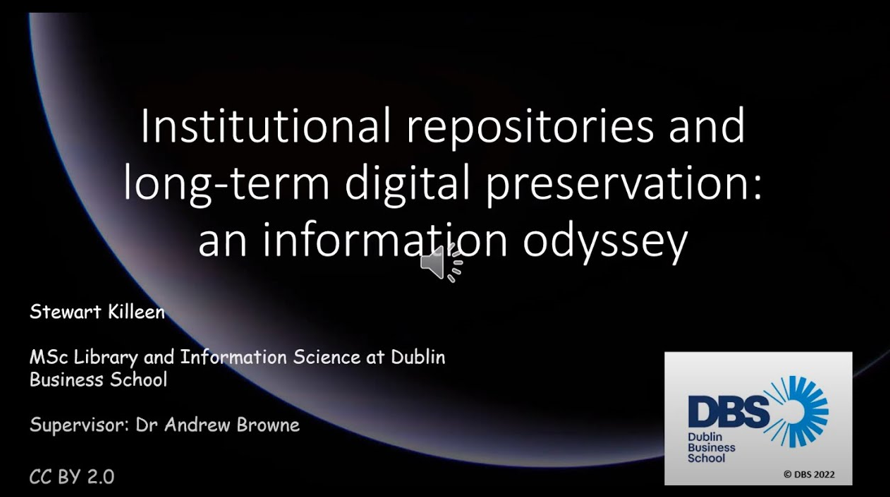
Institutional repositories and long-term digital preservationPechaKucha from Stewart Killeen

Recording the presentation was, I admit, the trickiest part of this journey. It demanded of me a little learning and sometimes a lot of frustration. However, with a little trial and error and several minutes of how-to videos on YouTube, my entry to the LIR Show and Tell competition was ready: Institutional repositories and long-term digital preservation (https://youtu.be/qt12lRFmuQ8).  

 Participating in the LIR Show and Tell Competition was both exciting and challenging, and it ignited many creative sparks. There are so many free resources available on the internet to choose from which will undoubtedly help you. Practice a few times before finally submitting your entry, but most important of all, have fun. 

 Stewart Killeen is a recent graduate of the MSc in Library and Information Management with Dublin Business School (DBS). He took up a position as a Library Assistant with Technological University (TU) Dublin during his studies and is currently the Senior Library Assistant on the Blanchardstown campus. He thoroughly enjoys working in an academic library, especially as it allows him to engage with a diversity of information needs.  

 LinkedIn:

ePortfolio


The LIR HEAnet User Group for Libraries is running its very successful Show & Tell competition once again. 

This time we have opened the competition up to all early career library staff with five years or less experience of working in library environments on the island of Ireland, as well current LIS students and/or recently qualified library professionals from LAI or CILIP accredited institutions. 

This competition provides you an opportunity to showcase your work to the wider library community. We are interested in hearing about any research or collaborative projects/ initiatives you have contributed to, or are currently engaged in. 

If you would like to improve both your presentation and communication skills this competition is an ideal platform to make an impact. 

We would like you to record a PowerPoint presentation (maximum of 5 minutes), following a template. 

Prizes will be given to the top 3 submissions (vouchers) and participants can win a LIR branded hoodie. A selection of videos will be showcased on the LIR Group website. 

For more information, visit LIR Show and Tell Competition 


29 Nov 2022

Reflections on my past year as a Digital Learning Specialist in UCC Library

https://twitter.com/iamstephanie_c/status/1572606591131684864

Guest post by Stephanie Chen. Stephanie is the Digital Learning Specialist in University College Cork Library where she explores ways to integrate new library technologies and spaces into the learning experience to support student engagement and success.


This past year (and a half), I’ve been working in a new role in University College Cork Library. When I say new role, I mean new role. Not only is this role new to me but it’s entirely new to the Library. Navigating into a newly created role can have its challenges – no handover, no previous documentation, no idea of what the role is supposed to be but within those challenges are opportunities. 

This role is also my first “professional” librarian role in a University (even though the word librarian doesn’t appear in the job title). Previously, I’ve worked as a solo Librarian in the Royal Society of Antiquaries of Ireland shortly after graduating with my Masters in Information and Library Management from Dublin Business School. After moving to Cork, I worked as a Library Assistant in Cork Institute of Technology (now MTU) Library for just under a year before moving to UCC Library as a Library Assistant. 

After about 7 months in UCC Library, the role for a Digital Learning Specialist was advertised…in March 2020. I applied for the role but, due to obvious reasons, recruitment was paused for the foreseeable future. It wasn’t until a year later in April 2021 that I was invited to interview for the role, an interview that (spoiler alert!) I was successful in and so I started my role as the Digital Learning Specialist in UCC Library on May 1st, 2021. 

The Role Itself

What exactly does the role entail? Good question!

When I started my role, as far as I could tell, there wasn’t an equivalent anywhere else in Ireland. There were some overlaps with other roles, such as Eileen Kennedy, Library Digital Experience Developer in University of Galway and Marta Bustillo, Digital Learning Librarian in University College Dublin but there was no Digital Learning Specialist in any university library. 

The job description for the role stated: 

“…the Digital Learning Specialist will lead on the design, delivery and evaluation of offerings that showcase innovative new learning spaces within the library such as the Library recording Studio, the dedicated virtual reality lounge, the evolving library makerspace, and other technology-enhanced spaces in development. The Digital Learning Specialist will lead the library’s efforts in adopting new technologies and spaces for innovative pedagogy and will partner with colleagues within the library and elsewhere to make use of new technologies to visualize, consume and experience library collections and services. The Digital Learning Specialist will develop educational resources and outreach services for digital, information and new media literacies.

The Digital Learning Specialist will also grow the library’s presence within the University’s new virtual learning environment, Instructure’s Canvas platform, to deliver high-quality, impactful and engaging digital library services. The post holder will also work collaboratively across the library to develop online supports directed at academic staff and researchers.”

New learning spaces, new technologies, new resources and outreach services, new VLE. And all of this while COVID was still happening. 

I dove headfirst into the role and took advantage of it being a new role to try new things. Some of the projects I undertook include: 

Challenges

Now that I’m a year (and a half) into the role, I’m trying to do something which I have a hard time doing and which I certainly don’t do enough of: reflecting. 

There were definitely challenges. As mentioned, this was an entirely new role and it was on me to make it my own. 

Variety is great but it can also mean having too much going on at the same time. Having to find and create your own work allows for a lot of autonomy but sometimes it’s nice to be told what to do. There were some days when I felt overwhelmed by my ever-growing to-do list and my own ambitions for what I wanted to do. 

I might have been overzealous in asking for student help – making sure they had work when I wasn’t even sure of the work I was supposed to be doing. I found a priority for me was to ensure they were okay and supported which meant there was less time for other things. 

I don’t have a technical background (my undergraduate degree is in Anthropology). All this new technology, all these new platforms and software – I had to learn about it myself. Luckily, for some things like 3D printing, I could defer to my fellow colleagues who had more experience. But this meant some days I felt like a fraud. How could I talk to someone about VR and how to use it in teaching and learning when I’m only just figuring it out myself? Getting past this idea that I must be the “expert” required a lot of unlearning my own way of thinking and my own approach to work – something I’m still working on. 

There was also a bit of self-doubt. Am I doing enough? Is what I’m doing okay? Am I on the right track? It could also be a little isolating at times – I had gone from working with a great group of colleagues on the Services Desk Team to pretty much working on my own. 

Plus, all the usuals that come with starting a new “professional” role: policies and procedures, more meetings, strategic planning, promoting yourself and your role, talking to people about what you do constantly. 

Opportunities 

But the challenges pale in comparison to all the opportunities this role has allowed for. I’ve had the opportunity to work with a variety of colleagues, both within the Library and in UCC. Elaine Harrington, Special Collections Librarian in UCC Library, and I worked closely on a number of projects with student help. Outside of the Library, I, along with the Library’s Learning and Teaching Team, was able to work with the Graduate Attributes Programme to develop content for their UCC Graduates Attributes & Values Compass. I helped develop two Pressbooks with Dr Briony Supple and Marnina Winkler. And I’ve worked with some amazing students – students who were involved in the Learning, Teaching & Assessment (LTA) Enhancement Fund 2021 summer project and my two student assistants for the 2021/2022 academic year.

https://twitter.com/UCCLibrary/status/1552575285152944128 

I’ve had the opportunity to explore new things. New technologies, new platforms, new services that I otherwise wouldn’t have been able to. We’ve 3D scanned date stamps, created a virtual 360 tour of a part of Cork city, and created interactive learning objects using H5P. 

I’ve had the opportunity to attend conferences, such as LILAC: The Information Literacy Conference, Wikimedia+Libraries International Convention 2022, IFLA World Library and Information Congress, and meet people doing loads of interesting stuff. 

I get to try new things and if it doesn’t work out, that’s okay because it’s all entirely new. Some things will work and some things won’t. 

Final Reflections

What’s next? 

As part of my interview for this role, I was asked to prepare a presentation on ‘Empowering students as co-creators of knowledge using emerging technologies in a physical and virtual UCC Library​.’ As part of the presentation, I weaved a hypothetical story of the Library helping to empower a student in UCC to have the experience and confidence in using technology. By engaging with technology available in the Library, such as the 3D printing or VR or the Library studio, this student would become digitally fluent and an independent and creative thinker. In line with UCC’s Graduate Attributes, they would be empowered to create and communicate knowledge. The Library would become an engaging, collaborative, and technology-rich physical and virtual space. This student could create a 3D model on one of the computers in the Library, experiment with it in the Library’s VR lounge and 3D printing it using the Library’s 3D printer. They could present on this process by recording a video using the Library Studio and editing it on a computer in the Library. That video could then be published online as an open educational resource for other students to learn from. 

Now that I feel I’ve found my feet a little, I’d like to start focusing on being more strategic with what I decide to do. I’d like to return to that “vision” I had of the Library supporting that hypothetical student and really focus on how I can make that happen. It won’t be an easy journey and I’m 100% sure I’ll make mistakes along the way and there’s still plenty for me to learn but if the last year (and a half) has taught me anything, it’s possible! 

Acknowledgements

All my achievements this past year (and a half) would not have been possible without the support and encouragement of my fellow UCC Library colleagues. In particular, Martin O’Connor has been a great resource in all things UCC Library and libraries in general and a fantastic sounding board. My line manager, Alan Carbery, has been nothing but supportive and encouraging every step of the way. I’m grateful to him for allowing me the autonomy to experiment and try new things.


https://twitter.com/iamstephanie_c/status/1516829232328028175


22 Nov 2022

Library Outreach via Volunteering at Irish Secondary Schools

Ray at IFLA #WLIC2022

Guest post by Ray Gainford. Ray is a Library Assistant with Louth Library Service.

Earlier this year I had the pleasure of working with Junior Achievement Ireland and volunteering with a Transition Year class at a secondary school in County Louth. 

Junior Achievement Ireland (JAI) is a member of one of the world’s largest educational non-profit organisations, helping prepare young people for their futures by delivering hands-on, experiential learning in entrepreneurship, employability, financial literacy and the value of STEM. JAI was established in Ireland in 1996 and since then has built up a strong demand from schools throughout the country and created successful partnerships with 180 leading organisations.

An email was circulated to staff in Louth County Council asking if anyone would be interested in volunteering with JAI. Some colleagues of mine in Louth Library Service had previously volunteered with them and greatly enjoyed the experience, so I was very happy to put my name forward. 

I will admit that I was a bit nervous at the thought of teaching a class, but the training from JAI put me at ease. I first had a video call with a liaison officer at JAI named Elaine, which enabled me to get a clearer vision of what volunteering would entail. Elaine explained to me that JAI can find it more difficult to find volunteers willing to teach secondary school students, as people may feel nervous about teaching teenagers rather than younger children. There was an opening in their programme for a volunteer to teach the Career Success module to a Transition Year class at Coláiste Rís in Dundalk. Thinking of how helpful a module like this could have been to me when I was a Transition Year student many moons ago, I agreed to volunteer with this class. It was a full circle moment getting to teach a TY class myself!

Training was arranged for me soon after. It took place virtually with two facilitators from JAI, and a number of participants from various career paths. I was impressed with the variety of careers among the participants, as it showed the wide reach that JAI has. The training was excellent and boosted my confidence. We were given a chance to practice delivering some course content to the rest of the group, and received helpful feedback. Following the training, I received the content for the entire module, so I had plenty of time to familiarise myself with the various lesson plans and exercises. I also had to complete Garda Vetting in advance of the course. 

My classes with the Transition Year group went very well. Though I still had some nerves, the students were welcoming and well-behaved, and the teacher also stayed in the class at all times for support.  The module itself consisted of six weekly lessons, covering topics such as teamwork, communication, personal branding and interview skills. At the end of the module, I also held mock interviews with the students. I was really thrilled to see the students put all their learning from the past six weeks into action – it was such a fulfilling experience! 

We were encouraged to enhance the lessons with information from our own personal career paths, so I was able to show the students how realistic the course content was by relating it to real-life examples from my experience in librarianship. I was delighted to see that so many of the students were interested in what working in a public library is like. Some students told me afterwards that they enjoyed discovering more about careers in public service, as it wasn’t a career option that was immediately obvious to them. 

Volunteering with JAI benefitted both the students and Louth Library Service. The students received valuable knowledge about the world of work, and the library gained a class visit and new memberships from the students. This age group can be a difficult demographic to bring into the library, so it was fantastic to see this class so enthusiastic about their visit. It also helped the library service further identify the needs of young adults in libraries. 

Based on my work, Louth Library Service plans to build on the knowledge gained from this experience and provide further services to young adults and students. These include small steps, like increasing the amount of exam revision materials we have available in our library collection, to bigger projects such as furthering our outreach in DEIS schools in the locality and organising career guidance and CV clinics for students. 

I had such a great experience teaching this class, and was I eager to share what I had learned with other library staff. I submitted a poster proposal to present on this topic at the IFLA World Library and Information Congress in Dublin this summer. I was delighted to be selected as a presenter as part of the event’s poster sessions, with my poster titled “Library Outreach in Irish Secondary Schools via Junior Achievement Ireland”. This granted me the opportunity to tell librarians from a wide range of countries about the experience, and gain inspiration from other libraries who may have conducted similar programmes in their own countries. 

Junior Achievement Ireland always welcomes new volunteers, and I highly recommend giving it a go! It’s a fantastic learning experience for both the students and volunteer. Further information can be found at www.jai.ie.


Photo courtesy of author