14 Apr 2023

Digitising projects in Maynooth University Library using a digital camera and scanner

Guest post by Bridie O’Neill, Edel King & Laura Gallagher, DPDS, MULibrary

The Digital Publishing and Data Services (DPDS) department in Maynooth University (MU) Library purchased a new state-of-the-art Zeutschel scanner last year. We received training on  the scanner and its accompanying software, Omniscan. We spoke to people digitising in other institutions and paid a visit to the National Library of Ireland to view their scanning suite. Since then, we have received some reprographic requests from around the world. 

In this blog post, we will detail how we fulfilled these requests using our DSLR digital camera and the scanner.

Digitising using the DSLR camera. 

We were requested to digitise the Bloomfield maps of the Loughton & Redwood Estate by MU's Arts and Humanities Institute. The maps consisted of 34 maps and ledgers dating 1836-1840. The maps were oversized, measuring 80 cm by 1 metre. We chose the digital camera (DSLR) as the best medium to digitise the maps.  

Image from the Bloomfield collection

We ran several tests using different exposure settings to gain the depth of field required for the maps. As the maps were oversized we placed them on the floor supported by backboards and the copy stand was adjusted to allow the maps to be photographed in that position.

We also experimented with lighting and discovered that the best exposure could be gained from turning off the overhead fluorescent lights and engaging the flash function on the camera with even tungsten lighting. We documented all our findings in a ‘How to’.  

The photographs were captured and saved using TIFF format which renders the best quality for reproduction purposes. The files were then converted into JPEG format to assist data transferring and ease of editing. The MU Arts and Humanities department are utilising the maps in an interactive project with pop up fields for further in-depth information.   

Using the camera and copy stand

Digitising using the scanner 

We received a reprographic request from an academic in Durham University for the digitisation of a 1595 book called Essais de Michel de Montaigne. This was the first request we received where we could properly use the new scanner.  

Image from Essais de Michel de Montaigne

The scanner comes with some excellent features. One of these is Interleaving. Interleaving allows you to scan one half of the book entirely, for example solely the right-hand pages. After that, with Interleaving mode on, you can scan the left-hand pages. Interleaving puts each scan in its correct place automatically so that page 3 is followed by page 4 etc. 

We found this feature extremely useful when scanning the Montaigne book.  It allowed us to set up the book on the scanner with the relevant supports, scan one half of it and then set up the other half. This meant that there was much less handling of the item.

Interleaving equipment

The requestor wanted a full view of the book including the spine and leaves. These areas were not possible to capture using the scanner, so we supported the book and took the images using our DSLR camera and then worked on them using Photoshop. 

Spine of Montaigne

Initially, we thought it best when scanning the right-hand pages to just scan the images and then use filters after to crop, straighten or brighten the image. However, this book generated nearly 800 scans and so cropping and straightening after scanning proved time consuming. When scanning the left-hand pages, we made sure the book was positioned exactly how we wanted before scanning so that little work had to be done on the images after.

A proper file structure had to be established. The images are scanned as TIFFs, (as per best practice). Then, as part of finalising, a feature called ‘Copy’ can copy them all into another chosen format. For testing purposes, we used one folder for all formats. But as we would only be sending one version to the requestor, we needed to separate formats for actual projects so that everything was more easily accessible. 

Using the scanning software

Teams has proven to be a very useful tool. Creating a channel or folder and either uploading or copying the files to that location means that the files are available for the team to work on or look at no matter where they are. It also provided us with a useful location to store backups.

We purchased some book supports for digitising as well and they have been very useful to us with regard to handling of the sometimes fragile material being digitised.

Book supports that we purchased

Wardell

We are currently working on a curatorial request to digitise the Wardell Archive, housed in our Special Collections and Archives (SC&A) department. This collection comprises the personal papers of the Wardell family. This project has over 600 items, organised across 147 items. They are mainly letters and are handwritten front and back. 

Image from the Wardell collection

As the collection is so vast, a good naming convention is vitally important so that once all the letters are digitised and converted from TIFFs to JPEG, they are easily identifiable and therefore easy to ingest into our Digital Library. For example, Item 1 in Wardell, a handwritten letter with writing front and back was named PP2-1-001 (front) and PP2-1-002 (back) to clearly identity that the item generated 2 scans. We used a renaming feature set up with the OmniScan software which allowed the user to name each scan they digitise on a project.

We use colour cards beside each item and a grey back board underneath. This allows for the requestor to see the full depth of the paper and the ink used in writing.

Conclusion

 The feedback we received on the digitisation of our projects to date has been extremely positive. Digitising allows academics and researchers to see items that could have been. They can enlarge and use them without damaging the original item.  We are looking forward to working with both the camera and the scanner in the future on further reprographic or curatorial projects and exploring all the features that the scanner has to offer.

If you have any questions about our digitisation projects or wish to put in a request, you can contact the team at, digital.library@mu.ie

The MU Library Digital Library will launch in the coming months.


3 Apr 2023

Libfocus Link-out for April, 2023


Welcome to this month’s edition of the Libfocus link-out, an assemblage of library-related things we have found informative, educational, thought-provoking and insightful on the Web over the past while.

US Library Survey 2022 Navigating the New Normal.
Since 2010, Ithaka S+R has conducted the Library Survey on a triennial basis with the overarching goal of tracking the perspectives, priorities, and leadership strategies of library deans and directors at four-year academic institutions. The results of their latest survey are now out.

How to get people to come to your library events.
We've all been there. We've spent a lot of time and energy organising our event, our workshop, our training session. And nobody or virtually nobody turns up. This great short video from Angela Hursh offers some simple advice to make sure this doesn't happen to you again.

In the latest episode of the podcast, Noelle Knows Nothing, titled 'Yes, please touch the 500-year-old book, Noelle speaks to John Overholt, Curator of the Donald and Mary Hyde Collection of Dr. Samuel Johnson and Early Books and Manuscripts about life as a rare books librarian at Harvard Library.

In The Librarians are Not Okay, Xochitl Gonzalez speaks to librarians in the United States about new laws that challenge what books librarians can buy and put on shelves, for fear of facing personal litigation.

AI in Higher Education: The Librarians’ Perspectives.
An interesting survey of 125 academic librarians exploring attitudes to the growing development of Artificial Intelligence Technologies; whether to embrace or ban them and the effect they may have on students' ability to think critically. Using ChatGPT to help write a paper and reference software to automate citations, is this the new norm?

ChatGPT: Implications for academic libraries.
A brief study of the implications of AI tools for academic libraries. We learn the rise of AI tools might lead us to an arms race as Google and Microsoft add ChatGPT into their tools. Will academic discovery tools do the same? An interesting thought is introduced – perhaps ChatGPT could help speed up the development of OER textbooks and reduce the cost of education for students?

 A bibliophile’s paradise: the National Library of France in a classic documentary from 1956.
The 21-minute documentary Toute la mémoire du monde (All the Memory in the World), made by French filmmaker Alain Resnais in 1956, is an astounding tour of the la Bibliothèque nationale de France (the National Library of France) before digitisation, when the world’s largest well of information wasn’t at our fingertips, but fastidiously collected and sorted behind library walls.

 Libraries Need More Freedom to Distribute Digital Books. But publishers are working hard to prevent that, wherein Dan Cohen writes about how a district court judge in New York recently ruled on Hachette Book Group, Inc. v. Internet Archive, a case that is likely to shape how we read books on smartphones, tablets, and computers in the future.

 Europeana re-use - be inspired.
This article highlights the creative ways artists, poets, educators and researchers reuse Europeana’s digital cultural heritage. The material on Europeana's site has inspired everything from educational videos, problem-solving challenges created through the gamification of digital material, robotic sea monster designs, poetic responses to artwork to collages for greeting cards.

 Building the future intelligent campus.
This guide from JISC looks at how many universities are developing intelligent campuses in an effort to use data collection to improve the student experience, business efficiencies and environmental performance. It explores the benefits of this development, looking at how it is helping the third-level education sector make better use of resources and facilities, deliver more personalised services to students and improve their campus experience. The guide also looks at the ethical concerns around data collection and the questions that have and should be asked about how the data might be used.

23 Feb 2023

UCC Library Annual Seminar 2023


Guest post by Blazej Kaucz (on behalf of UCC Library CPPD Committee) 


On Monday, the 6th of March 2023, UCC Library is going to host the UCC Library Annual Seminar 2023.  

The event will explore the role libraries play in promoting and supporting equality, diversity, and inclusion (EDI). There will be a range of speakers on the day, who will offer perspectives from a Library viewpoint, and also from the perspective of the communities that libraries serve. 

The speakers will be discussing, inter alia, the role of the libraries in decolonisation initiatives; how EDI is transforming the strategic landscape; how the libraries can develop as a place of welcome as part of the Library of Sanctuary; and how in doing so the libraries can encourage diversity and not division. 


Programme 

10:00 

Registration and morning refreshments 

10:45 

Welcome and Introduction 

11:00 

Keynote speaker - Marilyn Clarke (Institute of Advanced Legal Studies) 

12:00 

Leona Burgess (Louth County Libraries) 

12:45 

Lunch 

13:30 

Katy Lumsden (National Library of Ireland) 

14:30 

Elaine Chapman (Technological University Dublin) 

15:15 

Closing remarks 


The keynote speaker is Marilyn Clarke (Institute of Advanced Legal Studies Librarian).  

The seminar is free and in-person, but registration is required. To register please visit https://libcal.ucc.ie/calendar/librarytraining/seminar2023 


Posted on Thursday, February 23, 2023 | Categories:

13 Feb 2023

Open to All? LAI Open Scholarship Group Webinar


Image from event listing on LAI website 

This is a guest post by Jane Burns, Director of Education and Public Engagement, Faculty of Engineering and Informatics at the Technological University of the Shannon. Jane holds Fellowship Membership with the Library Association of Ireland where she is a Member of the Executive Council. Jane is also a Steering Group Member of the National Open Research Steering Group. She is involved in Equality and Diversity at TUS and nationally as an Aurora Champion and was appointed to the National Aurora Advisory Group. Jane is currently a PhD candidate at Dublin City University where she is exploring the areas of Education, Graphicacy and Graphic Medicine. Find her on Twitter @JMBurns99 or on LinkedIn. 

As a librarian, educator and a researcher I am eternally curious about new ideas, and new approaches to connect with others inside and outside of areas that I know about. Over the course of the webinar there were three fantastic presentations, by Dr. Lisa Padden (UCD), Dr. Chrissi Nerantzi (University of Leeds) and Oisin Duffy (National Biodiversity Data Centre). While each of the presenters were engaging and informative I found that the presentation by Lisa Padden was the one that connected to me most, for my personal and professional role. I was recently appointed the Director of Education and Public Engagement at the Technological University of the Shannon.

I found the idea that ‘Open’ is more than just ‘Open Access’ - so open and beyond publications but inclusive of things like information, teaching, learning and research. Access needs to be more than just ‘accessible by’ to be inclusive.

Dr. Padden offered an example of an ordinary daily experience of automatic opening doors. This was something that never occurred to me as an ‘example of Open’ (no pun intended) but using that as a model for all other areas and applications of openness really was insightful. It is something that is so much a part of every day that allows openness for all - and we don’t even have to think about it - it just is. This is perhaps a way we need to think about openness - not as something special, or extra, but integral so we don’t think about it all - it is so engrained.

A demo of the Microsoft Accessibility Checker was engaging. I had never heard of it before and often struggle with the question of whether or not my communications are accessible enough – if am I being inclusive.

I found Dr. Padden’s approach to be engaging and understandable, sometimes I get so worried about making a mistake with accessibility that I choose not to publish, present or engage. After today I know that is not the best way to proceed, that there are tools, resources and colleagues to reach out to for help in developing this area of knowledge.

Thank so much to my Library colleagues, who continue to develop ideas and expertise and who bring us along with them to learn together. 


Posted on Monday, February 13, 2023 | Categories:

15 Dec 2022

Reflecting on IFLA WLIC 2022.

Image courtesy of Author
Guest post by Kathryn Briggs, Systems Librarian at ATU Galway-Mayo with a strong interest in emerging technologies, library instruction, Open (OA, OER), TEL & UDL.

It is with thanks to a bursary from the Acquisitions Group of Ireland (AGI) that I was afforded the opportunity to attend the IFLA World Library and Information Congress, the most global professional and trade event for the library and information sector.  This was the 87th Congress but only the first time it was held in Ireland. With over 2,000 delegates the event had high-level speakers, experts in the profession, and library and information people from around the world exploring issues and developments of interest to the global library field. The event was a time to celebrate library advocacy successes, learn lessons from each other, and strengthen the voice of the library profession. I heard from lots of people I would not have had the chance to hear or learn from before, met up with many familiar faces not seen since before COVID, and got many ideas to follow up on. It was a great day out!

The event took place over several full days in July 2022. There were so many sessions scheduled (over 50) that an iPlanner app was available to help delegates plan and coordinate their personal timetable. Although I only attended for one day, having the planner let me see which sessions were scheduled and when so I could choose the sessions that were of most interest to me before the event as it’s impossible to attend all the programmed sessions! The bursary covered one day’s registration fee for the event, one of the downfalls of the event is the cost. However, to enable as much participation as possible, eight key sessions were made available online for free. This meant that I (and anyone) could look over the wonderful opening and closing ceremonies even though I was not in attendance on the days they took place, as well as watching other key sessions on demand. 

Image courtesy of Author

As well as the huge number of programmed sessions there were over 170 poster presentations. The cat poster asking, “Are librarians cat people?” was the most talked about poster of the event. The winning poster was the Gazi Husrev-beg Library Book Museum which showcased their Library and its nearly half-millennium-long journey. 

The Library Boulevard was an opportunity to discover Irish libraries. Featuring a variety of promotional pop-ups on a range of different topics, such as new projects in libraries on digital innovation, distinctive architecture, and new library services. It was fantastic to see the array of work being done in libraries across Ireland. The boulevard was great to wander around when moving between sessions or grabbing a quick cup of coffee. 

Image courtesy of Author

Here I will discuss some of the sessions I attended and enjoyed. 

The State of Outcome/Impact Measurement in Metropolitan, National, and Academic Libraries (Session 097).

The IFLA Metropolitan Libraries Section and Statistics and Evaluation Section presented information on diverse approaches to outcomes and impact measurement at their libraries. Focusing on how libraries move from outcome measurement to the assessment of the impact or value of library programs and services.

Telling the Next Chapter: Marketing Libraries of the Future (Session 109).

This session presented a keynote by Waterford City & County Libraries Executive Librarian Tracy McEneaney on marketing of Irish libraries. Tracy spoke about the ‘Squeeze in a Read’ campaign by encouraging everyone to read. She believes that we need to put more money into marketing our libraries and thinks library staff are our best assets, and I would have to agree!

The keynote was followed by the top 3 winners of the 2022 IFLA PressReader International Marketing Award. First place and worthy winners were Yarra Libraries in Australia with We’re ready for the next chapter. Help us write it, this marketing campaign was a mix of digital and print, non-traditional outreach as well as effective user participation. The screenshot shows some of their catchy marketing material. 

The Use of Transformative Agreements: Do They Increase Access to Research? (Session 121).

This session started with the statement that the only constant is change and asked what can we do to manage change. Libraries have always evolved with time, as the image below shows. 

Image courtesy of Author

With the growing appreciation and support for Open Access there has been a growth in the use and development of transformative agreements. These transformative agreements allow for libraries and other such institutions and organizations to shift subscription costs to open access publishing. Due to efforts by funders, governments and libraries, these types of agreements and this reallocation of funding has grown notably in recent years. The panelists concluded that transformative agreements are not a perfect solution, but by developing existing models, sharing risk, and establishing clear communication, libraries can move open access forward.

I attended other sessions, but the sessions highlighted here gave me the most inspiration and ideas to follow up on. 

Now it wasn’t all about attending sessions by experts, there were also wellbeing activities, including guided walks and library visits, but as I was only there for the day these were unworkable for me. What I did enjoy though was meeting two lovely Irish guide dogs who were there as part of the conference wellbeing activities. 

The most valuable gain from attending this event was the personal connections with other delegates. I enjoyed my conference experience; even though, the venue and crowds were a bit overwhelming! I did not realize how big the Convention Centre is and how packed the venue, particularly the poster area would be. Nevertheless, it made for a great opportunity to bump into delegates, sometimes literally, making new connections and re-establishing ties with familiar faces. I was sorry to have missed out on the cultural evening at the Lexicon in Dún Laoghaire which was held on the evening I attended the conference as it would have been a good chance to meet people from around the world in a more relaxed environment, but I had to get the bus back to Galway!

The day was packed full of lively discussion from both experts in the field that were presenting and the delegates I met in the venue areas. The diversity of our profession was truly reflected in the conference, I heard stories of libraries and librarians from all over the world and found the conference experience extremely engaging and inspiring. My tip for anyone who wishes to attend the event is to try not to get overwhelmed by the massive size of the conference, plan ahead and embrace it! Try and attend for the duration of the conference so you can fully immerse yourself in the conference experience, attend more sessions to learn and get more of a chance to engage and connect to widen your profession network. 

To conclude, register to become a volunteer, this means that if accepted you will get to attend the event for free. The application for volunteers has just opened for the 88th World Library and Information Conference in the Netherlands in August 2023, if anyone is tempted apply now! Thanks again to the AGI for the opportunity to attend this huge event. 


References.

Conference website: https://2022.ifla.org/  

WLIC 2022 online sessions and recordings: https://www.youtube.com/playlist?list=PLV81siTMahbuJpAjacTKcbgrq0KClBswM 

Winning poster: Ejla and Adnan Ćurovac, Bosnia and Herzegovina: Gazi Husrev-beg Library Book Museum

The International Federation of Library Associations and Institutions (IFLA)’s albums – Flickr

2023 Conference website: https://2023.ifla.org/ 


Posted on Thursday, December 15, 2022 | Categories:

9 Dec 2022

Ligatus Summer School 2022: Histories of Bookbinding

Guest post by Yvette Campbell, Collections and Content Librarian at Maynooth University Library. Yvette’s professional interests include the history of the book, codicology, descriptive bibliography, and digital preservation.
 
(Fig 1) - Week 1 Ligatus School 2022 participants at the Edward Worth Library. Photo courtesy of Elizabethann Boran

I was very fortunate to undertake a terrific professional development opportunity this year to attend the 2022 Ligatus Summer School for two consecutive weeks in September. The Summer School took place in Dublin and was hosted by the Edward Worth Library and included scheduled visits to both Marsh’s Library and the Chester Beatty.
 
The Ligatus Summer School is world-renowned amongst librarians, cataloguers, conservators, historians, and scholars who work with early books. It offers courses on bookbinding history and Linked Data - in particular, the development of historic bindings with a particular emphasis on description and recording of their various structures and materials.
 
Ligatus is organised in collaboration with many institutions including the University of the Arts, London and the Saint Catherine Foundation which supports conservation work at Saint Catherine’s Monastery in Sinai, Egypt. The Summer School takes place in a different city each year worldwide and 2022 was the first year it has been held in Ireland.
 
Call for applications
 
I noticed the call for applications to attend the school on social media and didn’t hesitate twice about applying. Anyone who works with unique and distinctive collections in Ireland will know what little opportunities are afforded to us in recent years to upskill in the areas of special collections curatorship. I also felt it was a great opportunity to visit some of the most important historical collections in other local institutions and to re-connect with colleagues in this area. I previously had knowledge of European bookbinding which for several years has been beneficial in my role as a rare materials cataloguer. In recent times, I have been drawn to the traditions of bookbinding that developed in the East (in particular, the Islamic manuscript tradition) and was very keen to expand my knowledge in this area. For me it was important to understand that bindings can be read as a text with a language of their own, and to describe them accurately is to learn their language.
 
The Application Process
 
The course fee (as of 2022) was €400 per week and candidates could choose to attend one or both weeks. Maynooth University Library kindly supported my application to attend both weeks. The application process was much the same as applying for a regular job. The school required an up-to-date CV and a supporting cover letter outlining who we are, our occupation and why we were interested in applying.

Successful candidates would be contacted in August, and I was delighted when I received the acceptance email. Shortly afterwards, I received the summer programme including a reading list for week 1 which focused on European Bookbinding 1450-1830. I was also provided with a list of software to download in advance of week 2 which was concerned with Identifying and Recording Bookbinding Structures of the Eastern Mediterranean.

Week 1 - European Bookbinding 1450 - 1830
 
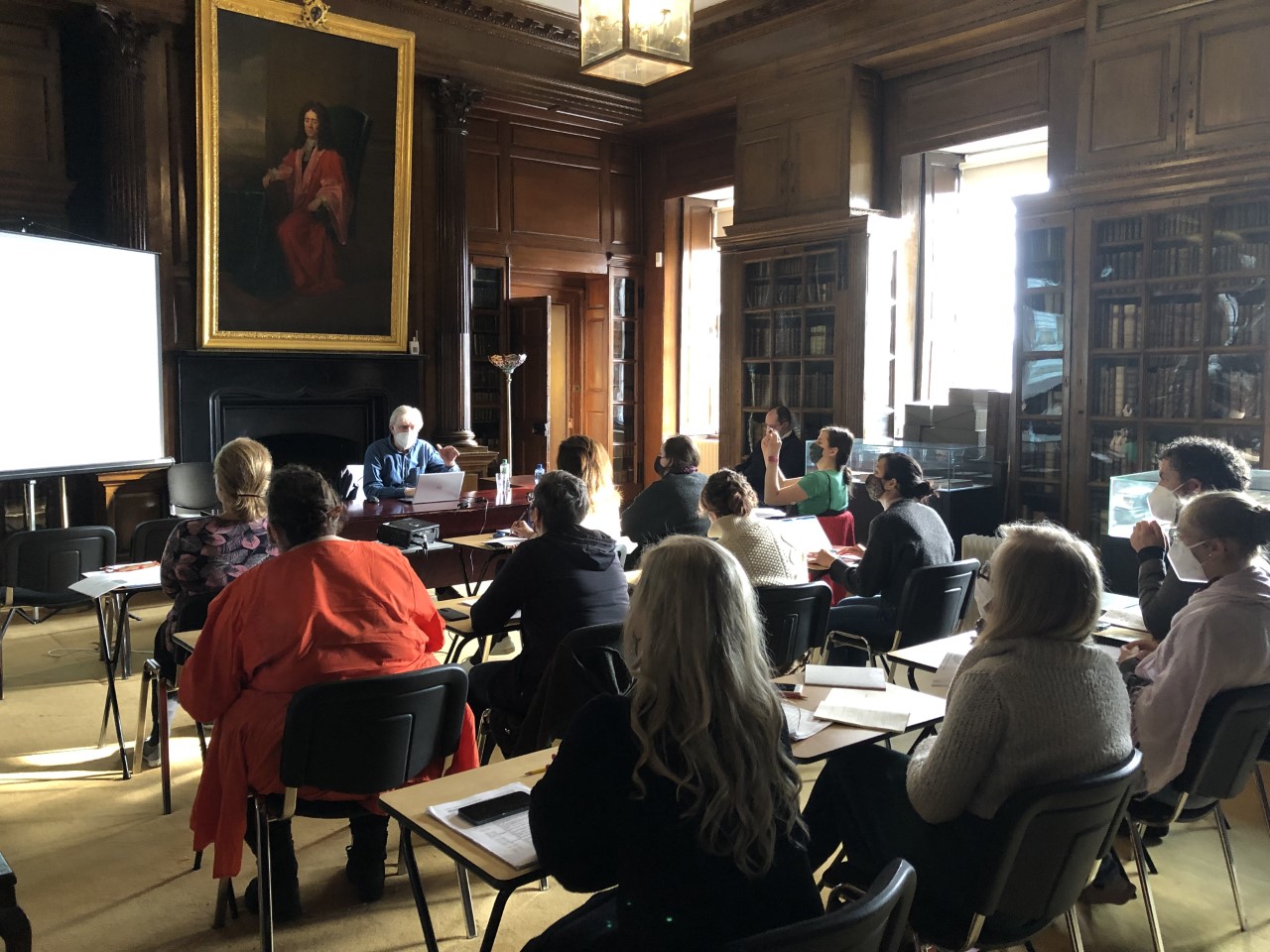
(Fig 2) - Prof. Nicholas Pickwoad teaching European Bookbinding at the Edward Worth Library. Photo courtesy of Elizabethann Boran

Professor Nicholas Pickwoad‘s course on European Bookbinding, 1450-1830 was every bit as meticulous but rewarding as I had hoped it would be. It consisted of rich lectures every morning and hands-on sessions in the afternoons looking at specimens from the Edward Worth Library. Two afternoons included excursions to Marsh’s Library and the Chester Beatty for classes examining their collections in greater detail.

Participants came from a variety of diverse backgrounds, traveling from Estonia, France, England, Germany and Sweden. Eight students were book and paper conservators, while three were Irish librarians (including a digital librarian and two special collections librarians). It was fascinating to see the mix of backgrounds and I was heartened that there was representation within my own profession. Without the know-how to catalogue and describe binding structures as accurately as possible, we are losing great opportunities to provide researchers and scholars with enough material evidence to support important historical research including questions of who bound a book, where and for what purpose?

As a rare materials cataloguer, I have always tried to include at least a brief description of each book’s decorative binding. This course has now given me the knowledge and vocabulary to describe other important elements and how they were made. For example, recording the presence of uncut edges is vital for understanding the status of the book and to be cautious when recording the prices on title-pages to understand exactly what they mean - as without other supporting historical annotation, it can be meaningless - is it the price of the textblock, the print, or the binding?

(Fig 3) - Selection of bindings to examine from the Edward Worth Library 


(Fig 4) -Selection of European bindings from the Chester Beatty


We concentrated on the structural analysis of bindings particularly regional techniques and materials present rather than decorative finishing. We also examined how to date bindings in the medieval period, how to identify the raw materials used (with caution), how to check leather that has been tooled by hand through symmetry, sewing and stitching techniques, recessed supports, spine linings, edge treatments, board types and endleaves – all of which can tell us the where, why and hows of the history of the book as an object.

As books regularly travelled from the bindery to private collections across Europe during this time-period, they were often rebound to suit the taste of their wealthy owners. Patrons could choose their books to be bound in various uniform colours or stripped back to the plain old basics. Thus, Professor Pickwoad emphasised the importance of intact historic collections as one of the most important for studying original bindings - since they were often commissioned for one or perhaps two collectors and unlikely to have moved around. Some Irish examples in this context include the St. Canice’s Cathedral Library Collection on long term loan from the Church of Ireland held at Maynooth University, the Bolton Library at University Limerick and indeed the Edward Worth Library itself.

(Fig 5) - Example of customised fore-edge painting by Cesare Vocellio from the Pillone Library


Week 2 - Identifying and Recording Bookbinding Structures of the East Mediterranean
 
For week 2, the course was divided into two inter-related sessions delivered by Dr Georgios Boudalis and Dr Athanasios Velios, both conservators respectively working on the St. Catherine’s Monastery Project in Egypt. In the first session, Dr Boudalis focused on the major structural and decorative features of different bookbinding traditions that developed in the Eastern Mediterranean, including Coptic bindings, Arabic, Armenian, Georgian, Syriac and Ethiopic books– with a special focus on Byzantine and post-Byzantine bookbindings. We examined various precursors to the multi-gathering codices such as wooden, legal and wax tablets and papyrus rolls.

(Fig 6) - Week 2 Ligatus School 2022 participants at the Chester Beatty. Photo courtesy of Kristine-Rose Beers


While showcasing bookbindings from various museums and libraries (including St. Catherine’s Monastery), we were guided through the development of these closely related binding structures and their influences from the West. Dr. Boudalis emphasised that by examining representations of the codex in iconography, we can ascertain evidence of decorative and functional characteristics that may no longer survive and how they may have been utilised once upon a time. We concluded this session by visiting the Chester Beatty again to view and study examples of these various traditions with an impromptu visit to the Conservation lab hosted by Kristine Rose-Beers, Julia Poirier and Hoa Perriguey.
 
(Fig 7) – Coptic binding fragments from the CBL dating to 600 AD 


(Fig 8)  - Bone ties decorated with characteristic concentric circles used to keep leather ties in place

In the second session, Dr Athanasios Velios introduced participants to the semantic web, Linked Data and the CIDOC Conceptual Reference Model (CRM) for cultural heritage objects. We were also introduced to the consolidation potential currently being explored in a Linked Conservation Data Pilot.

The session consisted of a combination of presentations and hands-on group-oriented workshops. We explored the importance of standardised vocabularies for book descriptions and the significance of using Uniform Resource Identifier’s (URI) to assist systems in linking to a global thesaurus for maximum discovery impact. The afternoons were spent writing xml schema for various book components and mapping these to CIDOC-CRM using 3MEditor, a web application to view xml mapping files and publishing the Linked Data in ResearchSpace, an open-source platform that supports knowledge preservation.

At the end of the course, I received a certificate of completion for my continuing professional development (CPD) records.
 
Reflections on the course
 
I am looking forward to applying new knowledge of concise binding descriptions to my role in Maynooth University Library and perusing our holdings again as we enter an exciting and challenging new phase of the Russell Library Cataloguing Project to enrich records from the collections of St. Patrick’s College Maynooth with copy-specific features related to bindings. If contemplating how to describe bindings, I would highly recommend consulting the Language of Bindings thesaurus as a reference. The course has given me a deeper appreciation for the study of bindings as artefacts and how materiality impacts history. As Prof. Pickwoad declared during one tea break when I revealed that I need to go back and amend a few entries in our catalogue - “I want you to go away from this course feeling worried”… And I do, but in an optimistic way!