20 Apr 2022

My Top Tips for CVs, Cover Letters and Interviews


Guest post by Marie O’ Neill, Head of Enhancement, CCT College Dublin

I was delighted to be invited by the Career Development Group (CDG) of the Library Association of Ireland recently to speak on all things pertaining to job seeking, CV preparation and interviews. It was an honour to speak alongside peers that I admire greatly such as Emma Doran of Kildare County Council Library, Martin O’ Connor of UCC Library, Johanna Duffy of AIT Library and Linda Fennessy of the National Library of Ireland. The work of the Career Development Group of Ireland is a vital support to those wishing to develop their careers further. Membership of the Library Association of Ireland connects library students, graduates and staff to a vibrant, dynamic and supportive national community of practice. Students of a recognized LIS course can join the Library Association of Ireland for free (course details and year must be provided). Further information about joining the Library Association of Ireland is available at: https://www.libraryassociation.ie/membership/

A little bit about me. I am a graduate of the library schools of University College Dublin and the University of Northumbria. I have been a librarian for 30 years, working in libraries such as King’s Inns, Technological University Dublin, University College Dublin, the HSE, the Welsh Office, the Oireachtas and Dublin Business School where I was Head Librarian for 12 years. I was the originator and co-founder of the MSc in Information and Library Management at Dublin Business School. More recently I have migrated into an academic enhancement role at CCT College Dublin. I remain as active as ever in the library sector. I am a Council member of the Library Association of Ireland and a Committee member of the Library Association of Ireland’s Library Publishing Group. I am a judge for the third year in a row on the Library Association of Ireland’s National Library Champion Awards and a mentor in the Library Association of Ireland and CILIP Ireland’s Virtual Mentoring Scheme. 

My talk for the CDG event focused on my top tips in relation to job seeking, CVs and interviews. I was allocated 15 minutes. Below is a brief summary of my main points which includes my top tip in relation to adapting the STAR approach to answering competency-based questions for additional success in interviews.

Avoid tunnel vision. Don’t forget the information management component of your qualification. If you can’t get a library job immediately after graduation, apply for roles in data protection, GDPR or freedom of information. An increasing number of library graduates are also working as taxonomists for companies such as Amazon. Reach out to professionals working in these roles for advice. These roles can help you to transition into a library role. Alternatively, many graduates pursue successful roles in the broader information management area in the long term. See this job vacancy for a taxonomist role at Amazon as an example at: https://www.ucd.ie/t4cms/Amazon Description.pdf

Find a Mentor: Ask a librarian working in a role that you would like to work in, to be a mentor. Seek advice from this mentor virtually or in person in relation to your career development. Ask your mentor to peer review your CV or to conduct a mock interview. The library community is a generous profession. Consider joining a formal mentoring programme such as that offered by the Library Association of Ireland and CILIP Ireland. Conducted on a virtual basis, the LAI/CILIP programme is extremely beneficial for mentors and mentees alike. 

For further information, see: https://www.cilip.org.uk/members/group_content_view.asp?group=201287&id=970445

Some extra considerations in relation to CVs. If you are interested in becoming an information literacy librarian or a systems librarian as examples, ask an experienced librarian in this area or a mentor to peer review your CV.  Include a Technical Proficiencies Section in your CV in which you list as many technical proficiencies as you can, as all areas of modern librarianship have a strong technicality. Proficiencies could be platforms and standards such as an LMS, MARC, Dublin Core etc.

What’s missing from cover letters! Cover letters shouldn’t exceed one page. Additionally, they shouldn’t be just about you. Close your letter with reasons as to why you want to work in the recruiting library with specifics. Perhaps the library is a centre of excellence in health librarianship. Perhaps you admire a specific objective in the recruiting library’s strategic plan. Always mention in your cover letter that you are a member of the Library Association of Ireland. This indicates to recruiters from the outset, a commitment to your profession.

Go the extra mile in relation to job preparation. Read the strategic plan of the recruiting library and of the organization in which it operates. Do a PDF search of the library on Google. Reports can appear that have not yet been published on the library website. Check out the library website and the website of the recruiting organization. Look at the library’s social media platforms to get a sense of the institutional culture on the ground. Repeat this search for the organization in which the recruiting library is located. Check out the recruiting library’s institutional repository to see what library staff are publishing. Do a Google news search on the Library. Libraries regularly feature in the news media in relation to events, new developments etc. Talk to a former employee of the library. Reach out to librarians working in the role in the wider sector (not in the recruiting library) to get additional information. Knowledge is power!

STAR is not Enough!  The STAR approach to answering competency-based questions in interviews requires that you evidence competencies by discussing the Situation, Task, Actions and Results. I encourage people that I mentor to add an additional two S’ to the process; one S representing the strategic plan of the library and the other, the strategic plan of the institution in which the library is located. For example, if you are applying for a job at Maynooth University Library as an example, talk through your competency using the STAR approach and close out by adding how this competency aligns to both the strategic plan of Maynooth University Library and the overall strategic plan for Maynooth University. This process indicates how your competencies align to the strategic priorities of the library and institution and presents you as someone who can contribute to the goals of both the library and the institution. 

More on the STAR technique at: https://www.careerhigher.co/career-advice/answering-competency-based-interview-questions-124224/


Image: Slide from Marie O’ Neill’s presentation for CDG event

Do a mock interview. Get a colleague, family member or better still a mentor to ask you questions. Make sure that you do this several times. You can also ask a librarian in an equivalent role who is not working in the recruiting library. Muse.com has information on 53 questions typically asked at interviews with answers. Whilst not library specific, they are helpful in providing some ideas in relation to how you might answer questions. See: https://www.themuse.com/advice/interview-questions-and-answers

Stand out with value added professional development: Ireland is a small island. Applicants can be similar. Stand out by engaging in additional value-added professional development. It doesn’t have to be library related, for example a certificate in digital marketing. Consider undertaking a National Forum for the Enhancement of Teaching and Learning open course/digital badge. The National Forum offers badges in academic writing, research and universal design as examples, topics that are highly relevant to the library profession. Consider taking a free MOOC in a library related topic or general topic such as leadership.

The benefits of professional development frameworks. Familiarize yourself with a professional development framework. The Library Association of Ireland offers a digital badge in partnership with the National Forum for the Enhancement of Teaching called the L2L Joint Digital badge which promotes engagement with the National Forum’s Professional Development Framework for all Those Who Teach in Higher Education. Librarians have a strong teaching component to their work informally and formally whether they are working on the readers services desk, are a systems librarian or work in an information literacy role.

Add competitive edge by including a link to an e-portfolio in your CV: Create and maintain an e-portfolio that showcases your professional development. An e-portfolio that I really like belongs to Robert Alfis of ETBI. He maps his entries to the National Forum’s National Professional Development Framework by adding tags aligned to the Framework’s domains and typologies. See: https://robertalfis.wordpress.com If you have a Gmail account, consider creating an e-portfolio using Google Sites which is a user-friendly e-portfolio platform.

Watch your body language. Remember to smile and to appear affable. Organizations want to recruit people who are pleasant to work with. If you are a shy person or have autism, you can evidence how you support your colleagues through competency based examples. When all things are equal between the two final candidates, a candidate who has evidenced a strong team working approach can edge ahead of the other candidate.

Don’t ask a question at the end of an interview for the sake of it: I have never asked a question in 30 years, and it has not prevented me from being successful in an interview. Having done a successful interview, a candidate can occasionally ask a question that exposes a lack of knowledge. Equally a candidate can ask a question that an interview panel is unable to commit to, for example, “can you fund my PhD?” It is perfectly okay to say that you have no questions and that the information provided in advance of the interview was very comprehensive. A tired interview panel is often relieved and happy to hear that they have met your information needs successfully. It also means that you close out your interview by thanking the recruiting library.

Dealing with pre-interview nerves Go early to your interview. Find a coffee shop nearby and do something nice. Have a slice of cake and watch something funny on your phone (Father Ted, Monty Python etc.) This small technique is very effective at reprogramming your brain into a calmer, more relaxed space. Many people who have undertaken this advice, have reported back how effective it was in relaxing them. 

Communities of Practice, A critical way to develop your career is to engage with your community of practice. Join a Library Association of Ireland committee, attend conferences in your areas of interest and follow librarians in your areas of interest on social media platforms. 

Best of luck with your career development and interview opportunities. Remember that librarians are very generous. Reach out to librarians in roles that you aspire to work in for advice and support. To see my slides from the CDG event, go to: 

https://bit.ly/3KGLwQS


28 Mar 2022

A behaviour study of how academic library employees approach their jobs and manage change

 Ronan Cox (@ronancox2) - Business Librarian, Dublin City University.


Introduction
You may remember I posted a piece back in early December 2020 asking for assistance completing a short survey as part of my dissertation on the MSc in Work and Organisational Behaviour. The context for my research was the ever-changing world of work and an investigation into how academic library employees, despite facing shifting job demands, can deal with these changes in order to remain aligned and engaged with their jobs. 

This research direction was chosen for two reasons. Firstly, my work and studies coincided with Covid-19 and I could not ignore the huge impact it had on us as individuals and employees. Secondly, I saw it as a good opportunity to try and understand how employees interact with their workplace and why we approach and manage our jobs in the way that we do.

Many of you kindly answered the call and I am delighted to now share some insights and observations. I have put together a short summary which can be accessed here. While this research focuses on academic library employees, I believe the research and findings will resonate with individuals working in any type of library. So, please feel free to share with your colleagues!

In summation, academic library employees tend to exhibit strong levels of personal growth which results in individuals proactively developing their job over time in a variety of ways. This results in a better sense of psychological well-being at work for the employee, a greater ability to manage change, and a likelihood of becoming involved in additional projects or tasks to further self-development.

This research may be of interest to employees who seek to better understand why they approach work in the way they do. Employers might use this research as a basis for recognising the different personality types present in their teams and how to manage these for the benefit of both the individual and the library.

Should anyone wish to obtain a copy of the full dissertation, please do not hesitate to get in touch directly.

15 Mar 2022

Cataloguing maps: developing archival skills with the RCB Library’s diocesan collection

Guest post by Bryan Whelan, Assistant Librarian in the RCB Library in Dublin.

The Representative Church Body (RCB) Library is a specialist library. It is both reference library and archive repository for the Church of Ireland, which like all the main Christian churches has an all-Ireland 32-county remit. The collections are extensive and organic, currently in excess of 80,000 print items, 1,214 collections of parish records (including registers of baptism, marriage and burial), the records of 20 historic Church of Ireland dioceses and 20 cathedrals and 1,230 manuscript collections relating to a variety of people, buildings and activities, as well as the non-current records of the General Synod and the RCB.

A small specialist library offers information professionals the opportunity to develop non-traditional skillsets that may not have been covered in their undergraduate or postgraduate courses. In my role as Assistant Librarian, I have gained cataloguing experience with rare books and pamphlets, as well as working with archives. All of this experience was vital with regards to the project which is the focus of this article.

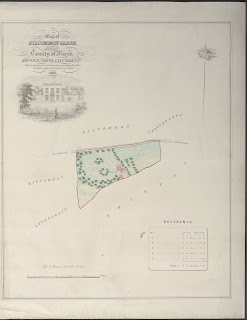
Figure 1: Kilcommon: A map of Kilcommon glebe (Hodges, Smith & Company, 1855).

Surveying the project

The RCB Library’s Diocesan Archive of Tuam, Killala and Achonry is a great example of how archive collections can develop and expand over time. Items pertaining to this collection have been arriving in piecemeal since the mid-1980s, being transferred gradually from local diocesan custody to the Library. A small but important part of this collection was a large assortment of maps and plans, along with other related material, spanning the period 1753-1873.

I have had a long personal interest in maps and cartography, and so this project was identified by the Librarian & Archivist, Dr Susan Hood, as one with which to obtain valuable experience with an archive collection. Working closely with Dr Hood, we identified the best way in which to approach this project. The maps were separated from the rest of the collection, and laid out flat - this would be essential in ensuring a smooth workflow with regards to cataloguing when we came to this stage.

In the meantime, the Library purchased some key core texts to help with the basics of map librarianship. The two items that I found most useful were Cataloging Sheet Maps: The Basics by Paige G. Andrew (2003) and Mary Lynette Larsgaard’s Map Librarianship: An Introduction (1998). These helped to identify the essential details that I would need to include in our catalogue list, as well as core MARC fields that I could utilise should we wish to make these maps available to search on our online (print) catalogue. These sources also provided helpful pointers that would prove essential during the course of the project.

I received a lot of guidance and direction from Dr Hood with regards to the more archival-specific aspects of this project. This included best practice pertaining to storage as well as how to display the information as part of a traditional archive catalogue. The project also required careful planning and time management. Working as part of a small team in a busy and diverse library (where space is limited) meant determining the optimal use of workspace on large and often cumbersome items, while ensuring that the project did not interrupt people visiting the Library and other ongoing projects. Another important and practical consideration was the purchase of tailor-made acid-free folders for storage in the Library’s secure strongrooms.

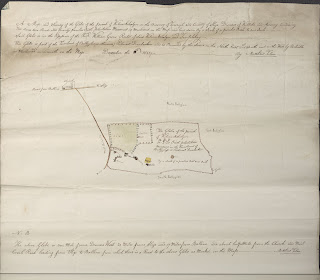
Figure 2: Kilmackshalyon: A map and survey of the glebe of the Parish of Kilmackshalyon in the Barony of Tireragh and County of Sligo (Folan, 1855). 

The finished project

With the completion of the project, the Library now has a detailed catalogue-list of over 80 maps, showing either parish or district boundaries, and divided into four distinct categories. There are some duplicates, and some of the maps are very fragile, whether due to age or in many instances, the fact that they were drawn on tracing paper. It was felt to be important to include not just the key core data elements (title, measurements, publisher, surveyor and date) but also to include townlands not mentioned specifically in the title. We also felt that it was important to state where land measurements were included (showing arable land) as the existence of this information could be useful for local historians. The detailed list also indicates where unique features are displayed. Often this would mean where a sketch of the glebe house or surrounding areas were included. The maps are in many cases strikingly beautiful, particularly the glebe maps, and resemble maps of the time that blur the distinction between functionality and art.

The maps form an integral part of the overall Diocesan Archive of Tuam, Killala and Achonry. Although the earliest item (a map of Kilmactigue in County Sligo) is dated May 6, 1754, it is important to note that it states it was ‘filed in Registry 10 July 1875’ (2020, RCB Library). Many of these maps date from the 1850s up to 1873, a time when land was at the forefront politically and culturally in Ireland. This was also a decisive point in the history of the Church of Ireland, with its Disestablishment from the State taking place on 1 January, 1871. This is a good example of the value of a detailed catalogue list for highlighting the context of a collection - for staff as well as for the Library’s users.

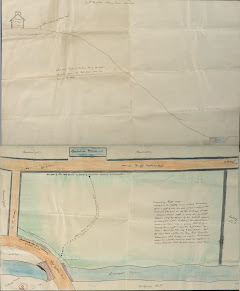
Drumlong: Chambers House map (n.d.).

Spreading the word

Much has been written, and with good reason, as to the importance of libraries exploring avenues to make their collections available and accessible to users, and the RCB Library is no exception. In practice, this meant examining what staff could achieve with the resources that we had to hand. Although we now have an incredibly useful and detailed catalogue of these maps as part of the handlist for the diocesan collection, it is envisaged that we will incorporate these items as part of our online (print) catalogue, allowing our users another avenue to locate these items.

Digitisation is an area that the RCB Library has been developing, principally as a preservation tool. This process will make digital surrogates available rather than original materials and will ensure that key items can be accessed and viewed by people all over the world. Some of these include the digitisation of the Red Book of Ossory, The Church of Ireland Gazette (1856 to 2010), the architectural drawings of churches, cathedrals, and glebe houses, as well as its most ambitious project to digitise the extensive collections of parish registers.

Any digitisation project will necessarily raise questions as to cost and storage, and with this in mind, I looked at maximising the potential of what we already have here in the Library. There is an option to upload high-resolution images to our versatile Library Management System which will require further investigation. I like the idea of a user being able to search for a particular map or area on our online print catalogue, and being able to immediately view this item.

Promoting such an important collection is a key focus for the RCB Library. I have already mentioned the technical aspects of a detailed and findable catalogue - a great way for historians and researchers to locate items of interest. However, the RCB Library has an active social media presence, and we have learned what a fantastic medium this provides for announcing aspects of a collection to a wider audience. Since 2012, the Library has been publishing blogs highlighting interesting aspects of the collection as part of its popular Archive of the Month feature. Additionally, the Library’s Twitter account @rcblibrary (which commenced in 2017) has grown steadily. An article has already been published about the Tuam Diocesan collection as a whole, and we hope to write about the map collection in the forthcoming months.

I mentioned that the RCB Library is an organic library, and one with a collection that is continually growing over time. Given the success of the project outlined above it is envisaged that I will work on similar collections in other diocesan collections. We have identified a similar collection as part of the Diocesan Archive of Killaloe, Kilfenora and Kilmacduagh that will be prioritised in 2022.

Image details:

Figure 1: Kilcommon: A map of Kilcommon glebe (Hodges, Smith & Company, 1855). An example of the beautiful design that is on display for many of the glebe maps in this collection. This map of Kilcommon Glebe is from 1855 and shows a sketch of the glebe house from this time. We also have a smaller sketch of the church in the top-right of the map. These small details can be very important for local historians and architects. RCB Library D5.17.1.28

Figure 2: Kilmackshalyon: A map and survey of the glebe of the Parish of Kilmackshalyon in the Barony of Tireragh and County of Sligo (Folan, 1855). This map of Kilmackshalyon, Co. Sligo, is incredibly detailed, not only in terms of the type of material shown on the map (we can see a very brief sketch of the church some distance from the glebe lands, as well as all the buildings that were present on the glebe), but also in the detail included at the top of the page, as well as the extra information contained in a note at the bottom. RCB Library D5.17.1.39

Figure 3: Drumlong: Chambers House map (n.d.). This is an interesting contrast to the intricate designs of the majority of the maps in this collection. It concerns a disputed right-of-way in Drumlong, Co. Mayo from the Newport river to Chambers House through rectory land. RCB Library D5.17.3.1

REFERENCE LIST:

Andrew, P. G. (2003). Cataloging sheet maps: The basics. Haworth Information Press.

Drumlong map: Chambers House. (n.d.).

Folan, M. (1855). Kilmackshalyon: A Map and Survey of the Glebe of the Parish of Kilmackshalyon in the Barony of Tireragh and County of Sligo. [Map]. 

Hodges, Smith and Company. (1855). Kilcommon:  a map of Kilcommon glebe. [Map].

Larsgaard, M. L. (1998). Map librarianship: An introduction (3rd ed.). Libraries Unlimited.

RCB Library. (2020). D5/ & D5A/ Diocesan Records of Tuam, Killala & Achonry c. 1613-2000. Representative Church Body Library. Retrieved 15 March 2022 from https://www.ireland.anglican.org/cmsfiles/images/aboutus/AOFTM/2020/June2020/TKA-Diocesan-Archive-Final-2020.pdf

Posted on Tuesday, March 15, 2022 | Categories:

21 Feb 2022

New Maynooth University Library Service is born during Covid-19 Pandemic,

Guest post by Bridie O’Neill, currently working with Maynooth University John Paul II Library as a Library Assistant. 1st Year student with University of Ulster (Master in Library Information Management). , 

Like all other libraries both academic and public, Maynooth University closed its doors in March 2020 due to the Covid-19 Pandemic.

This blog explores the new click and collect service devised to assist both Academic staff and students at Maynooth University (MU) Library. This service allows access to books on the library shelves when visiting in-person was not an option. As with other Libraries, Maynooth had to implement new digital services overnight. Social Media played a key role in advertising the new services available. The Library homepage  was updated daily to reflect the fast-paced changes occurring both in restrictions and online services.


Preparing essential and accessible technology for both staff and students was vital. Our (72) laptops which had been for in-house use only, were loaned to both students and staff. This was accomplished in collaboration with the Maynooth Access Programme (MAP), laptops were delivered to students at home.  Being able to access both our catalogue and electronic books entailed connecting to our server via our ‘Off – campus link’ for both students and staff which connects  differently than when used on campus.  


Library staff, some of whom were on site, while others were working from home dealt with a lot of queries about off-campus access via the chat function on the library website, email, and by telephone. The complexities from equipment set-up, broadband speeds to browsers used all played a part. As the title indicates “Click & Collect” is a service where a user, having searched the library catalogue to ascertain if a book is available in physical or electronic format, can request the physical copy if no e-book is available.  The user submits a request for a book in stock and includes the title and author of the book and most importantly the classification number for ease of retrieval by library staff. Staff receive click and collect request electronically via Lib-Answers which is linked directly from our webpage. The details of the click and collect request are checked. E.g., has the library user completed all required fields, are they indeed a current member of staff or a student? The book is then located by library staff from the library shelves and issued to the requestor’s account. This is not always straightforward as restrictions apply to the limit of books that a library user can borrow at any given time an e.g., short loan books can only be borrowed for xxx days, making them unsuitable for click and collect. Once the book is registered to the borrower’s account an email is sent to them stating the date and time for collection. We were able to streamline the service with standard reply emails informing the library user if the request has been successful or in some cases unsuccessful. Why not? Sometimes books are no longer available in our library catalogue, and they need to be requested via an Inter library loan (this again recommended the use of e-books or scanning up to one chapter.). Books could also be out on loan, lost or not present in the library at the time the Click and Collect request was submitted. We had specific times allocated for collection assisted our security team who facilitated access to the library.


Success!

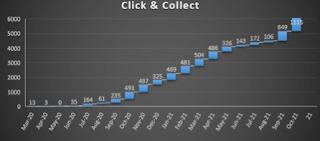
The service has been highly successful and well received by both students and staff with a 50/50 split take up. The graph below displays the usage of this service over a 16-month period.

Statistical analysis of click and collect – compiled by Bridie O’Neill


On a personal note, continuing to communicate with both students and staff gave a normality to an exceedingly difficult situation. The camaraderie with other staff in our combined efforts to not only meet but exceed our users’ expectations was a rewarding unexpected well-being bonus.

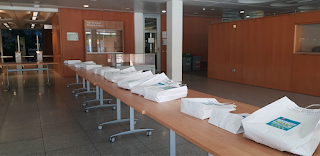
Click & collect books ready for collection in Maynooth Library Foyer © Emma Boyce MU Library

The service has proved invaluable with feedback received via our poll survey. An example of such feedback is the following: How would you rate the service - “Excellent” and do you want the service to continue? “Yes, please.” At the peak we receive up to 80 click and collects requests in a normal 9 am – 5 pm working day. We welcome our library users' feedback and Click and Collect was born out of necessity and has become a popular new library service.

What Next?

In conclusion Click & Collect has proven to be an invaluable service and we have received numerous requests to continue this service now that the doors to the library have reopened.  The click and collects success has raised the question how we can improve this service further?   A parcel motel approach is being investigated to allow click and collect books to be left in the Library foyer in coded lockers for users to collect at times convenient to them.


2 Feb 2022

The Maynooth University Library Engagement and Information Services (EIS) Desk: A student to staff member perspective

Guest post by Kate Hawkins, Library Assistant, Engagement and Information Services, Maynooth University Library

Introduction 

This blog post explores my experience of the Maynooth University (MU) Library service as a student and as a library staff member. Initially, as a postgraduate student, I worked with the Library Facilities and Events Team (F&E) for a year from October 2020. Next, I took up a post as a Library Assistant providing front line desk services. I will outline the duties associated with both library posts, and what I’ve learned from both a student’s and an employee’s perspective, and how my understanding and knowledge of the world of information has grown through my experiences. 

John Paul II Library (Pic by Kate Hawkins)

Undergraduate 

I began my undergraduate degree in Law and English at MU in 2017. During my orientation I received a library tour and an information session about the Library. The beginning of first year was overwhelming and exciting. As law is heavily book based, I borrowed many textbooks for my law modules. I accessed the Library early in the academic year and I learned how to use the self-service machines with the help of library staff. Group study rooms were a valuable space for working with my classmates. From my second year onwards, I was selected to be an orientation leader. I felt proud to be showing the first-year students around MU. I spent time in the Library during orientation week where I met students in the foyer for their campus tour, and I brought them to meet the librarians for their interactive session on using the library. I enjoyed answering their questions and showing them how they could best use the resources to get the most out of their university studies.

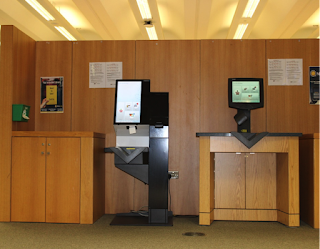
Self-service borrowing machines
 (Pic by Kate Hawkins)

Postgraduate 

I began a master's degree in International Justice at MU in September 2020. It was a full-time course that linked to aspects of my undergraduate degree and allowed me to explore these topics in more detail. I completed my masters during the COVID-19 pandemic which was overwhelming at times, both with adjusting to studying remotely and online lectures. Thankfully the Library continued to offer a comprehensive service during this time. As all my lectures were online, most of my experience with the Library was as a remote user. When restrictions eased, I was able to book a study space in the Library for a three-hour period. That was an opportunity to read textbooks and consult British and Irish journals that were available in print only. The online service I used most frequently was the library search function on the MU Library homepage to find journal articles and eBooks. I used legal databases such as Westlaw and Lexis Library to read important case law for assignments, and for my dissertation. Some older textbooks were available online as eBooks. I used the digital on demand service for chapters of law textbooks when studying remotely. I did not use the click and collect service, however now as a staff member I notice the benefits of this service for MU students. 


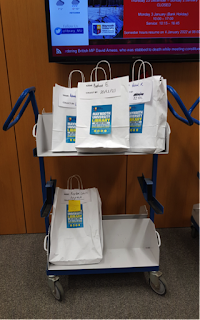
Click and Collect Service (Pic by Kate Hawkins)

Member of Facilities and Events (F&E) Team

When my postgraduate studies began, I started work as a member of the Facilities and Events (F&E) team. This post is restricted to MU postgraduates. Due to the pandemic, there were no in-person events at MU Library, and I was not involved in online events. We conducted daily fire safety checks and contact tracing and mask checks, when students were back on site. Occasionally we were given projects. Two of us were tasked with creating an Excel spreadsheet in a Microsoft Team folder, with information on the layout of university library websites in Ireland and abroad. We recorded features of their homepages that we didn’t have on our website and added links to their websites. Transitioning to accommodate the easing of restrictions was a major project that the whole team was involved in. We placed QR codes on the appropriate desks and socially distanced the furniture. We made new signs to put around the library. It was great to be a part of the library orientation team week in 2021, especially meeting new students. When my time as a member of the F&E team was coming to an end, I trained new members of the team. It felt good to share my experiences and knowledge with them. 

                                  Maynooth University Library Homepage (Pic by: Maynooth University)  


Engagement and Information Service (EIS)

I was delighted when my application for EIS Library assistant was successful. I was nervous starting this job; there was a lot to learn. I was also excited. Now I am learning more about how libraries operate, and about MU Library’s policies and procedures. Recently I learned that there are multiple ways for library users to communicate with library staff including via different e-mail addresses and the library chat service. I use Libapps for answering student queries and click and collect requests. We rotate roles during shifts. I’m learning about the importance of keeping statistics, to demonstrate how our services are being used. I enjoy interacting with students and assisting them. Each shift brings something different a new query, a new library database to explore or a new book to find!  


                                                      EIS Desk (Pic by Kate Hawkins)


Where next?

I am enjoying my work as a Library assistant and am looking forward to learning more about the Library. I enjoy combining working as a Library Assistant with exploring my interest in human rights and immigration law. I attended the Library Outside In Lecture (this is part of a series of guest lectures) given by a Maynooth University graduate who spent six years living in Direct Provision while an MU student.  We are a University of Sanctuary, and I hope to explore this more and write about it. 


6 Oct 2021

Embrace the virtual library space


Graphic designed by Iain McCool

Libfocus is very happy to post the winning entry in this years CONUL Library Assistants Award. Congratulations Iain McCool,  Queens University Belfast Library. Congratulation Iain. 

Introduction 

The emergence of the COVID-19 pandemic and the subsequent lockdown restrictions have turbo-blasted libraries toward becoming fully integrated virtual service providers. Libraries have very much always been about the provision of frontline services, offering valuable and friendly support for library users. 

The uncompromising situation witnessed throughout 2020, however, saw the nature of face-to-face interaction no longer being a viable option. As a consequence, library staff had to adapt to changes quickly and discover innovative new ways of communicating with their patrons. 

The library profession continually tries to find novel new ways to engage and offer support. Long before COVID-19, libraries had considered how to maximise the potential of digital services. The sudden impact of lockdown brought about a circumstance of uncertainty for which libraries were already ably prepared to cope (Walsh & Harjinder, 2020). 

Libraries have accordingly sought to develop the services they provide, in so far as, they now allow for patrons to gain access to resources remotely (Lindsay, 2021). The culmination of what has been experienced over the course of lockdown has presented libraries with an opportunity to become an effective virtual service provider that can make library resources more accessible.

                                        Image of the McClay Library atrium from the 2nd floor


A large aspect of university life has always been about a student’s ability to learn for themselves and thereby develop the necessary skills required to progress onto postgraduate study. 

Learning for oneself 

In order to be successful at university, students need to attend lectures and seminars. Students have to know how and where they can access learning resources, they should allocate adequate time to study, and learn how to correctly cite references (Barnes, 1995).

The library seeks to improve the experiences of students with a supportive study environment by helping develop research skills and manage expectations, equipping students with the necessary reading material, as well as offering a spacious study location that is quiet and well-kept, and is simultaneously in close vicinity to alternative campus amenities. 

The McClay Library, for example, also prepares students for university with the Transition Skills Online Training programme. Begun in 2019, this programme functions as an outreach project to improve school leavers information literacy.

                                       Image of a study area for students in the McClay Library


In many instances, patrons were no longer able to physically access the library during lockdown. This situation necessitated a rethink in terms of borrowing rights. Over the course of lockdown, library users had their standard loans extended. 

We learn by doing 

The renewal policy in the McClay Library had been under review prior to COVID-19. A new procedure has since been implemented whereby standard loans are renewed automatically unless the book is requested by someone else.

Complications regarding physical access to collections also initiated the deployment of a temporary Scan and Deliver service in the McClay library, whereby patrons could get a scan of print collections sent to them personally if the request was one chapter or 10% of a book, whichever being greater.

                A strategy model created by Library Chat Enhancement Group to assist staff training 


A new feature to library services was rolled out at the beginning of lockdown which enabled library users to get in touch with library staff using an online chat service. The implementation of Library Chat proved to be an advantageous success for library services, as queries are answered in real-time. 

Library Chat 

Library Chat places new demands on frontline library staff who adapted their skillset from answering queries in-person to using an interactive online tool (Cohn & Hyams, 2021). Communication was key to share specialised knowledge amongst departments, so a new process had to be devised for query referral and new training guides were developed for staff. 

The Library Chat Enhancement Group (LCEG), was comprised of library assistants who had first-hand experience of using Library Chat and was formed for the benefit of staff development in order to enhance the library user experience. The strategy employed encouraged a hands-on learning model based on experiential learning techniques (Kolb, 2014), complimented by group training sessions to obtain feedback. 

LCEG began by publishing a QuickStart guide which gave basic guidance on how to use the platform, a Latest Announcements page was designed to keep staff UpToDate with library developments, and an Information for LibChatters guide was produced to detail library policy.

Conclusion 

Higher education was identified as an essential service which could operate in some shape or form during lockdown. The nature of the restrictions imposed have had such a debilitating effect on the provision of in-person library services that much of what was practiced before the pandemic may no longer be applicable in the future (Ma, 2020). 

In embracing the virtual space, some of the new changes mentioned in this piece may still have a relevant part to play going forward, and ultimately enhance the provision of library services.

* all images and graphics by Iain McCool

References 

Barnes, R. (1995) Reading academic texts, in Barnes, R. (ed.) Successful Study for Degrees. London: Routledge, pp. 51-63. 

Cohn, S., Hyams, R. (2021) Making Room for TBD: Adapting Library Websites during a Pandemic, Computers in Libraries, 41(2), pp. 18-21 [Online]. Available at: http://search.ebscohost.com.queens.ezp1.qub.ac.uk/login.aspx?direct=true&db=edsbig&AN=edsbig.A654780607&site=eds-live&scope=site (Accessed: 5th July 2021). 

Kolb, D.A. (2014) The Process of Experiential Learning, in Kolb, D.A. (ed.) Experiential learning: experience as the source of learning and development. New Jersey: Pearson Education Inc., pp. 68-108. [Online]. Available at: https://r3.vlereader.com/Reader?ean=9780133892505 [Accessed: 5th July 2021). 

Lindsay, M.J., et al. (2021) Mind like Water: Flexibly Adapting to Serve Patrons in the Era of COVID-19, Medical Reference Services Quarterly, 40(1), pp. 56-66 [Online]. Available at: https://doi.org/10.1080/02763869.2021.1873622 (Accessed: 5th July 2021). 

Ma, L.F.H. (2020) Academic Library Services during COVID-19: The Experience of CUHK Library, International Information and Library Review, 52(4), pp. 321-324 [Online]. Available at: https://doi.org/10.1080/10572317.2020.1834251 (Accessed: 5th July 2021). 

Walsh, B., Harjinder, R. (2020) Continuity of Academic Library Services during the Pandemic: The University of Toronto Libraries Response, Journal of Scholarly Publishing, 51(4), pp. 237-245 [Online]. Available at: muse.jhu.edu/article/760728 (Accessed: 5th July 2021).