21 Nov 2012

Why Research Impact Is About Promotion, Not Impact Factors (and Why This Is Good News For Libraries)

A paper published in the current issue of the Journal of the American Society for Information Science and Technology (paywall, sorry :( ) estimates that the proportion of highly cited papers published in high impact journals has declined substantially in recent decades. In 1990 45% of the most cited 5% of papers were published in the top 5% of journals ranked by impact factor; by 2009 the proportion had dropped to 36% - representing a 20% fall in market share in 20 years. This is partly due to the growth in the number of publication outlets generally over the period, however it still appears a high impact factor is no longer the sine qua non it once was.

In my view, this is just the beginning. The increased use of altmetrics has already shown that tweets, bookmarks and other social sharing tools can have a substantial impact in disseminating research quickly. However, channels like these only represent the tip of the iceberg when it comes to promoting research. Whilst twenty years ago getting your paper into a high impact title like Nature or Science was enough to ensure it would be widely read, in today's competitive research environment it counts for a lot less. Now, research promotion is almost as import as research itself.

The video below is an excellent example of this idea. This short film essentially functions as a 'trailer' to promote a research paper by Cross & Wheatland (the YouTube URL links to the pre-print), and with over one million views to date is a simple but effective example of how creativity and promotion can increase research visibility - and potentially impact. This doesn't mean that every author should start making videos to accompany their journal articles, but it does provide an opportunity for libraries to position themselves as research promoters as part of their overall research support package.

This is an area where libraries can provide a real value-added service to researchers - leveraging their existing expertise and networks to help package, distribute and promote research. In most cases, libraries are already doing this on a lesser scale e.g. through open access initiatives, promoting institutional respositories and advising on bibliometrics. However the benefits from ramping up these efforts into a more co-ordinated and creative package, including aspects like SEO and social-media, are potentially significant. As Brian Mathews argues in this article in the Chronicle: "It’s no longer about just publishing a paper but creating a suitable outlet and campaign to share the findings. Our [librarians'] job becomes producers: designing and developing the channels, methods, processes and metrics to repackage content (academic papers) into formats apt for expanding the audience".
20 Nov 2012

Our Wonderful World: Making Connections Courtesy of Information and Communications

Guest post by Emily Weak, Hourly Librarian at City of Mountain View

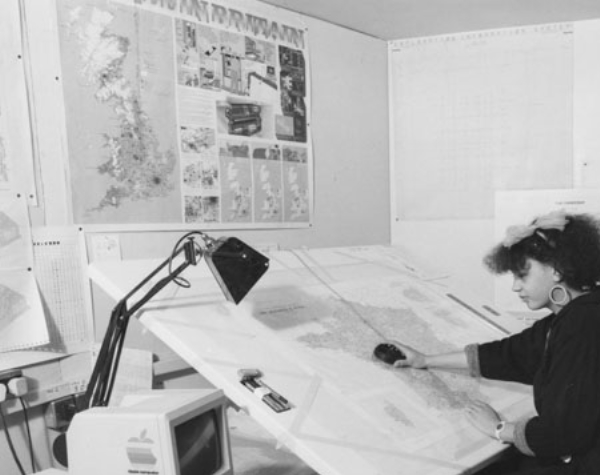
LSE, Geography Department, 1986
I often think about what it would have been like to try to embark on a career in librarianship in the olden days. And by olden days I of course mean that dark time before the internet existed.

What really blows my mind is how easily we can now communicate, not only with that tiny handful of people we know, but with the great sea of the world’s librarians. And librarians are such nice people. They will surely help you out, if you just ask politely.

Origins
I started the blog Hiring Librarians at the end of February 2012. I was about four months in to my own frustrating and demoralizing job hunt. I was mystified by the strange rituals of library hiring – the inscrutable government lists for public library employment, the enigmatic rituals of academic processes, and the lack of even a hint as to where to find special library jobs. I wanted work, but I didn’t know how to get it.

So I started asking people who hired librarians to answer some basic questions for me. I started by emailing a few people from my own tiny pool of library contacts, posting their responses to a short, online survey. Then I sent out requests to listservs such as PUBLIB, collib-I, AUTOCAT, LIBREF-L, LM NET and ILI. Only one of these refused to let me post (telling me that it was off-topic).

Further Questions
I made it really easy for people to respond to my questions, and I didn’t require anyone to leave a name. But some did! And then when readers brought up questions that hadn’t been included in the initial survey, some of those non-anonymous people agreed to answer them, and this is how the Further Questions feature got started.

Growing Content
I also started to send out emails to individuals. Both Barbara Stripling and Gina Millsap, who were running for ALA president, responded. I also was able to “interview” some employers with open positions, at the request of readers who were applying. The innovative AnyThink library was one such respondent. I also found and contacted people via Twitter. Librarians love Twitter.

Megan Hodge and Nicole Spoor emailed me because their own research focused on library hiring, and then were gracious enough to write a guest post describing their findings. Since then I have been able to include guest posts by other researchers and authors, such as Priscilla K. Shontz and Rich Murray, who wrote What Do Employers Want? A Guide for Library Science Students and run the blog LIScareer.

Mind: Blown
I am amazed by the number of people who have been willing to take time to contribute to this project. As of November 12th, 2012, 161 people have responded to the original survey and 235 have responded to a second survey about interview clothes, created in collaboration with Jill of the blog Librarian Hire Fashion. 25 people let me email them hiring questions on a weekly basis. And I’ve been able to work with several other researchers, bloggers, and authors on guest posts, either for my blog, or for theirs, as I am doing here on LibFocus.

Journalist Lucy Morgan with video camera and phone, ca. 1985
None of this has happened face to face, or even over the phone (with the exception of one individual). I only met a few readers in person just recently, when I attended my first library conference. Could I ever have worked with this number of people, from all over the globe, without the glorious internet? Can you imagine carrying this on via written correspondence? I could not have created and distributed my survey without Google Apps, and I certainly couldn’t deliver transcribed content daily without my best friends, copy and paste.

What a wonderful world.

18 Nov 2012

Introducing the Hurdy Gurdy Museum of Vintage Radio...

Ye Olde Hurdy Gurdy Museum of Vintage Radio
On a hill in Howth resides the Hurdy Gurdy Museum of Vintage Radio in the historic setting of Martello tower no. 2. Since 2002 Pat Herbert, the curator, has housed all manner of artefacts, relating to Marconi and the history of communication.

Various constraints meant that the museum's catalogue remained undeveloped, until this year. So when looking to jump into a cataloguing project, choosing the Hurdy Gurdy was not a difficult decision. The criteria? A greenfield in terms of cataloguing, a rich collection and an agreeable management team. Evaluating the IT infrastructure within the tower, it was apparent that a local server solution was not feasible. In order to promote the museum’s collection an online public catalogue would be preferable. Financially speaking open source was the only option, and so Omeka.net ticked all these boxes.

Omeka.net was constructed for museums to archive their artefacts in the cloud. Functionalities such as exhibiting collections online and Google analytic plug-ins made the site attractive. Dublin Core metadata is the primary descriptive method on Omeka. Visually attractive, Omeka would allow the team at the Hurdy Gurdy to exhibit online their various collections in an effective and informative manner.

Downstairs exhibits
Dublin Core suited our collection considering the wide variety of objects in the museum. There are a number of specific collections within the museum, such as radios, valves, household products and historical documents from the foundation of the Irish state amongst items relating to the history of telecommunications.


With the upcoming anniversaries relating to the foundation of the Irish state such as 1913 lockout, 1916 Easter Rising, 1919 War of Independence and the 1922 Civil War, we recognised that certain areas of the collection would generate interest.


As we became more familiar with the various aspects of the collection, we began to formulate a cataloguing policy.

Rental receipt from 1922 with (Irish Free State) stamp
As we began to virtually classify items, the activity surrounding this allowed us to re-evaluate the exhibits within the museums physical space. Fuelled by tea, Wagonwheels® and a love of all things vintage, we classified items within specific collections on Omeka. As the catalogue took shape online, we began to construct mirrored collections within the museum itself, areas such as a valve corner, an Irish history space and an Ever Ready® dry battery display. This has only enhanced what is already a splendid collection of radios, valves, artefacts and batteries, this is an untapped treasure trove of historical items within the Howth environs.

So far a thoroughly rewarding endeavour and will hopefully continue to be so.

Marie-Therese Carmody - Cataloguer Hurdy Gurdy Museum of Vintage Radio
Sarah Connolly - Cataloguer Hurdy Gurdy Museum of Vintage Radio

15 Nov 2012

Turning E-Learning into Engaged-Learning

Last January I registered for Codeacademy brimming with good intentions and motivation. The first few weeks I was a model student, but after a month or so I started missing the weekly deadlines due to work and other commitments, and shortly afterwards I gave up completely. It wasn’t a conscious decision, but once I fell behind by a couple of weeks it was all too easy to forget about it altogether (I am still getting the weekly reminder emails, which are a constant source of guilt!).

I also signed up for a Coursera course (Computing for Data Analysis) a few months ago, thinking a shorter time frame may be more manageable, but unfortunately the programme commenced at a very busy period for me and I never seemed to find the time to even get started with it. I did make it through Google’s recent Power Searching MOOC (I was primarily interested in seeing what Google view as the key issues and skills), though I admit it was a struggle, and in some cases I played the videos in the background whilst doing other things. Maybe online learning is just not for me?

So I was really interested to see the post-course reflections of Roger Peng, the tutor of the aforementioned Coursera module: Some Thoughts on Teaching R to 50,000 Students (further information on the participation levels and attendance of participants is detailed here). Peng took away several lessons from his initial experience of delivering instruction through MOOC infrastructure including: 

    • 50,000 students is in some ways easier than 50 students.
    • Clarity and specificity are necessary.
    • Modularity is key to overcoming heterogeneity
    • Time and content are more loosely connected

      Peng will also be running the course through his Simply Statistics blog shortly. It will be interesting to compare the feedback and experiences of users across both platforms (read the comments accompanying Peng’s post for feedback from the Coursera participants).


      I don’t believe that truly effective online teaching can ever be a case of simply videoing a face-to-face lecture and uploading it to YouTube, even though I have experienced several examples of this in the past. To do so, is largely missing the point; even if the 'content' needs to be broadly the same, it requires very different packaging. In the same way that active learning strategies are so valuable in the classroom, interaction and participation is just as important (if not more so) with online and asynchronous learning.

      My own lack of success to date as an online student may partly be due to time pressures, but I am a great believer that if something is important enough you will make the time. Maybe I just wasn’t passionate enough about the topic to really push myself to see it through? But surely one of the characteristics of good instructional design involves stimulating interest and encouraging engagement (within reason)? I also get discouraged easily when faced with the prospect of lengthy presentations and videos – in this respect I think Peng’s comments about modularity are key. Personally, I am far more engaged as a learner when presented with a menu of resources each covering a single concept or idea, rather than a single longer presentation. With the former I can select the relevant content I need, achieving an immediate pay-off that motivates me to continue. I can essentially tailor the content specifically to my personal learning needs even within the infrastructure of a generic programme or module. Conversely, with the latter my interest quickly tapers off when presented with less relevant material or aspects I'm already familiar.

      Most recently, I have registered for a Coursera module on Elearning and Digital Cultures starting in January 2013. A pre-course email circulated this week recommends that participants should use a blog to record and share their learning, so depending on my success this time around, you may see my own reflections on the Coursera experience here in the near future.

      13 Nov 2012

      A view from Zimbabwe

      Ireland getting you down? Fancy moving to a country with one of the best climates in the world and helping to get a new generation of Zimbabweans back into their libraries?
      If so, read on…

      Here in Harare there is a grassroots movement underway to renew our city libraries. Harare City Libraries consist of the main library on Rotten Row in the city centre and 5 other suburban branches. Efforts this year have seen reading and storytelling session carried out by volunteers to encourage our next generation of readers to make use of this important community resource and to bolster membership of our libraries. The city of Harare libraries is also hard at work sourcing new books to renew the collection and to raise funds for essential repairs to the libraries, in particular the main library.

      This was established in 1902 as the Queen Victoria Memorial Library, celebrates an important anniversary in 2012.  This year, the award winning building to which the library moved in 1962, turns 50. When it was completed, the building was awarded a medal by the Royal Institute of British Architects as one of the best designed buildings in Southern Africa during the period between 1948 and 1962. This is one of only three Bronze medals ever awarded in the whole of Africa. Sadly over the last 10 years the library has fallen into a state of disrepair. 

      Many thousands of people have used the library facilities.  A generation of Zimbabweans fondly remember Saturday mornings sitting in the light and airy building as they benefitted from reading the library’s huge collection of books. Our aim is to create these seem memories for a new generation of Zimbabweans and this is your opportunity to be part of this important and exciting initiative!

      Through Voluntary Services Overseas (VSO) we are looking for a senior librarian and a community librarian who can work with us to restore the City of Harare Libraries to their former glory! At present, there are two paraprofessional members of staff who have obtained diplomas from Harare Polytechnic however there are no fully qualified and experienced professional staff. We’d like you to remedy that!!

      If this sounds like something that you might be interested, please get in touch with either Deirdre Ní Cheallaigh dnicheallaigh@trocairezw.org or Katrina Wallace-Karenga Katrina@yoafrica.com for more information about the two posts. 
      Read the blog at: http://thehararevillager.blogspot.com/

      We look forward to hearing from you soon!
      Posted on Tuesday, November 13, 2012 | Categories: