Ronan Cox (@ronancox2) - Business Librarian, Dublin City University.
Introduction28 Mar 2022
15 Mar 2022
Cataloguing maps: developing archival skills with the RCB Library’s diocesan collection
Guest
post by Bryan Whelan, Assistant Librarian in the RCB Library in Dublin.
The Representative
Church Body (RCB) Library is a specialist library. It is both reference library
and archive repository for the Church of Ireland, which like all the main
Christian churches has an all-Ireland 32-county remit. The collections are
extensive and organic, currently in excess of 80,000 print items, 1,214
collections of parish records (including registers of baptism, marriage and
burial), the records of 20 historic Church of Ireland dioceses and 20
cathedrals and 1,230 manuscript collections relating to a variety of people,
buildings and activities, as well as the non-current records of the General
Synod and the RCB.
A small specialist library offers information professionals the opportunity to develop non-traditional skillsets that may not have been covered in their undergraduate or postgraduate courses. In my role as Assistant Librarian, I have gained cataloguing experience with rare books and pamphlets, as well as working with archives. All of this experience was vital with regards to the project which is the focus of this article.
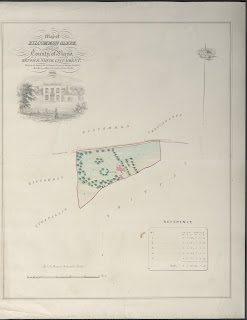
| Figure 1: Kilcommon: A map of Kilcommon glebe (Hodges, Smith & Company, 1855). |
Surveying the project
The RCB Library’s Diocesan
Archive of Tuam, Killala and Achonry is a great example of how archive
collections can develop and expand over time. Items pertaining to this
collection have been arriving in piecemeal since the mid-1980s, being
transferred gradually from local diocesan custody to the Library. A small but
important part of this collection was a large assortment of maps and plans,
along with other related material, spanning the period 1753-1873.
I have had a long personal interest in maps
and cartography, and so this project was identified by the Librarian &
Archivist, Dr Susan Hood, as one with which to obtain valuable experience with an archive
collection. Working closely with Dr Hood, we identified the best way in which
to approach this project. The maps were separated from the rest of the
collection, and laid out flat - this would be essential in ensuring a smooth
workflow with regards to cataloguing when we came to this stage.
In the meantime, the Library purchased some
key core texts to help with the basics of map librarianship. The two items that
I found most useful were Cataloging Sheet
Maps: The Basics by Paige G. Andrew (2003) and Mary Lynette Larsgaard’s Map Librarianship: An Introduction (1998).
These helped to identify the essential details that I would need to include in
our catalogue list, as well as core MARC fields that I could utilise should we
wish to make these maps available to search on our online (print) catalogue.
These sources also provided helpful pointers that would prove essential during
the course of the project.
I received a lot of guidance and direction
from Dr Hood with regards to the more archival-specific aspects of this project. This included best practice pertaining to storage as well as how to display the
information as part of a traditional archive catalogue. The project also required
careful planning and time management. Working as part of a small team in a busy
and diverse library (where space is limited) meant determining the optimal use
of workspace on large and often cumbersome items, while ensuring that the
project did not interrupt people visiting the Library and other ongoing
projects. Another important and practical consideration was the purchase of
tailor-made acid-free folders for storage in the Library’s secure strongrooms.
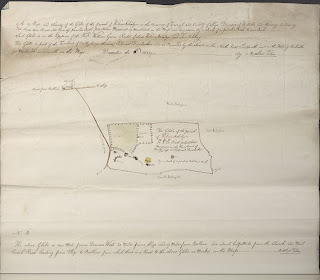
| Figure 2: Kilmackshalyon: A map and survey of the glebe of the Parish of Kilmackshalyon in the Barony of Tireragh and County of Sligo (Folan, 1855). |
The finished project
With the completion of the project, the
Library now has a detailed
catalogue-list of over 80 maps, showing either parish or district
boundaries, and divided into four distinct categories. There are some
duplicates, and some of the maps are very fragile, whether due to age or in
many instances, the fact that they were drawn on tracing paper. It was felt to
be important to include not just the key core data elements (title,
measurements, publisher, surveyor and date) but also to include townlands not
mentioned specifically in the title. We also felt that it was important to
state where land measurements were included (showing arable land) as the
existence of this information could be useful for local historians. The
detailed list also indicates where unique features are displayed. Often this
would mean where a sketch of the glebe house or surrounding areas were
included. The maps are in many cases strikingly beautiful, particularly the
glebe maps, and resemble maps of the time that blur the distinction between
functionality and art.
The maps form
an integral part of the overall Diocesan Archive of Tuam, Killala and Achonry.
Although the earliest item (a map of Kilmactigue in County Sligo) is dated May
6, 1754, it is important to note that it states it was ‘filed
in Registry 10 July 1875’ (2020, RCB Library). Many of these maps date from the 1850s up to
1873, a time when land was at the forefront politically and culturally in
Ireland. This was also a decisive point in the history of the Church of
Ireland, with its Disestablishment from the State taking place on 1 January,
1871. This is a good example of the value of a detailed catalogue list for
highlighting the context of a collection - for staff as well as for the
Library’s users.
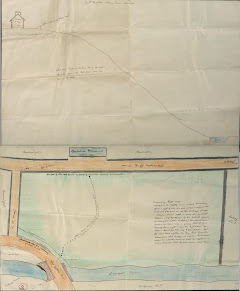
| Drumlong: Chambers House map (n.d.). |
Spreading the word
Much has been
written, and with good reason, as to the importance of libraries exploring
avenues to make their collections available and accessible to users, and the
RCB Library is no exception. In practice, this meant examining what staff could
achieve with the resources that we had to hand. Although we now have an
incredibly useful and detailed catalogue of these maps as part of the handlist
for the diocesan collection, it is envisaged that we will incorporate these
items as part of our online (print)
catalogue, allowing our users another avenue to locate these items.
Digitisation is
an area that the RCB Library has been developing, principally as a preservation
tool. This process will make digital surrogates available rather than original
materials and will ensure that key items can be accessed and viewed by people
all over the world. Some of these include the digitisation of the Red Book of Ossory,
The Church of Ireland Gazette (1856 to 2010), the architectural drawings of
churches, cathedrals, and glebe houses, as well as its most ambitious
project to digitise
the extensive collections of parish registers.
Any
digitisation project will necessarily raise questions as to cost and storage,
and with this in mind, I looked at maximising the potential of what we already have
here in the Library. There is an option to upload high-resolution images to our
versatile Library Management System which will require further investigation. I
like the idea of a user being able to search for a particular map or area on
our online print catalogue, and being able to immediately view this item.
Promoting such
an important collection is a key focus for the RCB Library. I have already
mentioned the technical aspects of a detailed and findable catalogue - a great
way for historians and researchers to locate items of interest. However, the
RCB Library has an active social media presence, and we have learned what a
fantastic medium this provides for announcing aspects of a collection to a
wider audience. Since 2012, the Library has been publishing blogs highlighting
interesting aspects of the collection as part of its popular Archive
of the Month feature. Additionally, the Library’s Twitter account @rcblibrary (which commenced in 2017)
has grown steadily. An article
has already been published about the Tuam Diocesan collection as a whole, and
we hope to write about the map collection in the forthcoming months.
I mentioned
that the RCB Library is an organic library, and one with a collection that is
continually growing over time. Given the success of the project outlined above it
is envisaged that I will work on similar collections in other diocesan
collections. We have identified a similar collection as part of the Diocesan
Archive of Killaloe, Kilfenora and Kilmacduagh that will be prioritised in
2022.
Image details:
Figure 1: Kilcommon: A map of Kilcommon
glebe (Hodges, Smith & Company, 1855). An example of the beautiful design
that is on display for many of the glebe maps in this collection. This map of
Kilcommon Glebe is from 1855 and shows a sketch of the glebe house from this
time. We also have a smaller sketch of the church in the top-right of the map.
These small details can be very important for local historians and architects. RCB
Library D5.17.1.28
Figure 2: Kilmackshalyon: A map and survey of the glebe of the Parish of
Kilmackshalyon in the Barony of Tireragh and County of Sligo (Folan, 1855). This
map of Kilmackshalyon, Co. Sligo, is incredibly detailed, not only in terms of
the type of material shown on the map (we can see a very brief sketch of the
church some distance from the glebe lands, as well as all the buildings that
were present on the glebe), but also in the detail included at the top of the
page, as well as the extra information contained in a note at the bottom. RCB
Library D5.17.1.39
Figure 3: Drumlong: Chambers House map (n.d.). This is an interesting
contrast to the intricate designs of the majority of the maps in this
collection. It concerns a disputed right-of-way in Drumlong, Co. Mayo from the
Newport river to Chambers House through rectory land. RCB Library D5.17.3.1
REFERENCE LIST:
Andrew, P. G. (2003). Cataloging sheet maps:
The basics. Haworth Information Press.
Drumlong
map: Chambers House. (n.d.).
Folan, M. (1855). Kilmackshalyon:
A Map and Survey of the Glebe of the Parish of Kilmackshalyon in the Barony of
Tireragh and County of Sligo. [Map].
Hodges, Smith and Company. (1855). Kilcommon:
a map of Kilcommon glebe. [Map].
Larsgaard, M. L.
(1998). Map librarianship: An introduction (3rd ed.). Libraries
Unlimited.
RCB Library. (2020). D5/ & D5A/ Diocesan Records of Tuam, Killala & Achonry c.
1613-2000. Representative Church Body Library. Retrieved 15 March
2022 from https://www.ireland.anglican.org/cmsfiles/images/aboutus/AOFTM/2020/June2020/TKA-Diocesan-Archive-Final-2020.pdf
21 Feb 2022
New Maynooth University Library Service is born during Covid-19 Pandemic,
Guest post by Bridie O’Neill, currently working with Maynooth University John Paul II Library as a Library Assistant. 1st Year student with University of Ulster (Master in Library Information Management). ,
Like all other libraries both academic and public, Maynooth University closed its doors in March 2020 due to the Covid-19 Pandemic.
This blog explores the new click and collect service devised to assist both Academic staff and students at Maynooth University (MU) Library. This service allows access to books on the library shelves when visiting in-person was not an option. As with other Libraries, Maynooth had to implement new digital services overnight. Social Media played a key role in advertising the new services available. The Library homepage was updated daily to reflect the fast-paced changes occurring both in restrictions and online services.
Preparing essential and accessible technology for both staff and students was vital. Our (72) laptops which had been for in-house use only, were loaned to both students and staff. This was accomplished in collaboration with the Maynooth Access Programme (MAP), laptops were delivered to students at home. Being able to access both our catalogue and electronic books entailed connecting to our server via our ‘Off – campus link’ for both students and staff which connects differently than when used on campus.
Library staff, some of whom were on site, while others were working from home dealt with a lot of queries about off-campus access via the chat function on the library website, email, and by telephone. The complexities from equipment set-up, broadband speeds to browsers used all played a part. As the title indicates “Click & Collect” is a service where a user, having searched the library catalogue to ascertain if a book is available in physical or electronic format, can request the physical copy if no e-book is available. The user submits a request for a book in stock and includes the title and author of the book and most importantly the classification number for ease of retrieval by library staff. Staff receive click and collect request electronically via Lib-Answers which is linked directly from our webpage. The details of the click and collect request are checked. E.g., has the library user completed all required fields, are they indeed a current member of staff or a student? The book is then located by library staff from the library shelves and issued to the requestor’s account. This is not always straightforward as restrictions apply to the limit of books that a library user can borrow at any given time an e.g., short loan books can only be borrowed for xxx days, making them unsuitable for click and collect. Once the book is registered to the borrower’s account an email is sent to them stating the date and time for collection. We were able to streamline the service with standard reply emails informing the library user if the request has been successful or in some cases unsuccessful. Why not? Sometimes books are no longer available in our library catalogue, and they need to be requested via an Inter library loan (this again recommended the use of e-books or scanning up to one chapter.). Books could also be out on loan, lost or not present in the library at the time the Click and Collect request was submitted. We had specific times allocated for collection assisted our security team who facilitated access to the library.
Success!
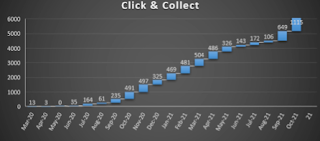
The service has been highly successful and well received by both students and staff with a 50/50 split take up. The graph below displays the usage of this service over a 16-month period.
| Statistical analysis of click and collect – compiled by Bridie O’Neill |
On a personal note, continuing to communicate with both students and staff gave a normality to an exceedingly difficult situation. The camaraderie with other staff in our combined efforts to not only meet but exceed our users’ expectations was a rewarding unexpected well-being bonus.
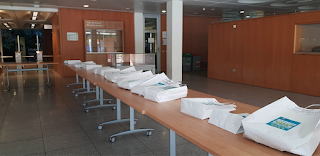
| Click & collect books ready for collection in Maynooth Library Foyer © Emma Boyce MU Library |
The service has proved invaluable with feedback received via our poll survey. An example of such feedback is the following: How would you rate the service - “Excellent” and do you want the service to continue? “Yes, please.” At the peak we receive up to 80 click and collects requests in a normal 9 am – 5 pm working day. We welcome our library users' feedback and Click and Collect was born out of necessity and has become a popular new library service.
What Next?
In conclusion Click & Collect has proven to be an invaluable service and we have received numerous requests to continue this service now that the doors to the library have reopened. The click and collects success has raised the question how we can improve this service further? A parcel motel approach is being investigated to allow click and collect books to be left in the Library foyer in coded lockers for users to collect at times convenient to them.
2 Feb 2022
The Maynooth University Library Engagement and Information Services (EIS) Desk: A student to staff member perspective
Guest post by Kate Hawkins, Library Assistant, Engagement and Information Services, Maynooth University Library
Introduction
This blog post explores my experience of the Maynooth University (MU) Library service as a student and as a library staff member. Initially, as a postgraduate student, I worked with the Library Facilities and Events Team (F&E) for a year from October 2020. Next, I took up a post as a Library Assistant providing front line desk services. I will outline the duties associated with both library posts, and what I’ve learned from both a student’s and an employee’s perspective, and how my understanding and knowledge of the world of information has grown through my experiences.
John Paul II Library (Pic by Kate Hawkins) |
Undergraduate
I began my undergraduate degree in Law and English at MU in 2017. During my orientation I received a library tour and an information session about the Library. The beginning of first year was overwhelming and exciting. As law is heavily book based, I borrowed many textbooks for my law modules. I accessed the Library early in the academic year and I learned how to use the self-service machines with the help of library staff. Group study rooms were a valuable space for working with my classmates. From my second year onwards, I was selected to be an orientation leader. I felt proud to be showing the first-year students around MU. I spent time in the Library during orientation week where I met students in the foyer for their campus tour, and I brought them to meet the librarians for their interactive session on using the library. I enjoyed answering their questions and showing them how they could best use the resources to get the most out of their university studies.
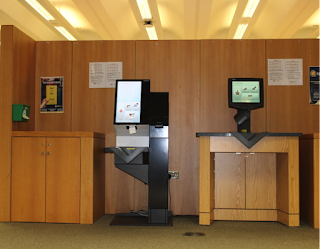
| Self-service borrowing machines (Pic by Kate Hawkins) |
Postgraduate
I began a master's degree in International Justice at MU in September 2020. It was a full-time course that linked to aspects of my undergraduate degree and allowed me to explore these topics in more detail. I completed my masters during the COVID-19 pandemic which was overwhelming at times, both with adjusting to studying remotely and online lectures. Thankfully the Library continued to offer a comprehensive service during this time. As all my lectures were online, most of my experience with the Library was as a remote user. When restrictions eased, I was able to book a study space in the Library for a three-hour period. That was an opportunity to read textbooks and consult British and Irish journals that were available in print only. The online service I used most frequently was the library search function on the MU Library homepage to find journal articles and eBooks. I used legal databases such as Westlaw and Lexis Library to read important case law for assignments, and for my dissertation. Some older textbooks were available online as eBooks. I used the digital on demand service for chapters of law textbooks when studying remotely. I did not use the click and collect service, however now as a staff member I notice the benefits of this service for MU students.
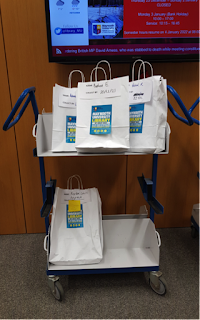
| Click and Collect Service (Pic by Kate Hawkins) |
Member of Facilities and Events (F&E) Team
When my postgraduate studies began, I started work as a member of the Facilities and Events (F&E) team. This post is restricted to MU postgraduates. Due to the pandemic, there were no in-person events at MU Library, and I was not involved in online events. We conducted daily fire safety checks and contact tracing and mask checks, when students were back on site. Occasionally we were given projects. Two of us were tasked with creating an Excel spreadsheet in a Microsoft Team folder, with information on the layout of university library websites in Ireland and abroad. We recorded features of their homepages that we didn’t have on our website and added links to their websites. Transitioning to accommodate the easing of restrictions was a major project that the whole team was involved in. We placed QR codes on the appropriate desks and socially distanced the furniture. We made new signs to put around the library. It was great to be a part of the library orientation team week in 2021, especially meeting new students. When my time as a member of the F&E team was coming to an end, I trained new members of the team. It felt good to share my experiences and knowledge with them.
Maynooth University Library Homepage (Pic by: Maynooth University)
|
Engagement and Information Service (EIS)
I was delighted when my application for EIS Library assistant was successful. I was nervous starting this job; there was a lot to learn. I was also excited. Now I am learning more about how libraries operate, and about MU Library’s policies and procedures. Recently I learned that there are multiple ways for library users to communicate with library staff including via different e-mail addresses and the library chat service. I use Libapps for answering student queries and click and collect requests. We rotate roles during shifts. I’m learning about the importance of keeping statistics, to demonstrate how our services are being used. I enjoy interacting with students and assisting them. Each shift brings something different a new query, a new library database to explore or a new book to find!
EIS Desk (Pic by Kate Hawkins)
Where next?
I am enjoying my work as a Library assistant and am looking forward to learning more about the Library. I enjoy combining working as a Library Assistant with exploring my interest in human rights and immigration law. I attended the Library Outside In Lecture (this is part of a series of guest lectures) given by a Maynooth University graduate who spent six years living in Direct Provision while an MU student. We are a University of Sanctuary, and I hope to explore this more and write about it.
6 Oct 2021
Embrace the virtual library space
![]() |
| Graphic designed by Iain McCool |
Libfocus is very happy to post the winning entry in this
years CONUL Library Assistants Award. Congratulations Iain McCool, Queens University Belfast Library. Congratulation
Iain.
Introduction
The emergence of the COVID-19 pandemic and the subsequent lockdown restrictions have turbo-blasted libraries toward becoming fully integrated virtual service providers. Libraries have very much always been about the provision of frontline services, offering valuable and friendly support for library users.
The uncompromising situation witnessed throughout 2020, however, saw the nature of face-to-face interaction no longer being a viable option. As a consequence, library staff had to adapt to changes quickly and discover innovative new ways of communicating with their patrons.
The library profession continually tries to find novel new ways to engage and offer support. Long before COVID-19, libraries had considered how to maximise the potential of digital services. The sudden impact of lockdown brought about a circumstance of uncertainty for which libraries were already ably prepared to cope (Walsh & Harjinder, 2020).
Libraries have accordingly sought to develop the services they provide, in so far as, they now allow for patrons to gain access to resources remotely (Lindsay, 2021). The culmination of what has been experienced over the course of lockdown has presented libraries with an opportunity to become an effective virtual service provider that can make library resources more accessible.
![]() |
A large aspect of university life has always been about a student’s ability to learn for themselves and thereby develop the necessary skills required to progress onto postgraduate study.
Learning for oneself
In order to be successful at university, students need to attend lectures and seminars. Students have to know how and where they can access learning resources, they should allocate adequate time to study, and learn how to correctly cite references (Barnes, 1995).
The library seeks to improve the experiences of students with a supportive study environment by helping develop research skills and manage expectations, equipping students with the necessary reading material, as well as offering a spacious study location that is quiet and well-kept, and is simultaneously in close vicinity to alternative campus amenities.
The McClay Library, for example, also prepares students for university with the Transition Skills Online Training programme. Begun in 2019, this programme functions as an outreach project to improve school leavers information literacy.
![]() |
In many instances, patrons were no longer able to physically access the library during lockdown. This situation necessitated a rethink in terms of borrowing rights. Over the course of lockdown, library users had their standard loans extended.
We learn by doing
The renewal policy in the McClay Library had been under review prior to COVID-19. A new procedure has since been implemented whereby standard loans are renewed automatically unless the book is requested by someone else.
Complications regarding physical access to collections also initiated the deployment of a temporary Scan and Deliver service in the McClay library, whereby patrons could get a scan of print collections sent to them personally if the request was one chapter or 10% of a book, whichever being greater.
![]() |
A new feature to library services was rolled out at the beginning of lockdown which enabled library users to get in touch with library staff using an online chat service. The implementation of Library Chat proved to be an advantageous success for library services, as queries are answered in real-time.
Library Chat
Library Chat places new demands on frontline library staff who adapted their skillset from answering queries in-person to using an interactive online tool (Cohn & Hyams, 2021). Communication was key to share specialised knowledge amongst departments, so a new process had to be devised for query referral and new training guides were developed for staff.
The Library Chat Enhancement Group (LCEG), was comprised of library assistants who had first-hand experience of using Library Chat and was formed for the benefit of staff development in order to enhance the library user experience. The strategy employed encouraged a hands-on learning model based on experiential learning techniques (Kolb, 2014), complimented by group training sessions to obtain feedback.
LCEG began by publishing a QuickStart guide which gave basic guidance on how to use the platform, a Latest Announcements page was designed to keep staff UpToDate with library developments, and an Information for LibChatters guide was produced to detail library policy.
Conclusion
Higher education was identified as an essential service which could operate in some shape or form during lockdown. The nature of the restrictions imposed have had such a debilitating effect on the provision of in-person library services that much of what was practiced before the pandemic may no longer be applicable in the future (Ma, 2020).
In embracing the virtual space, some of the new changes mentioned in this piece may still have a relevant part to play going forward, and ultimately enhance the provision of library services.
* all images and graphics by Iain McCool
References
Barnes, R. (1995) Reading academic texts, in Barnes, R. (ed.) Successful Study for Degrees. London: Routledge, pp. 51-63.
Cohn, S., Hyams, R. (2021) Making Room for TBD: Adapting Library Websites during a Pandemic, Computers in Libraries, 41(2), pp. 18-21 [Online]. Available at: http://search.ebscohost.com.queens.ezp1.qub.ac.uk/login.aspx?direct=true&db=edsbig&AN=edsbig.A654780607&site=eds-live&scope=site (Accessed: 5th July 2021).
Kolb, D.A. (2014) The Process of Experiential Learning, in Kolb, D.A. (ed.) Experiential learning: experience as the source of learning and development. New Jersey: Pearson Education Inc., pp. 68-108. [Online]. Available at: https://r3.vlereader.com/Reader?ean=9780133892505 [Accessed: 5th July 2021).
Lindsay, M.J., et al. (2021) Mind like Water: Flexibly Adapting to Serve Patrons in the Era of COVID-19, Medical Reference Services Quarterly, 40(1), pp. 56-66 [Online]. Available at: https://doi.org/10.1080/02763869.2021.1873622 (Accessed: 5th July 2021).
Ma, L.F.H. (2020) Academic Library Services during COVID-19: The Experience of CUHK Library, International Information and Library Review, 52(4), pp. 321-324 [Online]. Available at: https://doi.org/10.1080/10572317.2020.1834251 (Accessed: 5th July 2021).
Walsh, B., Harjinder, R. (2020) Continuity of Academic Library Services during the Pandemic: The University of Toronto Libraries Response, Journal of Scholarly Publishing, 51(4), pp. 237-245 [Online]. Available at: muse.jhu.edu/article/760728 (Accessed: 5th July 2021).
28 Sept 2021
Outreach Content Creation: How to Produce YouTube Videos and Podcasts
Libfocus is very happy to post the second of the joint second placed entries in this years CONUL Library Assistants Award. Congratulations David Rinehart, Maynooth University Library
Introduction
This blog post describes the processes and tools I have used to create YouTube video and podcast outreach content for Maynooth University’s Special Collections and Archives department. The central aim of the YouTube and podcast series was to expand our Library Treasures blog into the audio and visual platforms giving our collections greater visibility and discoverability, thus engaging a larger audience. I detail the tools used, collaboration, editing, and social media promotion. Further, I identify where improvements need to be made in addition to long-term goals.
![]() |
Screen shot from the second episode of Library Treasures video series |
Inspiration
The inspiration for this project was sparked by the pandemic. Being a service that handles unique and rare materials, we tend to cater to patrons with specific interests or visitors keen on historical tourism. We were, thus, faced with the challenge of how to connect our patrons to these rare materials in some way. We took many measures to provide the service as best we could. The positive spin, however, is that we had the space to focus more on our virtual presence. While videos do not replace the in-house experience, it is still a way for us to remain connected to our public while giving the Russell Library space some life during a lonely time.
![]() |
| Image of the Russell Library Reading Rooms taken by David Rinehart |
Getting Started:
YouTube series:
Equipment:
- Camera (Canon EOS 2000D)
- Tripod
- Microphone
- Computer
Software:
- Adobe Premiere Pro or Davinci Resolve (video editing)
- Canva (poster creation)
Hosting Service:
![]() |
| Image taken by David Rinehart of Hardware Used for Podcast and Video Series Podcast Series: |
Equipment:
- Microphone
- Computer
Software:
- Audacity (capturing audio)
- Adobe Premiere Pro (works well for audio editing too)
Hosting Service:
Collaboration
One of the greater challenges in creating this kind of content is, as a relatively new employee, identifying the collections and content to showcase. Collaboration has been key for a large project like this and a fantastic way to learn more about the work my colleagues are doing. I have collaborated with three colleagues – an archivist, a conservator, and a library assistant for the first three videos.
The work load has been divided up in the following way: I establish a timeline while my counterpart writes the script, records most of the video, and takes the necessary images. I then record the
introduction and outro for continuity. Lastly, I take all of the raw footage and material and edit it into the final product, post it to YouTube, and advertise on social media.
![]() |
| Image captured by David Rinehart from The Scenery and Antiquities of Ireland (1842) for Adam Staunton’s blog post and episode 3 of the Library Treasures video series |
The editing process has been a steep learning curve. I have watched many YouTube videos and read many forums to learn about the techniques and tools available to me. For ease of editing, I have asked my collaborators to share the folders of images and videos with me via OneDrive in the order that they should appear in video, this makes it far easier to place the videos and still images along the timeline to sync up with the content being described.
Social Media promotion is essential to get the content out to your target audience. It is important to think about which organization handles, individual handles, and hashtags would bring the content closest to your target audience.
![]() |
| Screenshot of twitter post for Library Treasures Episode 2 |
Results
The first video has received 127 views since it was released on March 8th, 2021; the second video has received 48 views since its release on June 14th, 2021 and the third video has received 36 views since its release on July 9, 2021. The first video was created around the theme of women in the collections, e.g. Teresa Deevy, and released on International Women’s Day, which could account for the greater traction it picked up on social media.
Reflection
We have had team conversations about how to best get these videos to their target audiences and beyond. We made the decision to change the name of the YouTube series from Collections Spotlight to Library Treasures. We have had a blog of the same name running for years with many hundred followers. The video series and podcast are an expansion of this project and are meant to complement each other. Having the same name makes them more discoverable, as someone who has been following the blog may more easily search for or stumble across our podcast and video series. The three mediums will also have links to each other.
Our long-term goal is to incorporate the blog posts, video and podcast episodes into LibGuides we are designing for our various collections showcased in Library Treasures posts. We are also developing a LibGuide exclusively for Library Treasures media, highlighting our more recent videos, podcasts, and blogs. This will greatly contribute to the lifespan and discoverability of the posts as they will have a permanent home instead of getting buried in a YouTube channel or deep down in a blog.
![]() |
| Image created using Canva for third Library Treasures episode |