25 Apr 2016

Practical Tips for Facilitating Research - Moira J. Bent (Review)

The title of this book emanates directly from Facet Publishing's new Practical Tips series, and in this case the content certainly backs up that claim. Throughout Practical Tips for Facilitating Research Moira J. Bent’s ‘wisdom of crowds’ approach offers insights and experiences that are very much based on real world examples and exemplars, both her own and those of colleagues working in other institutions. As a result, there is not only a real richness and breadth to the advice presented, but an underlying authenticity and credibility to it as well.

During the opening section on landscapes and models, Bent discusses how to understand who your researchers are, their needs, motivations, and workflows - an aspect that is fundamental to helping us facilitate research more effectively. Those who are relatively new to working in the academic environment may find this section particularly helpful to orient themselves in their new role and as a means of getting to grips with the perspective of a typical researcher. However, the recurring and useful “to think about” prompts also provide food for thought and reflection for even the most experienced readers. The references to theory are plentiful and well-researched, and give ‘just enough’ without dwelling on too much detail – it is, after all, a book very much focused on practice.

A similar pattern continues throughout the rest of the text, which covers a range of areas including collections and information literacy, as well as unpacking specific interventions where libraries can actively position themselves, such as RDM and systematic reviews. Suggestions are notably pragmatic, and very much cognisant of the practical realities of many resource-stretched libraries. For instance, in relation to the potential for libraries to become more involved in supplying data for research proposals, Bent suggests: "Before venturing down this route, consider whether you have sufficient resources to continue if the idea takes root. Treating the contribution as a pilot or experiment will ensure that you are able to draw back or even investigate if a percentage of the subsequent grant might devolve to the library in recognition of the work" (2016, p.131). Currency is crucial in a rapidly-changing area such as scholarly communications, and the text is very much up to date with reference to a number of recent developments such as the Leiden Manifesto.

Those who are exploring how to support research more strategically may find the chapter on organisational structures particularly useful. Again using examples from different institutions, Bent showcases some of the varied and different approaches that can all work well, depending on the specific context and objectives, for instance having a specialised research services function versus offering research support through subject or liaison librarians. I was particularly glad to see a section encouraging librarians to become researchers and writers themselves, as this is something that has personally given me a much greater understanding of the research process, and the needs and workflows of researchers.

What is very much apparent throughout the book is Bent’s awareness that a one size fits all approach does not typically work. Underpinned by a flexible rather than prescriptive format, the book prompts readers to consider the options that might work best for researchers in their own organisations, rather than suggesting that they try to transplant or replicate a successful service, model or programme verbatim from another institution. Unlike many books, the structure is deliberately designed to allow readers to dip into specific sections as needed, rather than necessarily having to read it from cover to cover – a real advantage for those time-poor librarians looking for a quick burst of inspiration or advice. Above all however, it’s a book that offers a variety of approaches, insight, and real-world examples that work – exactly what you need whether you are searching for a simple solution to quickly improve services, or ideas to help inform and shape a more fundamental or strategic change.

Practical Tips for Facilitating Research is published by Facet Publishing, March 2016, 299pp, £49.95.
21 Apr 2016

Western Regional Section of the LAI -- 'Literacy for Life' Seminar

Guest post by the WRSLAI committee

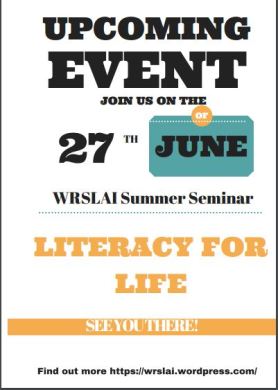
The Western Regional Section of the LAI is holding its annual seminar on Monday, 27th June 2016, 9.30am-4.30pm. Venue in Galway TBC. The seminar theme is ‘Literacy for Life’. This seminar is an annual training day, attended by library professionals from all disciplines. Details of previous seminars can be found on our blog wrslai.wordpress.com/2015/11/05/wrslai-seminar-2015-slides-and-presentations/

Proposals should keep the theme of literacy for life in mind and we are also interested in any connections to 1916, given the Centenary celebrations.
Possible areas of interest are:
*Literacy- children’s books, adult education, literacy innovations & associations
*Online literacy and the library
*1916- Easter widows, library involvement, local memories, what was happening in the west? Examples of 1916 library exhibitions are encouraged.
*Library environment and its impact
*Library services

We are open to varied proposals, but those with a strong link to the theme will be given first choice.

Seminar Ad 2016
Presentations can be between 10-25 minutes. We welcome presenters from all library sectors. WRSLAI each year manage to successfully merge public and academic presentations, making it an unmissable event for all to attend.

Please email a short proposal of no more than 300 words to westernlibraries[at]gmail.com. All proposals must be submitted by 30th April 2016. Successful candidates will be notified by 16th May 2016.

20 Apr 2016

Different types of doctoral theses - an analysis from DiVA data 2000-2015

For a while now I have been thinking about the different forms of publishing a doctoral thesis. Just from my own experiences I had a feeling that today there is a greater share of doctoral theses published as comprehensive summary (content of published articles) than ordinary monographs. Can I confirm that and if so why?


I started with asking my colleague, Ulf-Göran Nilsson - library strategist at Jönköping University, for data from DiVA. DiVA is the digital repository used by Jönköping University. DiVA is also a cooperation among 40 different universities mainly from Sweden, but also from Denmark and Norway. I wanted the data to be as aggregated as possible so I choosed all member universities and all different subject and only used the total number of doctoral theses registrated in the archive. After that I separated the data between the two different formats, comprehensive summary or monograph, to be able to see the trend over the years from year 2000 - 2015. I selected a five year interval between the selected data to be able to see changes over time. This is what I found.


As you all can see there is a remarkable trend towards publishing the doctoral thesis as a comprehensive summary instead of a monograph. What can be the causes for this? Can new demands for academic publishing within peer reviewed scholarly journals be a reason? Or, has the new process of evaluating a researchers success and career to be more focused on your appearance is scholarly journals influenced the choice of format? I have no answer but I think it is interesting to evaluate and discuss.


Another thought running through my brain is how this impact the research. Can the move from working with a complete monograph towards publishing a comprehensive summary make the research more fragmanted and gouged? Is that beneficial or can it be a threat? Again I have no answers but I still think it is a very interesting and important question to discuss.


What is your experiences on this matter...

19 Apr 2016

Peerwise: a social platform for information literacy assessment?


I use multiple choice quizzes a lot in assessing my information literacy classes with DCU Business School (an example described here). The downside of MCQ quizzes is that they’re a bit boring, they can be easy to bluff your way through and they arguably encourage (or can only assess) surface  learning (Nicol 2007 p.54). 

An interesting twist on MCQ quizzes is to instead get the students to write the questions, share them among a class and ask them to answer, rate and comment on the questions. Assessments like this have been tried for a while without tech. (Denny 2008) and for a few years there has been a free social platform, PeerWise which does all this online. 

In a recent webinar, DCU’s Eamonn Costello spoke of his own success using PeerWise:
  • Students enjoy it - it can get very high participation rates. Many students surpass requirements - creating and answering extra questions because they enjoy it and find it slightly addictive. 
  • It encourages a higher level of learning. Designing a question demands a clearer, deeper understanding of the topic, forcing students to “made explicit their understanding of the complexities of the subject matter” (Fellenz 2004)
Eamonn’s experiences have been shared by others: research shows strong correlations between PeerWise use and improved exam performance (Sykes 2011, Denny 2008). 

Here’s an example or how PeerWise might be used in an assessment. A lecturer might ask students to use it to:
1. answer 10 MCQs written by other students
2. write 3 MCQs of their own

Not all the questions created by students will be great - some will be poorly phrased, be unclear, or a student who wrote it might accidentally set a wrong answer as the correct one. Peerwise addresses this by also allowing  students to rate and comment on each other’s questions, so in this example the class could also be asked to:
3. rate all the questions they answer (good to bad, easy to difficult)
4. comment on 5 of them (“I think this Q might have been better if you had instead written....”, “good question - I had been unclear on that idea but answering the Q forced me to understand this. I found a good explanation from this web page...”)

Participation is anonymous among the class, but the instructor can export the data with each profile linked to an identifier (say, their student numbers) for marking. 

I'm considering using this tool for assessing library orientation for a large cohort of first year undergrad students later this year.  As far as I'm aware, Peerwise has never been used in an info. lit. library context before. 

With this in mind, I’d like to invite any subject librarians / liaison librarians / IL practitioners interested in it  (or anyone else for any reason) to play around with a test Peerwise class I’ve set up. This may inspire your to try Peerwise in your own work. If enough librarians try it out, it could become a useful shared resource - a pool of test-driven MCQs to be reused elsewhere. It’ll just take you a few seconds to register. Once you’re in you can take a look around, answer a few questions and add some yourself - I have already added a few questions to get things started. Here’s a guide to registering and getting started with it. 

Let me know what you think, either with comments below or on Twitter. Do you think it can work for an info. lit. assessment?

References
  • Denny, P. et al., 2008. PeerWise. Proceeding of the fourth international workshop on Computing education research - ICER ’08, pp.51–58. Available at: http://portal.acm.org/citation.cfm?doid=1404520.1404526.
  • Fellenz, M.R., 2004. Using assessment to support higher level learning: the multiple choice item development assignment. Assessment & Evaluation in Higher Education, 29(6), pp.703–719.
  • Nicol, D., 2007. E‐assessment by design: using multiple‐choice tests to good effect. Journal of Further and higher Education, 31(1), pp.53-64.
  • Sykes, A., Denny, P. & Nicolson, L., 2011. PeerWise-The Marmite of Veterinary Student Learning. Proceedings of the 10th European Conference on e-Learning Brighton Business School, University of Brighton, UK. 10-11 November, 2011, Vols 1 and 2 (S Greener, A Rospigliosi, eds.), pp.820–830. Available at: http://eprints.gla.ac.uk/90693/1/90693.pdf.

18 Apr 2016

LILAC 2016

Guest post by Colin O'Keeffe

Ireland hosts the annual LILAC Conference every few years, 2016 is one of those years, and this year’s conference was held from 21st-23rd March at UCD’s O’Brien Centre for Science. Although hosting the conference in Ireland increases accessibility for Irish librarians it also diminishes the chance to secure funding to attend the full three days of events, a more likely scenario when travel to the UK is involved. That situation applied to me, I secured (a not unsubstantial) amount of funding to attend as a day delegate on Tuesday, 22nd March. This was to be my first LILAC, and as an Information Literacy Librarian, this conference was of particular interest to me. I booked in advance in order to avail of the marginally discounted early-bird rate but more importantly to secure a place in the parallel sessions that I wanted to attend. These sessions constitute the majority of LILAC’s programme of events and certain sessions are very popular, therefore it pays to study the full programme before booking to ensure a place.

From others’ descriptions I knew that the primary distinction between LILAC and the numerous other conferences that I have attended over the years would be the scale of the former. This year’s LILAC remained true to form, consisting of 93 separate events including three keynote addresses. Here are the sessions that I attended and my impression of them.

Keynote Address: Char Booth
The keynote address for day two was delivered by the current Library Associate Dean at California State University San Marcos, Char Booth. She has, to date written several books relating to library accessibility and reflective teaching, with the latter topic being the primary subject of her keynote, titled ‘Why Reflect? The Holistic Process of Stepping Back’. Char’s talk was engaging and well delivered, initially exploring the theory behind self-reflection, before describing initiatives that she has undertaken in order to assess and challenge both her own and subsequently her team’s teaching practices. The presentation then changed focus to examine the concept of ‘information privilege’, apparently many students are unaware that the access to information that they take for granted at university will cease on graduation. Additionally, students are unaware of the monetary cost of information. Char lauded the ever expanding open web and outlined how a group of her students edited a Wikipedia page for assessment purposes. Overall, Char’s enthusiasm, delivery, content and very polished slides made this particular keynote a very enjoyable experience. Slide are available here.

Parallel Session 1: Antony Groves
The first parallel session that I attended took the form of a workshop. It introduced and demonstrated Vine, a video sharing service that allows users record and share six second looped videos, created via a smartphone app. At the University of Sussex Library this has been utilised to show the physical location of the library, promote library training sessions and demonstrating of database filtering. Though easy to use, six seconds is a very limited amount of time to teach anything, though adequate time to advertise or highlight something to viewers. My group easily created and uploaded a Vine via smartphone; this service could easily be deployed on a library website, e-learning platform or display screen, though the looped nature of the video would require a full suite of Vines to ensure that content remains fresh to viewers. See Antony's vines here.

Parallel Session 2: Kimberly Mullins
The next session was a presentation on a new librarian/faculty partnership approach to integrate IL into academic courses; this is viewed as the most effective way to make IL relevant to students, which can sometimes prove challenging. Kimberly introduced IDEA (Interview, design, embed and assess) as a framework to integrate IL into academic courses. Librarian/faculty collaboration is considered the ‘Holy Grail’ in relation to IL delivery and IDEA ensures that IL outcomes and course outcomes are one in the same. IDEA is something I would definitely consider if I had faculty buy in. See Kimberly's presentation here.

Parallel Session 3: Fiona Mogg
I then attended a talk that outlined a project that saw Cardiff University Library, via school partnerships, provide critical thinking and digital literacy support to Welsh school students. The talk covered two initiatives undertaken by the library. The first was a MOOC, this was offered to level 3 students preparing for university in Wales, with the library providing a supporting role. The second initiative was a library/school partnership with a group of schools who are preparing students for the Welsh Baccalaureate. The library was tasked with providing support for both digital literacy and critical thinking. The projects seemed like very worthwhile initiatives that could be replicated in Ireland. Full presentation here.

Parallel Session 4: Philip Russell, Claire McGuinness, Jane Burns and Emer O'Brien
Next was a progress report on what librarians are doing, via the Task Force on Information Literacy (TFIL) to advance information and digital literacy in Ireland, especially in relation to lobbying government. The challenges that we face in Ireland in relation to promoting IL to government were outlined. The fact that references to libraries and information services were omitted from several recently released government digital literacy and ICT reports raised eyebrows. TIFL’s response and future plans were outlined. It seems that IL is still not on the radar of Irish government and will continue to play ‘poor cousin’ when compared to ICT and digital literacy/skills. The challenge continues. Access the full presentation via slidehare.

Parallel Session 5: Rachel Posaner and Emma Green
The final session described a distance learning project, undertaken via Moodle, to provide IL support to a large group of NHS students. In this initiative, four librarians utilised lots of tools to provide support to 1,500 students including online reading lists online forums for discussions and screen sharing technology. This one I felt was useful as the college where I work provides a library service to a group of Malaysian students, so online and distance support is the only feasible option for this cohort. We are about to re-launch our website using Libguides over the summer and already have online reading lists, so what the four librarians have been able to achieve in relation to IL support is feasible for this solo IL librarian. Full presentation available here.

Though I’ve attended many library conferences over the years, I’ve never been to one with the scale of LILAC. The amount of session choices, though fantastic, is somewhat of a double edged sword, you get to choose what you know you’ll enjoy, but you know you’ll miss out on a lot of good sessions. I attended 5 sessions, the maximum amount, out of 31 run on that day, but there were others that I would have really enjoyed also. Overall, I thoroughly enjoyed my day at the conference; to get others’ musings on the full three days I consulted Twitter, and there, via conference storyboards the consensus seems to be overwhelmingly positive for LILAC 2016.

11 Apr 2016

Brunel Bands…

Guest post by John West . John is a Customer Services Champion at Brunel University and has worked in Libraries of one sort or another since 1986. His interests include listening to long playing gramophone records and doing weird stuff in libraries.


It’s a cold, dark November night in 1978. Four unpretentiously dressed young men take to the stage in the Kingdom Room at Brunel University and start up a gloomy, industrial motoric as morose and unwelcoming as the winter weather outside. The audience bristles with discomfort at this strange new post-punk noise. There’s a bit of truculent booing. A few people even start, as was the custom of the day, to spit at the musicians on stage. The band and the audience endure this charade for about five songs and then all seem to arrive at the same conclusion simultaneously, and the boys grudgingly call it a day.

To add insult to injury, as the musicians are making their ignominious way from the stage, the drummer trips over a cable and falls flat on his face to yet more derisive laughter and abuse. "I see you are not educated down south..." comes the defiant Mancunian farewell from the slightly crazed looking, hollow-eyed skeleton of a figure who’s been trying to sound like David Bowie impersonating the singer from The Doors all evening whilst dancing around like an epileptic. His name is Ian Curtis and his band is called Joy Division.

That same night, if you’d stuck around, you could also have seen two other bands; Derry’s The Undertones, and Glaswegian new wavers The Rezillos who had recently stormed the charts with an insanely catchy song called ‘Top of the Pops’. The passage of time has probably turned that bill upside down: headliners The Rezillos were ultimately little more than one hit wonders whereas the poorly received opening act have achieved near legendary status down the years. All in all, not a bad night out for £1.20.

This is just one example among many fabulous music nights that have taken place here at Brunel over the last 50 years. From the epic late sixties all-nighters booked by our students union at such prestigious London venues as the Roundhouse and the Royal Albert Hall, through the anarchy of punk and the heyday of the ‘do-it-yourself’ pub rock ethos, all the way down to the likes of the Stone Roses, the University has been a magnet to some of the biggest names in rock and pop history. Fleetwood Mac, Deep Purple, Elton John, The Kinks, The Stranglers, The Sex Pistols, The Specials, UB40, The Pretenders…that’s just a short list from the top of my head of the kind of bands who were part of the student experience way back when. And many of them *didn’t* get booed off!

As part of the University’s 50th birthday celebrations, Brunel Library and Media Services staff have been working with the current students union and a handful of former students to compile as complete a history of Brunel’s unique musical heritage as we can. We’ve set up a blog and a Facebook page to document the work we’ve done so far. The Facebook page in particular has provided a fabulous outreach opportunity and through it we’ve been able to incorporate a lot of eyewitness accounts into our history which will hopefully make for a really unique social document.

Our aim is to have a fairly complete timeline of who performed where and when ready for the summer. Then, in early July, the University will be playing host to a large gathering of alumni during the main anniversary celebrations and we’ll be helping to stage an event called ‘Brunel Rocks’. There we’ll be presenting the research we’ve done and hosting a discussion about Brunel’s live music scene with those who made it happen – we’re hoping there might even be one or two well-known names there to join the reminiscences and maybe even perform a couple of numbers too. We’re ultimately hoping that over time we can make the blog a resource that’s searchable by date and artist and one that can become a lasting record of our University’s rich musical legacy.

If you’re interested in finding out a bit more about Brunel’s fabulous live music pedigree then visit our Brunel Bands blog - https://brunelbands.wordpress.com/ - or the Facebook page -

 
all photos courtesy of John West