19 Dec 2012

Recent Research from Irish Libraries

There has been some interesting research published from an Irish LIS perspective of late. Below are a few of the articles I have come across recently. Apologies, if I have left anyone out; it is completely inadvertent! Send me a tweet @libfocus and I will add the reference to the list below. Please forgive the self-promotion by including my own also :). If anyone would like to contribute a guest blog post about recent, ongoing or future research, just get in touch with us at libfocusguestpost at gmail.com or through twitter.

Hegarty, N. (2012) Breaking new ground: introducing special needs students to Waterford Institute of Technology (WIT) libraries. SCONUL Focus, 55(9).

Lalor JG, Clarke M, Sheaf G. (2012) An evaluation of the effectiveness of information literacy training for undergraduate midwives to improve their ability to access evidence for practice. Nurse Educ Pract. 2012 Sep;12(5):269-72. doi: 10.1016/j.nepr.2012.06.005. Epub 2012 Jul 7.

Regan J, Walshe M, Murphy A, McMahon BP, Coughlan T. Botulinum toxin for upper oesophageal sphincter dysfunction in neurological swallowing disorders (Protocol). Cochrane Database of Systematic Reviews 2012, Issue 7. Art. No.: CD009968. DOI: 10.1002/14651858.CD009968.

Dalton, M. (2012) Key Performance Indicators in Irish Hospital Libraries: Developing Outcome-Based Metrics to Support Advocacy and Service Delivery. Evidence Based Library and Information Practice, 7(4).

Posted on Wednesday, December 19, 2012 | Categories: ,

13 Dec 2012

LIR/AGI Mobile Technologies Symposium, Dublin, Nov. 22nd 2012

Guest post by Amye Quigley

On Thursday, November 22nd I attended the Mobile Technologies Symposium held jointly by LIR and AGI in the Davenport Hotel, Dublin. There were some really interesting talks on projects that have been implemented in a few universities as well as a few on making library content available in a mobile way. A couple of the presentations I didn’t find particularly relevant or interesting to be honest and one or two people could do with taking a cue from Louise Saults’ Prezi presentation which was by far the most appealing to look at presentation of the day. But rather than focusing on the negative I’d like to highlight a few of the talks which I found the most interesting and motivating. The videos of these talks are available to view here.

Kindles in the Library: NUIM Library Kindle Pilot 2011; Louise Saults, NUI Maynooth
Last year Maynooth introduced Kindle lending in the library. Louise Saults talked about the reasons behind their choice of using Kindles, how they set up the project and what kind of percentage borrowing they’ve had so far.

The library decided on Kindles due to their size, ease of use and overall cost manageability. NUIM library initially purchased five but quickly increased this to ten altogether. Library staff were given the option of borrowing the Kindles in advance so that they would be familiar with the devices should students have any difficulties. The Kindles were uploaded with 22 free e-books at first, but this has now increased to 150 titles altogether. The Business and History departments in Maynooth took part in this pilot project and the books uploaded were relevant to those departments.

The downsides to the project included the uploading process, which was time consuming as it had to be done wirelessly or by USB cable on each Kindle for each of the 150 titles. Also, as book publishers tend to restrict sharing of publications to between four and six Kindles in some cases it was necessary to purchase more than one copy of the title. It was of course necessary to de-register the Kindles once they were set up so that students could not buy books on the library account! Catalogue records had to be created for each Kindle and for each title on the Kindle, a 500 note was created to inform borrowers that the book was available on Kindle at the Information Desk. Louise then went into some practicalities of deciding on borrowing period (one week), fine for damage or loss (€100), and how they marketed the Kindles to library users (Facebook, Twitter, library website, in the relevant departments).

In order to get feedback the borrowers were asked to fill in a survey when they returned the Kindle with a prize of a Kindle as incentive to complete it. Borrowers found them easy to use, to carry and were happy with the borrowing period. Overall the pilot was successful and has now been rolled out to include more departments for the current academic year.

We’re going to run a feasibility study on whether our library could do something similar, possibly next year.

The Mobile Library at UCD – Achievements and Plans; Samantha Drennan, Joshua Clark, University College Dublin
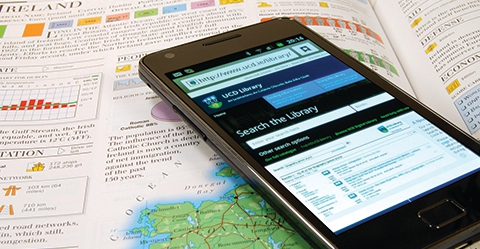
Samantha Drennan and Joshua Clark talked about creating a mobile version of the library website and what they decided to include and exclude from this version. They decided to have “need to know information” on the mobile website. This allows students to browse the library catalogue, lets them log in to their account, get branch information and opening hours, etc. It’s simple to use and loads quickly on a mobile browser even when limited to 3G. In the academic year 2011 to 2012 only 1.8% of page views to the UCD library website were by mobile devices. In October 2012 this had risen to 3.7%. The information students tend to be viewing on their mobiles is essential library information rather than looking to search databases. But there is still a question over how necessary a mobile website is and how much of an impact mobile users are making on library website usage.

Lemons, badges, fun and games: Gamification and Libraries; Andrew Walsh, University of Huddersfield
I really enjoyed this talk as I think it was an interesting idea to try and encourage getting people into the library more.

Andrew Walsh spoke about a study they did in Huddersfield to see if library usage by students had an impact on their final grade. They found that there was a correlation between use of e-resources, book borrowing and student attainment. But there was no correlation between visiting the library and student attainment and the librarians at the University of Huddersfield wanted to try and change that, and so began the Lemontree project.

Lemontree is quite like those games on Facebook where you carry out tasks and gain trophies or as is the case with Lemontree, badges. Students register once and it links to their library card. They don’t need to sign in again after this. They can also link to their Twitter or Facebook accounts and it will post their achievements to these. The game automatically gathers information about the students’ library activities. So when they borrow or return books, write reviews, log in to use e-resources, visit the library, etc. they will receive points. There are different badges and levels and the more points accrued the higher the level and the more your lemon tree grows. The game is proving quite popular so far. Students have been talking about it on Facebook and Twitter and seem to be using it. It’s still too early to find out if this will, in the long run, affect student attainment, but this will be the next part of the project to study.
Posted on Thursday, December 13, 2012 | Categories: ,

Information Literacy Journal Club

Niamh Tumelty has recently started a new Information Literacy Journal Club. Sheila Webber has set up a blog for the project, and the first article will be selected shortly.

In the meantime you can join in with the #ILread hashtag on Twitter or join the Zotero group (see the blog for further details). I'm looking forward to posting my thoughts on the articles on libfocus. Many thanks to Niamh & Sheila for setting this up!

Posted on Thursday, December 13, 2012 | Categories: ,

12 Dec 2012

Discovery Platforms in Special Libraries - Do We Need Them?

In recent years, libraries have been actively pursuing the 'single search box' philosophy to attract patrons used to the minimalism of Google's interface and to simplify the process of searching for scholarly content and resources. Publishing and database companies have happily obliged by providing a range of different products and technologies including Ebsco's Discovery Service, Primo and Summon from Serials Solutions. However, if users are already comfortable using Google's interface as an access point, do we really need to devote time and money to institution-specific consolidated indexes and discovery layers?

Aaron Tay discusses the key arguments in the discovery debate. In the academic setting, I think there are certainly some arguments for discovery layers and interfaces to help undergraduates get to grips with searching for scholarly content. However, even this is not clearcut. Tay quotes evidence from the University of Illinois who found that "users of their Ezsearch (a very impressive advanced federated search system that is for all intents and purposes on par with Summon and services in its class), did known item searches for almost half of all searches (49.4%)". Whilst searching for a known article will 'generally' work well using such interfaces, this is obviously not what these services are primarily designed for. Indeed, this same trend prompted Utrecht University Library to shift their focus to delivering content rather than discovery (Thinking the Unthinkable, a Library without a Catalogue; see also the video), and not because they do not not have the capability (they built their own in-house platform over ten years ago).

Moreover, without filtering or narrowing the sources appropriately (arguably defeating part of the one click advantage of these platforms), users may be overwhelmed and frustrated by a large volume of news articles and other content which may be useful to a journalism student for example, but not so helpful for a medical student.

Notwithstanding these issues, discovery services are now commonplace in the academic library setting. However, more recently I have also seen these platforms being implemented in special libraries, and I am not so sure about their real value in this context. From my own experiences as a medical librarian, the majority of searches undertaken by users require relatively complex search strategies rather than simply basic keyword searching; the use of MeSH and EMTREE terms are pretty much essential because of the need for searches to be systematic and comprehensive. No doubt a similar level of detail is required in other special library contexts, such as law libraries. However, discovery platforms often don't include all of the rich metadata from the original source in the central index that underlies the discovery layer. Furthermore, some databases and resources are not yet included in any of the commercial products currently available. This in itself causes confusion for users - which databases are included in the index and which resources are not? They may think using the discovery interface searches everything (like Google apparently does!), thereby omitting useful additional sources.

Many clinical staff and health-care workers still use PubMed as their default access point for the majority of primary research, and introducing a discovery platform would probably not change this. But do we even want it to? Replacing a freely available source with a subscription one is questionable. When staff move to another hospital (or indeed when most students leave University) they may have to switch back to sources such as PubMed and Google Scholar anyway. Right now, I don't see any great value in implementing discovery services within a health sciences library, in fact they may even do more harm than good in the long run. After all, are we just trying to help our users find information during a four-year degree or an employment contract, or for the rest of their lives?

6 Dec 2012

German Digital Library launched

The Deutsche Digitale Bibliothek (beta) launched last week as the central, digital open access point to Germany’s cultural and scientific heritage. Despite the fact that over 80% of traffic originates from German users and a lot (most) of the content is in German, it is well worth your while to check out this fast-growing aggregator of currently 5,6 million digital objects including digitised monographs, images, musical scores etc.
 
The search interface offers an English language option and search results will lead you straight back to the data provider’s digital object view.

The refreshing news about DDB is that it stands in vocal opposition to Google's scan project, Google Books: DDB is a public service that also feeds into Europeana.

DDB is a long-term project and exclusively funded by the taxpayer. Content is drawn from presently over 90 German cultural and scientific institutions (museums, archives and libraries). The idea is to create a network of over 30,000 institutional contributors over time.

2 Dec 2012

Is RFID the saviour of the small library?

I've been doing some research into Radio Frequency Identification (RFID) and whether it can assist the small library in meeting the challenges of everyday operation. Investigating whether self-service machines with RFID can assist small teams - and does it increase security? We are in a period of increasingly tight or non-existent budgets, and decreasing staff numbers, but we also face increased patron demands coupled with requests for extended opening hours. So in order to ensure an effective service delivery, do we seek a technical solution? 

CILIP recently ran another one day conference on the use of RFID within libraries, (the eighth that it has held). I've found the available presentations and the subsequent blogs and tweets from the conference helpful in working through the issues around RFID. Reading through the relevant literature is one thing, but the 'real world' feedback from the information professionals and librarians who are already working with and utilising RFID, is a little bit more enlightening.

As a new member of a small library team, I'm focused on what aspects RFID or other technologies can assist us in delivering a better overall service to our patrons. From testimonials on some vendor websites, it does appear that RFID provides the required self-service delivery. As a student, I personally preferred using the self-service kiosks and if I had been able to pay fines at the same time as check in/out books, it would have been a huge bonus. (Mea maxima culpa - I admit it, I did accrue fines!)

So where does all this pondering leave me? I welcome technology that assists our role and provides added value, whilst enhancing patron experience. I've been seeking a solution that incorporates RFID within a self-service kiosk that includes payment of fines, a one-stop-library-shop so to speak. Thankfully, our profession is one that encourages the use and implementation of technology to augment our service delivery. If only we had limitless budgets to fund all our ideas to enhance our patrons experience.


Posted on Sunday, December 02, 2012 | Categories: